
Many people begin the Canada immigration process confident they qualify for permanent residence.
But every year thousands of applicants receive the same devastating message from Immigration, Refugees and Citizenship Canada:
“Your application has been refused.”
In many cases, the Canada PR Rejection is not caused by ineligibility.
It happens because of preventable mistakes such as:
• choosing the wrong NOC code
• submitting incomplete employment documentation
• misunderstanding IRCC requirements
• inconsistencies between the Express Entry profile and supporting documents
Even small documentation errors can raise concerns during application review.
Understanding these risks before submitting your application can dramatically reduce the chance of refusal.

What Happens If Your Canada PR Application Is Refused?
A refusal can create serious complications for future immigration attempts.
Depending on the reason for refusal, applicants may face:
• loss of application fees
• delays of several months or years
• difficulty re-entering the Express Entry pool
• additional scrutiny from immigration officers on future applications
In cases involving misrepresentation, applicants may even face a five-year ban from applying for Canadian immigration programs.
Because immigration officers must carefully verify every document submitted, avoiding mistakes is essential before submitting your Canada PR application.
Why Canada PR Applications Get Rejected
Immigration officers reviewing permanent residence applications must verify that every applicant meets the exact eligibility criteria of the immigration program they applied under.
Applications are often refused when the supporting documentation does not clearly demonstrate the claims made in the application.

Some of the most common reasons for Canada PR rejection include:
- employment reference letters that do not match the selected NOC code
- incomplete or inconsistent documentation
- incorrect proof of funds documentation
- misunderstanding Express Entry eligibility requirements
- discrepancies between an Express Entry profile and uploaded documents
Many applicants believe they qualify for immigration but later discover that their documentation does not adequately support their claims.
Because immigration officers evaluate applications carefully, accuracy and consistency are essential throughout the entire immigration process.
Immigration refusal rates vary by program and applicant profile.
However, immigration professionals frequently see applications refused due to documentation errors or inconsistencies.
Many of these problems occur because applicants misunderstand:
- documentation standards
- NOC classification requirements
- employment verification expectations
- financial documentation requirements
In many cases, these issues could have been avoided with proper preparation before submitting the application.
Avoiding immigration mistakes requires careful preparation and documentation review.
Before submitting your application, make sure your documents are accurate and consistent.

The Most Common Express Entry Mistakes
Many applicants believe that Express Entry Canada is simply a matter of creating a profile and waiting for an invitation to apply.
In reality, preparing a successful Express Entry application requires careful preparation and accurate documentation.
Below are some of the most common Express Entry mistakes that may lead to delays or refusal.
Choosing the Wrong NOC Code
Canada uses the National Occupational Classification (NOC) system to categorize occupations.
Your selected NOC code Canada must accurately match the duties performed in your job.
If the job duties described in your employment reference letter do not align with the official NOC description, immigration officers may determine that your work experience does not qualify.
Selecting the correct NOC code is one of the most important parts of preparing a Canada PR application.
Submitting Incomplete Employment Records
Employment verification is one of the most closely examined parts of immigration applications.
IRCC typically expects employment letters to include:
• job title
• employment dates
• salary information
• working hours
• detailed job duties
If employment documentation is incomplete or missing required information, the application may be delayed or refused.
Incorrect CRS Score Calculations
The Comprehensive Ranking System (CRS) is used to rank candidates in the Express Entry pool.
Applicants sometimes calculate their CRS score incorrectly by entering inaccurate information about:
• work experience
• education credentials
• language test results
Incorrect CRS calculations can affect whether an applicant receives an invitation to apply.
Inconsistent Information Between Documents
Immigration officers review applications for consistency across all forms and documents.
Examples of inconsistencies that may create issues include:
• employment dates that do not match between documents
• differences between Express Entry profile information and uploaded documents
• incorrect personal history timelines
Consistency across your entire Canada immigration application is critical.
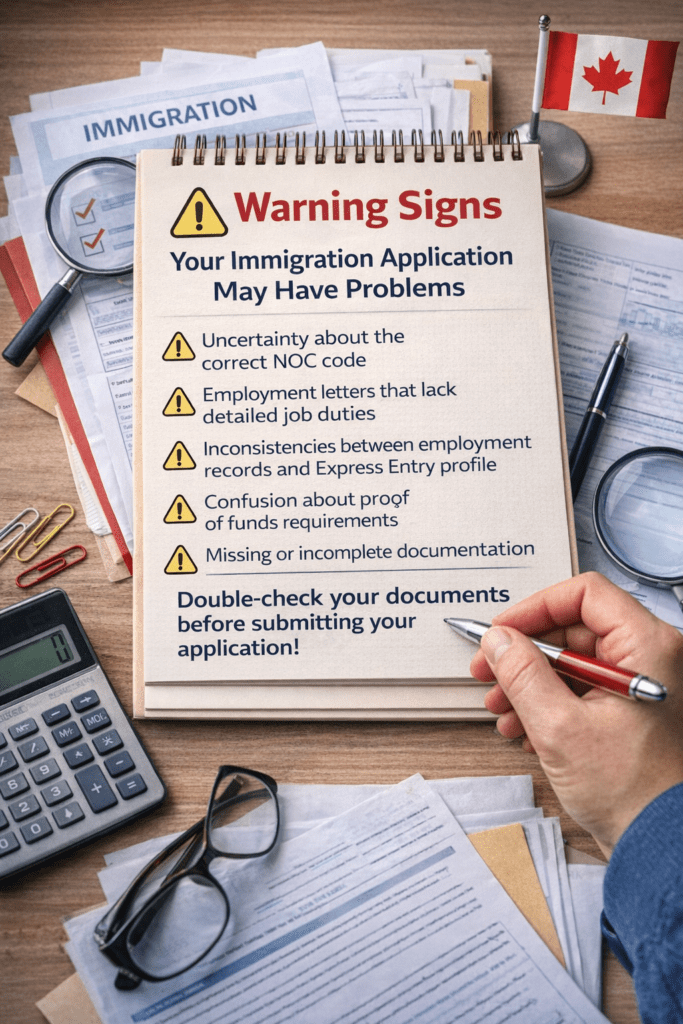
Warning Signs Your Canada PR Application May Get Rejection
Many applicants only realize there are problems with their application after receiving a refusal.
Some common warning signs include:
• uncertainty about the correct NOC code
• employment letters that lack detailed job duties
• inconsistencies between employment records and the Express Entry profile
• confusion about proof of funds requirements
• missing or incomplete documentation
If any of these issues apply to your application, reviewing your documentation before submission may help prevent avoidable problems.
Avoid submitting your Canada PR application with preventable mistakes.
Before uploading your documents to the IRCC portal, make sure your application file is complete and consistent.
Understanding IRCC Documentation Requirements
A complete Canada immigration application requires several supporting documents.
Common required documentation includes:
• educational credential assessments (ECA)
• language test results (IELTS, CELPIP, or TEF)
• employment verification letters
• proof of funds Canada documentation
• police clearance certificates
• medical examination results
Each document must meet IRCC formatting and verification standards.
For example:
• employment letters must include detailed job duties
• proof of funds must demonstrate available settlement funds
• police certificates must be issued within specific timeframes
Applicants who misunderstand IRCC documentation requirements often receive requests for additional documents or experience delays in processing.
Preparing documentation carefully before submission can significantly reduce the risk of complications.
How to Prevent Canada PR Rejection
Many application problems can be avoided through careful preparation and thorough review.
Before submitting an immigration application, experienced reviewers typically check:
- employment documentation accuracy
- NOC code alignment with job duties
- completeness of required forms
- proof of funds Canada documentation
- consistency across all submitted documents
Conducting a careful review before submission helps identify issues early.
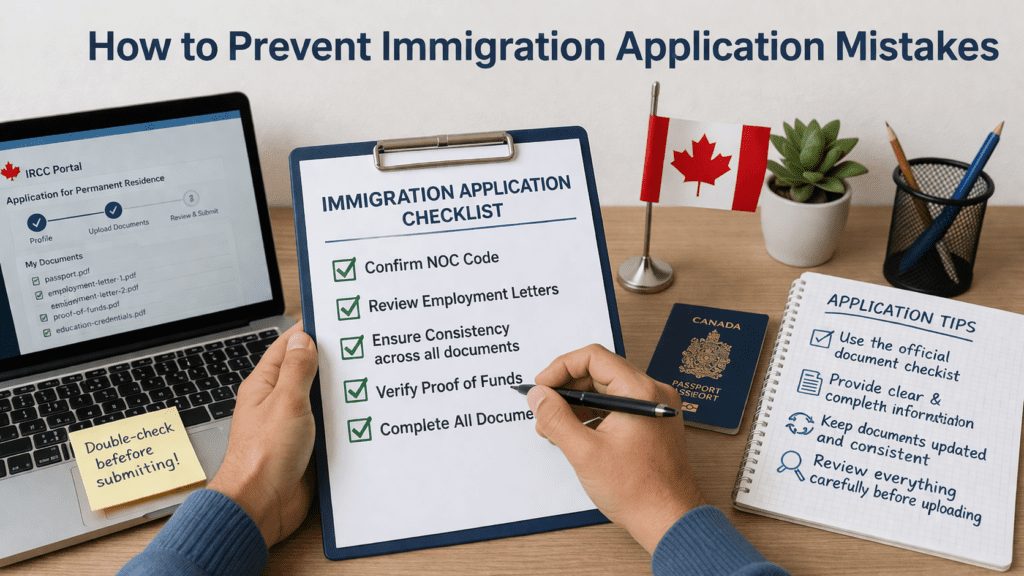
Because immigration applications involve many documents and requirements, reviewing your file carefully can significantly reduce the risk of delays or Canada PR rejection.
When Should You Review Your Immigration Application?
Applicants should review their immigration documentation at several stages during the application process.
Recommended review points include:
- before submitting an Express Entry profile
- before accepting an Invitation to Apply
- before uploading documents to the IRCC portal
- before submitting the final Canada PR application
Once an application has been submitted, correcting mistakes becomes more difficult.
Reviewing documentation in advance allows applicants to identify potential problems before they affect the outcome of the application.
Related Immigration Guides
Understanding the immigration process requires knowledge of several important components.
These resources explain important steps involved in preparing a Canada immigration application and avoiding Canada PR Rejection.
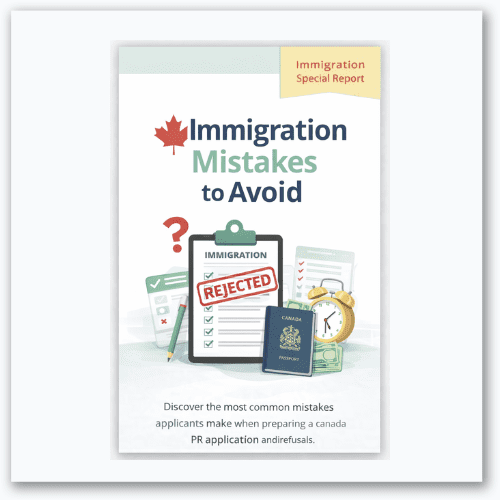
Avoid getting your Canada PR Rejection with preventable mistakes.
Before uploading your documents to the IRCC portal, make sure your application file is complete and consistent.