
Table of Contents
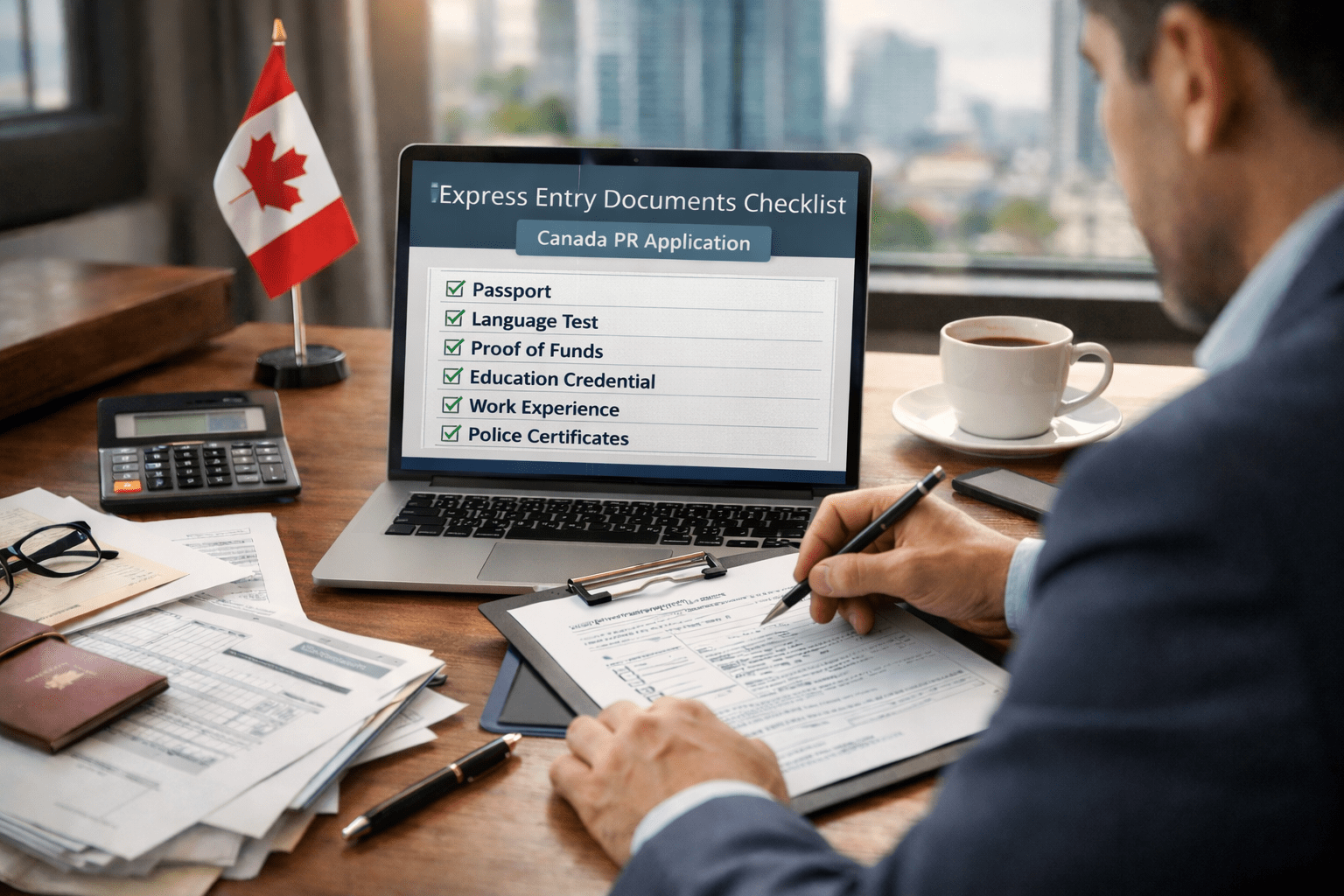
After receiving an Invitation to Apply through Express Entry, you have 60 days to submit a complete permanent residence application. Understanding exactly which express entry documents are required – and what IRCC needs each document to demonstrate – is the difference between a submission that moves smoothly through processing and one that creates problems before it ever reaches an officer’s desk.
This checklist covers every major category of express entry documents required for a Federal Skilled Worker Program or Canadian Experience Class application, what each document must show, and the most common mistakes applicants make in each category.
How Express Entry Document Requirements Work
Before going through the checklist, it is important to understand how IRCC uses express entry documents during processing.
Officers do not simply verify that documents are present. They assess whether the documents clearly and credibly support the claims made in the application – the work experience claimed, the language scores entered, the education credentials declared, and the settlement funds available. A document that technically satisfies the checklist requirement but fails to support the underlying claim creates a problem during officer review.
For Express Entry applicants, this means that gathering documents is only part of the preparation task. Ensuring each document is complete, specific, internally consistent with the rest of the file, and genuinely supports the relevant eligibility claim is equally important.
For a complete understanding of how the Express Entry system works before diving into documents, read the Express Entry Strategy Guide.
Express Entry Documents: Complete Category-by-Category Checklist
1 – Identity and Civil Status Documents
Passport: A valid passport is required for every person included in the application – principal applicant, spouse, and dependent children. The passport must be valid for the expected duration of processing. If your passport expires before your application is likely to be decided, renew it before submitting.
Birth certificates: Required for the principal applicant, spouse if applicable, and all dependent children included in the application. Birth certificates must be official government-issued documents.
Marriage certificate or proof of common-law partnership: If you are applying with a spouse, a marriage certificate is required. Common-law partners must provide documentation demonstrating twelve months of cohabitation – this typically includes a combination of joint bank account statements, joint lease agreements, utility bills, and statutory declarations.
Divorce or separation documentation: If either the principal applicant or spouse has been previously married, documentation of the legal dissolution of that marriage is required.
2 – Language Test Results
Language ability is one of the highest-weighted factors in the CRS calculation, and language test documents are among the most carefully reviewed express entry documents.
Accepted tests: For English, IRCC accepts IELTS General Training and CELPIP General. For French, TEF Canada and TCF Canada are accepted.
Validity requirement: Language test results must have been issued within two years of the date your permanent residence application is submitted – not within two years of your Express Entry profile creation. If your results expire during the 60-day application window, you must retake the test before submitting.
What the results must show: Test results must display scores for all four skills – reading, writing, listening, and speaking – at the band level that corresponds to the CLB scores entered in your profile. The scores must match exactly what was declared. Any discrepancy between declared CLB scores and actual test band scores creates an immediate credibility problem.
Second official language results: If you declared second official language scores in your profile, those test results must also be included.
3 – Educational Credential Documents
Domestic Canadian credentials: Transcripts and degrees from recognized Canadian institutions are included in the application. Transcripts must be official – copies issued directly by the institution, not copies made by the applicant.
Foreign credentials – Educational Credential Assessment: For education completed outside Canada, an ECA report from a designated organization is required before education points can be counted. The designated organizations include WES, ICAS, Comparative Education Service at the University of Toronto, and others approved by IRCC. The ECA report must confirm the Canadian equivalency of the foreign credential.
Important ECA timing: ECA reports have no stated expiry date, but they should reflect your current highest credential. If you completed additional education after your ECA was issued, a new assessment covering the updated credential may be required.
4 – Employment Reference Letters
Employment reference letters are the most consequential and most frequently problematic of all express entry documents. They are the primary evidence used to verify work experience eligibility under the NOC code claimed.
What a qualifying reference letter must include: The employer’s name, address, and contact information on official letterhead. The applicant’s job title and NOC code. The start and end dates of employment. The number of hours worked per week. The annual salary or hourly wage. A description of specific duties performed that aligns with the lead statement and main duties of the relevant NOC code.
Why generic letters fail: A reference letter that confirms employment dates and a job title without describing specific duties does not support the NOC qualification claim. Officers compare the duty descriptions in reference letters against the official NOC requirements. If the letter describes generic responsibilities that do not map to the NOC’s main duties, the work experience claim may not be accepted even if the employment was genuine.
Self-employed applicants: Self-employment presents a higher evidentiary bar. Reference letters from clients, tax records, business registration documents, financial statements, and proof of ongoing business operations are typically required to support a self-employment claim.
For each qualifying employer: A separate reference letter is required for each period of employment being claimed. If you are claiming experience from multiple positions over several years, each position requires its own letter. Read: How IRCC Officers Assess Employment History and Career Consistency
5 – Proof of Canadian Work Experience
For Canadian Experience Class applicants and applicants claiming Canadian work experience for CRS points, documentation of that Canadian experience is required in addition to or instead of foreign work experience documentation.
T4 slips and Notice of Assessments: Canadian tax documents provide independent third-party verification of employment in Canada. Including T4 slips and CRA Notices of Assessment for each year of Canadian employment significantly strengthens the documentary record.
Pay stubs: Pay stubs corroborate the salary and employer information in reference letters. Including pay stubs from the beginning and end of each Canadian employment period is standard practice.
Work permit documentation: Copies of the work permits under which Canadian employment was conducted are required to demonstrate that the work was performed legally.
6 – Financial Documents – Proof of Settlement Funds
Most Express Entry applicants are required to demonstrate sufficient settlement funds unless they have a valid job offer or are applying through the Canadian Experience Class with qualifying Canadian work experience.
Bank letters: Official bank letters on bank letterhead stating the account holder’s name, account numbers, current balance, and the date the letter was issued. The letter should also confirm the account has been held for at least six months, demonstrating that the funds are not recently deposited for immigration purposes.
Six months of bank statements: Statements covering the six months preceding the application submission date, showing the transaction history that led to the current balance. This is one of the most frequently misunderstood proof of funds requirements – a balance letter alone, without supporting transaction history, is often insufficient.
Foreign currency conversion: If funds are held in a currency other than Canadian dollars, the stated balance must be converted to CAD using the exchange rate at the time of application. The bank letter or statements should make the currency clear.
Read: How IRCC Officers Assess Financial Sufficiency and Source of Funds
7 – Police Clearance Certificates
Police certificates are required from every country where you have lived for six months or more since the age of 18. This applies to the principal applicant and, in most cases, to accompanying family members aged 18 and over.
Processing times vary significantly: Some countries issue police certificates within days. Others take weeks or months. Police certificates from some countries require specific application procedures, notarization, or apostille authentication. Initiating requests for all required police certificates immediately after receiving an ITA is strongly recommended.
Expiry: Police certificates typically must have been issued within the three to six months preceding application submission, though this varies by issuing country. Check IRCC’s current requirements for each specific country before requesting.
8 – Medical Examination Results
All applicants and accompanying family members must complete an immigration medical examination conducted by an IRCC-designated panel physician. The medical examination cannot be self-initiated from just any doctor – it must be performed by a physician on IRCC’s designated panel.
Timing: Medical examination results are valid for 12 months. Completing the medical examination too early – before you have received an ITA and confirmed your application timeline – risks having results expire before processing is complete.
Upfront medical examinations: IRCC may prompt certain applicants to complete medical examinations before receiving an ITA, as part of the Express Entry profile process. If you receive this prompt, follow the instructions provided.
9 – Additional Documents Depending on Your Situation
Provincial nomination certificate: If you have been nominated by a province through an Enhanced Nomination, include the provincial nomination certificate in your application.
Job offer letter and LMIA: If you declared a qualifying job offer, the offer letter and any associated LMIA documentation must be included.
Dependent children documentation: For dependent children included in the application, additional documents are required including birth certificates, adoption orders if applicable, and custody documentation if applicable.
Digital photos: Passport-style digital photos meeting IRCC’s specific technical requirements are required for each person included in the application.
Common Express Entry Document Problems That Cause Refusals
Several document problems appear consistently in Express Entry applications that result in refusals or procedural fairness letters.
Employment reference letters that describe duties in generic terms without mapping to specific NOC requirements are the single most common problem. Letters that confirm employment without specifically describing what the applicant did – using language like “managed operations” or “handled client relations” without further specificity – do not adequately support the NOC claim.
Language test results that have expired between profile creation and application submission create eligibility problems that require retesting before submission is possible.
Inconsistencies between documents – employment dates that differ between a reference letter and tax records, job titles that appear differently across documents, education dates that do not match between the application form and ECA report – create credibility concerns that officers must resolve. Read: Common Document Mistakes DIY Immigration Applicants Make
Settlement fund documentation that shows sufficient balance but lacks supporting transaction history raises source of funds questions that can result in procedural fairness letters requesting additional information.
How to Verify Your Express Entry Documents Before Submitting
The 60-day window after receiving an ITA is not the time to discover that a reference letter is inadequate or that a police certificate will take eight weeks to obtain. Starting document preparation before your ITA arrives – during your time in the pool – puts you in a significantly stronger position.
For each qualifying employer, contact your employer or former employer to request a complete reference letter meeting IRCC’s requirements before your ITA arrives. Review each letter against the NOC duties for your claimed occupation before including it in the application.
For each country where you have lived for six months or more, research the police certificate process and timeline so you can initiate requests immediately upon receiving an ITA.
Verify that your language test results will remain valid for the duration of your expected processing period – not just through the application submission date.
A pre-submission document review can help identify gaps, inconsistencies, and presentation problems in your express entry documents before they become refusal reasons.
Learn more about the DIY Document Review Service for IRCC applications: new.fly2canada.com/diy-document-review-for-ircc-applications
Frequently Asked Questions
What documents are required for an Express Entry application? The main categories of express entry documents include identity documents such as passports and birth certificates, language test results, educational credential assessments for foreign education, employment reference letters for each qualifying employer, proof of settlement funds including bank letters and six months of statements, police clearance certificates from each country of residence, and medical examination results from an IRCC-designated physician.
How specific do employment reference letters need to be for Express Entry? Reference letters must include the employer’s contact information on letterhead, the applicant’s job title and NOC code, employment dates, hours per week, salary, and a description of specific duties performed. The duty descriptions must align with the NOC’s main duties for the claimed occupation. Generic descriptions of responsibilities without specific task detail are frequently insufficient.
Do I need to translate my documents for an Express Entry application? Documents not in English or French must be accompanied by a certified translation prepared by a qualified translator. Both the original document and the certified translation are submitted together.
How early should I start gathering express entry documents? Start preparing before you receive an ITA, during your time in the Express Entry pool. Police certificates in particular can take weeks or months to obtain in some countries. Having most documents ready before your ITA arrives gives you the best use of the 60-day submission window.
What happens if a document is missing or inadequate after I submit? If IRCC identifies a problem during processing, you may receive a procedural fairness letter giving you an opportunity to respond with additional documentation. However, not all applications receive procedural fairness letters – officers may refuse an application without requesting clarification if the submitted documentation is insufficient.
Final Thoughts
Express entry documents are not just a checklist exercise. Each document in your application file is evidence that supports a specific claim – and officers assess whether that evidence is adequate, not just whether it is present.
Getting your express entry documents right before submission means verifying that every reference letter specifically addresses the NOC duties for your claimed occupation, that your language results are current and match your declared CLB scores, that your financial documentation demonstrates both balance and transaction history, and that all information is internally consistent across every document in the file.
The 60-day window after an ITA is not enough time to discover and fix significant document problems. Preparation that starts while you are still in the pool – reviewing reference letters, researching police certificate timelines, and ensuring financial documentation is complete – is what allows the 60 days to be used for assembly and review rather than scrambling to gather adequate evidence.
This article is for educational purposes only and does not constitute legal or immigration advice. For guidance specific to your situation, consult a licensed RCIC or immigration lawyer.
