
CRS Score Requirements: 5 Critical Express Entry Cutoff Facts
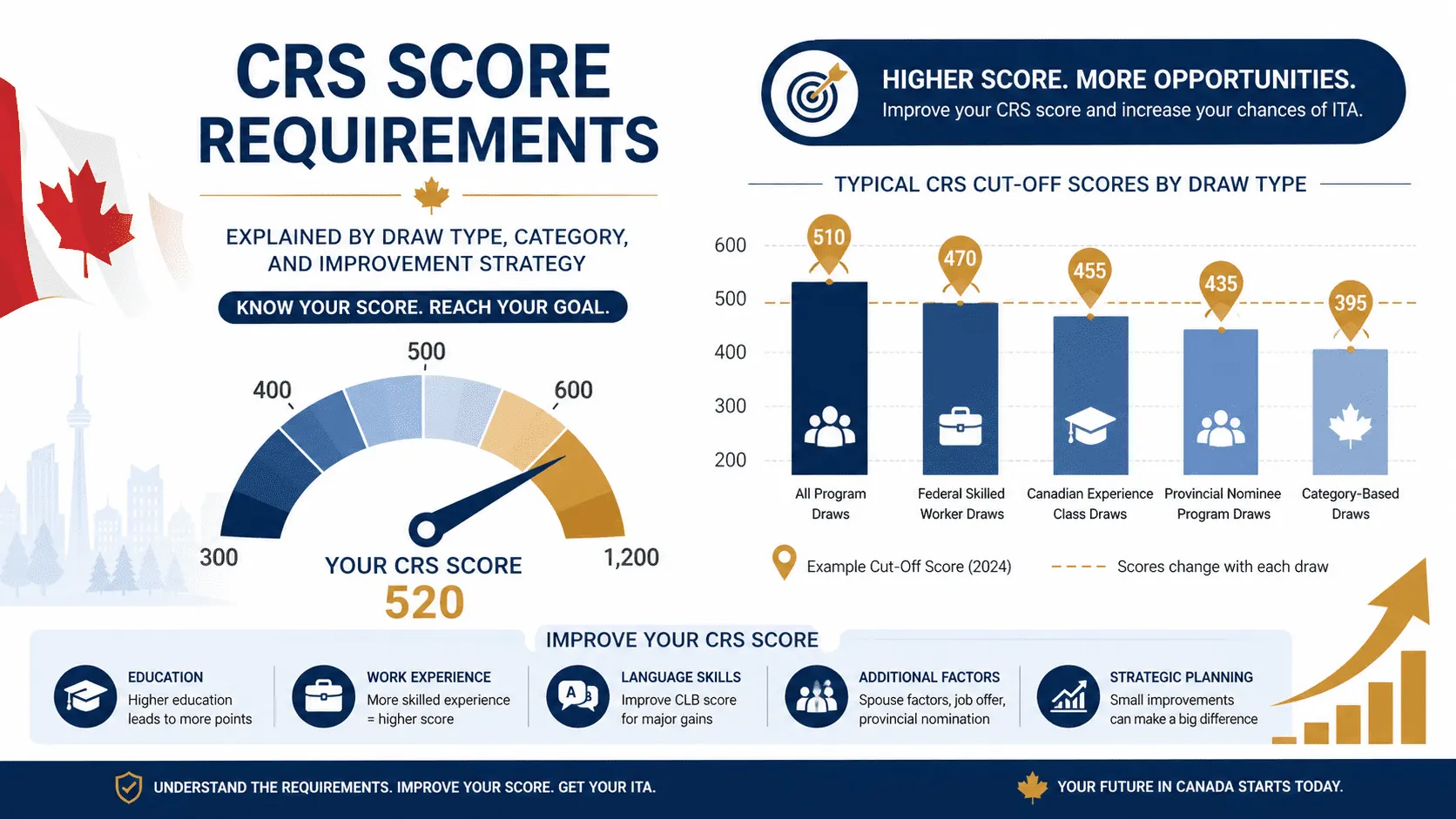
Table of Contents
- What CRS Score Requirements Actually Measure
- Fact 1 – CRS Score Requirements Differ by Draw Category
- Fact 2 – CRS Score Requirements Are Calculated From Multiple Factors
- Fact 3 – Age Is a CRS Score Requirement Factor That Only Moves in One Direction
- Fact 4 – Language Scores Are the Highest-Return CRS Score Improvement Available to Most Applicants
- Fact 5 – Provincial Nominations Bypass CRS Score Requirements Entirely
- FAQ
- Final Thoughts
CRS score requirements for Express Entry are not fixed minimums – they are moving targets that reflect pool dynamics, draw frequency, and IRCC’s invitation categories at any given time. Applicants who treat CRS score requirements as a static threshold to reach and then wait at are misunderstanding how the system works. The most effective Express Entry strategy is active: understand how CRS score requirements are calculated, which categories you qualify for, what improvement strategies are available, and how to manage your profile relative to current pool dynamics. This article covers the five critical facts about crs score requirements that shape that strategy.
CRS changes from November 3, 2026. IRCC has announced changes to how CRS points are awarded (official details): (1) a new Labour Market Integration factor gives points for Canadian work experience or an eligible job offer, not both, up to 150 points (140 with a spouse or common-law partner); (2) work-length points for Canadian experience stay the same, and at least 12 months in an eligible high-wage occupation adds 20, 40 or 70 points; (3) job offer points return for eligible high-wage occupations only, at 50, 70 or 100 points depending on the wage level; an LMIA is no longer needed, and having one no longer adds points; (4) when the changes take effect, IRCC will recalculate existing profiles, which could take up to two weeks, and invitation rounds pause during that time. The rest of this section reflects the rules in force until November 2, 2026.
What CRS Score Requirements Actually Measure
CRS score requirements are not an eligibility threshold – they are a competitive ranking. Meeting the minimum program requirements to enter the Express Entry pool gives you a CRS score of some value. Whether that score is sufficient to receive an ITA depends on how it compares to the scores of other candidates in the pool and to the cutoff in the next available draw for a category you qualify for.
Understanding this distinction is fundamental to Express Entry strategy. A CRS score of 450 is not high or low in absolute terms – it is high or low relative to current draw cutoffs. In a period when general draw cutoffs are running at 480, a score of 450 means waiting indefinitely unless a category-based draw targets profiles like yours at a lower cutoff. In a period when general draw cutoffs drop to 430, the same score of 450 receives an ITA in the next general draw.
For the complete breakdown of how every CRS factor is calculated and how to verify your score against the official calculation, the CRS score calculator guide covers every point category in detail.
Fact 1 – CRS Score Requirements Differ by Draw Category
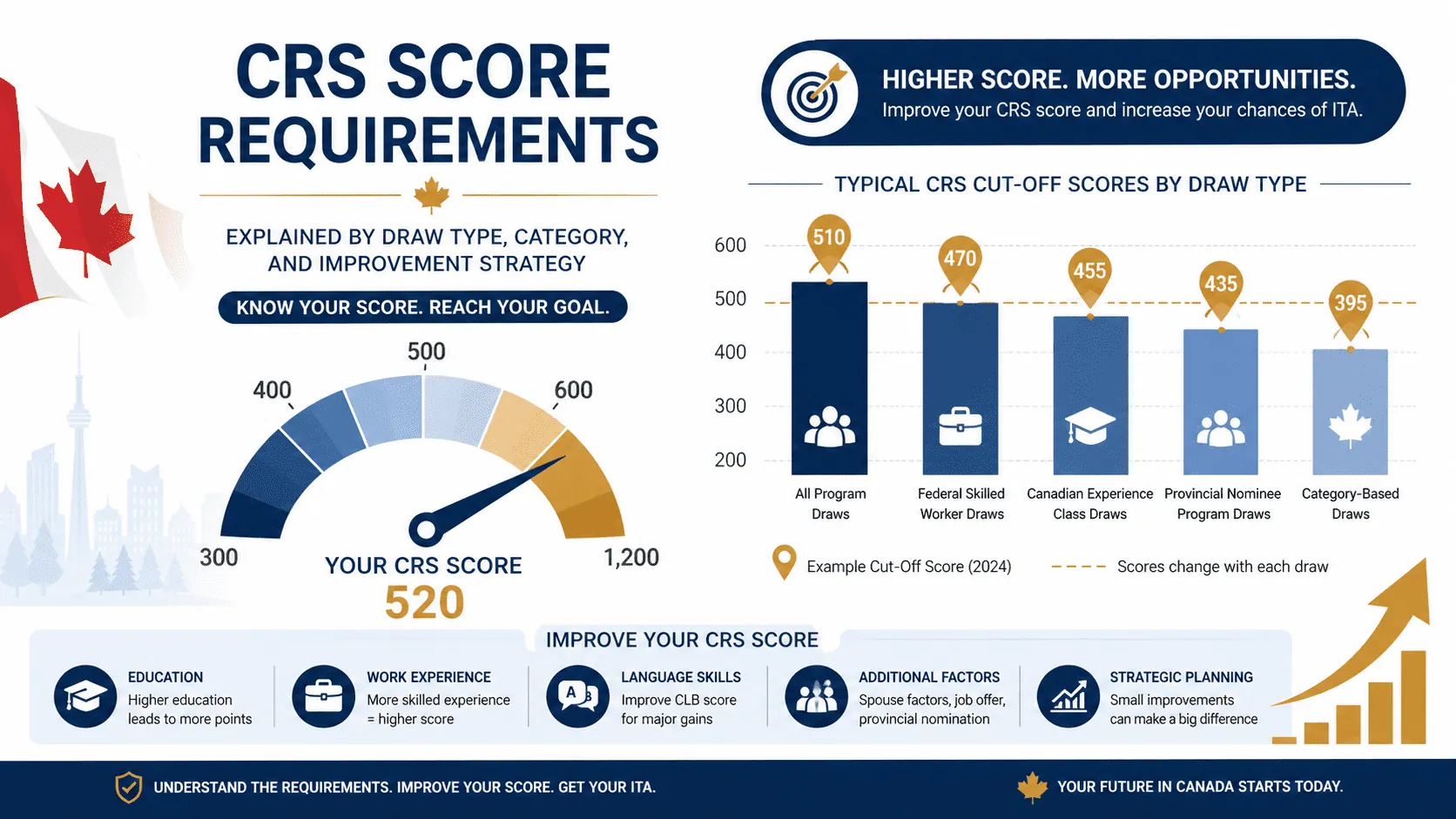
Since IRCC introduced category-based selection draws, crs score requirements vary significantly depending on which category a draw targets. General draws – open to all eligible Express Entry candidates – typically have the highest cutoffs because they compete across the entire pool. Category-based draws – targeting French language proficiency, specific occupations, or Canadian ties – have lower cutoffs because they draw from a smaller, more targeted subset of candidates.
The category-based draw system means your effective crs score requirements depend on which categories you qualify for. A candidate with French language proficiency at CLB 7 or higher qualifies for French-language category draws, where the crs score requirements have historically been lower than general draws by 20 to 50 points or more. A candidate with trade occupation experience qualifies for trade occupation draws with their own score dynamics.
Before assessing whether your CRS score is competitive, identify every draw category you qualify for and research the historical cutoff range for each. Your competitive position is defined by the lowest cutoff category you qualify for – not by the general draw cutoff.
Fact 2 – CRS Score Requirements Are Calculated From Multiple Factors
CRS score requirements cannot be assessed without understanding what your CRS score consists of. The score is calculated from four main component groups: core human capital factors, spouse or common-law partner factors, skill transferability factors, and additional points for specific circumstances.
Core human capital factors – age, education, first official language proficiency, second official language proficiency, and Canadian work experience – account for the largest share of most applicants’ CRS scores. For candidates between 20 and 29 years old with strong language scores and a Canadian degree or work experience, core factors alone can produce scores above 400.
Skill transferability factors reward specific combinations of education, language, and work experience. A candidate with a post-secondary degree, strong language scores CLB 7 or higher, and three or more years of foreign work experience receives additional points under the education plus foreign work experience skill transferability factor. These bonus points can add 50 or more points to a profile that would otherwise score lower.
Additional points for a provincial nomination add 600 CRS points. Additional points for Canadian study experience or a sibling currently living in Canada add smaller but meaningful amounts; a job offer from a Canadian employer adds no CRS points until November 2, 2026 (from November 3, 2026, see the note above). Reviewing all additional point categories for factors you may qualify for but have not claimed is a worthwhile exercise for any Express Entry candidate who has not recently audited their full score breakdown.
Fact 3 – Age Is a CRS Score Requirement Factor That Only Moves in One Direction
Age is one of the most underappreciated components of crs score requirements because it is the only factor that consistently decreases for most applicants over time. The CRS age points are maximized for candidates aged 20 to 29, then decrease progressively from age 30 onward, with the largest reductions occurring after age 35 and continuing to age 45 where the age points drop to zero.
The practical implication: every birthday after age 29 reduces your CRS score. For candidates whose profiles are near a draw cutoff threshold, an approaching birthday that will push their score below the current cutoff creates a genuine urgency that is often underestimated. If your CRS score is at or near a recent cutoff and your next birthday will reduce your age points enough to push you below that cutoff, submitting your profile before that birthday is time-critical.
Age also interacts with Canadian work experience points. A candidate who accumulates one year of Canadian work experience at age 27 will receive higher skill transferability points than the same candidate accumulating the same experience at age 38, because the age component of the core human capital factors is different. This makes early Canadian work experience accumulation more CRS-efficient than later accumulation.
Fact 4 – Language Scores Are the Highest-Return CRS Score Improvement Available to Most Applicants
For most Express Entry candidates assessing how to improve their CRS score to meet crs score requirements, language testing is the first strategy to evaluate because it offers the highest potential score increase in the shortest time. The CRS system rewards language proficiency at multiple levels – meeting the minimum threshold, achieving CLB 7 across all abilities, achieving CLB 9, and achieving CLB 10 – with progressively higher point awards at each level.
The jump from CLB 7 to CLB 9 in all four abilities of a first official language adds approximately 32 to 40 CRS points depending on other factors in the profile. The jump from CLB 9 to CLB 10 adds additional points. For many candidates, two rounds of language preparation and retesting can produce a score improvement of 40 to 60 points – enough to move a borderline profile to a competitive one.
Spousal language scores are a frequently overlooked CRS score improvement strategy. If your spouse or common-law partner has language test results that have not been entered in your Express Entry profile, adding them can contribute up to 20 additional CRS points under the spousal factor. If your spouse has not yet tested, their testing represents an available improvement that requires no change to your own qualifications.
For a comprehensive comparison of all score improvement strategies and their expected point impacts, the express entry minimum score guide covers every improvement pathway with timeline and point range estimates.
Fact 5 – Provincial Nominations Bypass CRS Score Requirements Entirely
The most powerful single intervention available to Express Entry candidates whose CRS scores fall short of crs score requirements in general draws is a provincial nomination. A valid nomination from an Express Entry-linked provincial stream adds 600 CRS points, and IRCC holds separate invitation rounds for candidates with a provincial nomination.
For candidates with CRS scores in the 400 to 470 range – below typical general draw cutoffs but potentially competitive for provincial nomination streams – pursuing a provincial nomination is often a more reliable path to an ITA than waiting for pool dynamics to shift or improving language scores by the required amount.
Provincial nomination eligibility varies by province and stream. Each province has its own selection criteria – occupation priority lists, language thresholds, provincial connection requirements, and for BC PNP, a registration scoring system. Confirming that your profile meets a province’s criteria before investing application time is the first step in any provincial nomination strategy.
If you receive a provincial nomination and add the 600 CRS points to your profile, IRCC’s next general draw will include your profile at the elevated score. The nomination effectively removes the crs score requirements barrier for general draw competitiveness. For applicants who want a pre-submission review of their Express Entry application package once they receive their ITA – whether through a provincial nomination or a general draw – the DIY Document Review service provides a structured assessment against IRCC’s actual review criteria.
FAQ
What are the CRS score requirements for Express Entry in 2026?
CRS score requirements for Express Entry vary by draw type and change with every draw. General draw cutoffs in recent years have ranged from the low 400s to above 500. Category-based draws targeting French proficiency, specific occupations, or Canadian ties typically have lower cutoffs. There is no fixed crs score requirement – competitiveness is relative to current pool dynamics and draw categories.
How are CRS score requirements calculated?
CRS score requirements are met or not based on your calculated CRS score compared to draw cutoffs. Your CRS score is calculated from core human capital factors including age, education, and language scores, plus spouse factors, skill transferability bonus points, and additional points for provincial nominations, Canadian study, and sibling ties. Until November 2, 2026, job offers add no points; from November 3, 2026, a job offer in an eligible high-wage occupation can add 50, 70 or 100 points.
Can I meet CRS score requirements without a provincial nomination?
Yes. Many candidates receive ITAs through general draws and category-based draws without provincial nominations. Whether a nomination is necessary depends on your base CRS score relative to current draw cutoffs. For candidates with scores well above recent general draw cutoffs, a nomination is not needed. For candidates with scores near or below cutoffs, a nomination provides a reliable ITA pathway.
How often do CRS score requirements change?
CRS score requirements – the draw cutoffs – change with every draw. IRCC conducts draws regularly, typically one to two per month for general draws and additional category-based draws. Each draw produces a new cutoff based on pool composition and invitation volume at that specific time. Monitor draw results regularly rather than relying on a single historical cutoff figure.
What is the fastest way to improve my CRS score to meet requirements?
The fastest CRS score improvement strategies are language score improvement through retesting CLB 9 or higher across all abilities, adding spousal language scores if your spouse has not tested, and ensuring all available additional point factors have been claimed in your profile. A provincial nomination adds 600 points and is the most reliable route to meeting crs score requirements for general draw ITAs for mid-range score candidates.
Final Thoughts
CRS score requirements are the lens through which everything else in Express Entry strategy should be evaluated. Understanding that they are relative – not fixed – changes how you approach both profile management and score improvement. A score that is insufficient for today’s general draw may be sufficient for a category-based draw you qualify for next month. A score that is sufficient today may be below the cutoff next month if pool dynamics shift.
The five facts in this article give you the analytical framework to assess your competitive position accurately, identify the improvement strategies most available to you, and choose between waiting, improving your score, or pursuing a provincial nomination pathway. CRS score requirements are not a wall – they are a threshold that moves, and your goal is to be above it when the right draw occurs.
This article is for educational purposes only and does not constitute legal or immigration advice. For guidance specific to your situation, consult a licensed RCIC or immigration lawyer.