
First 30 Days in Canada: 5 Critical Steps Every New PR Must Take
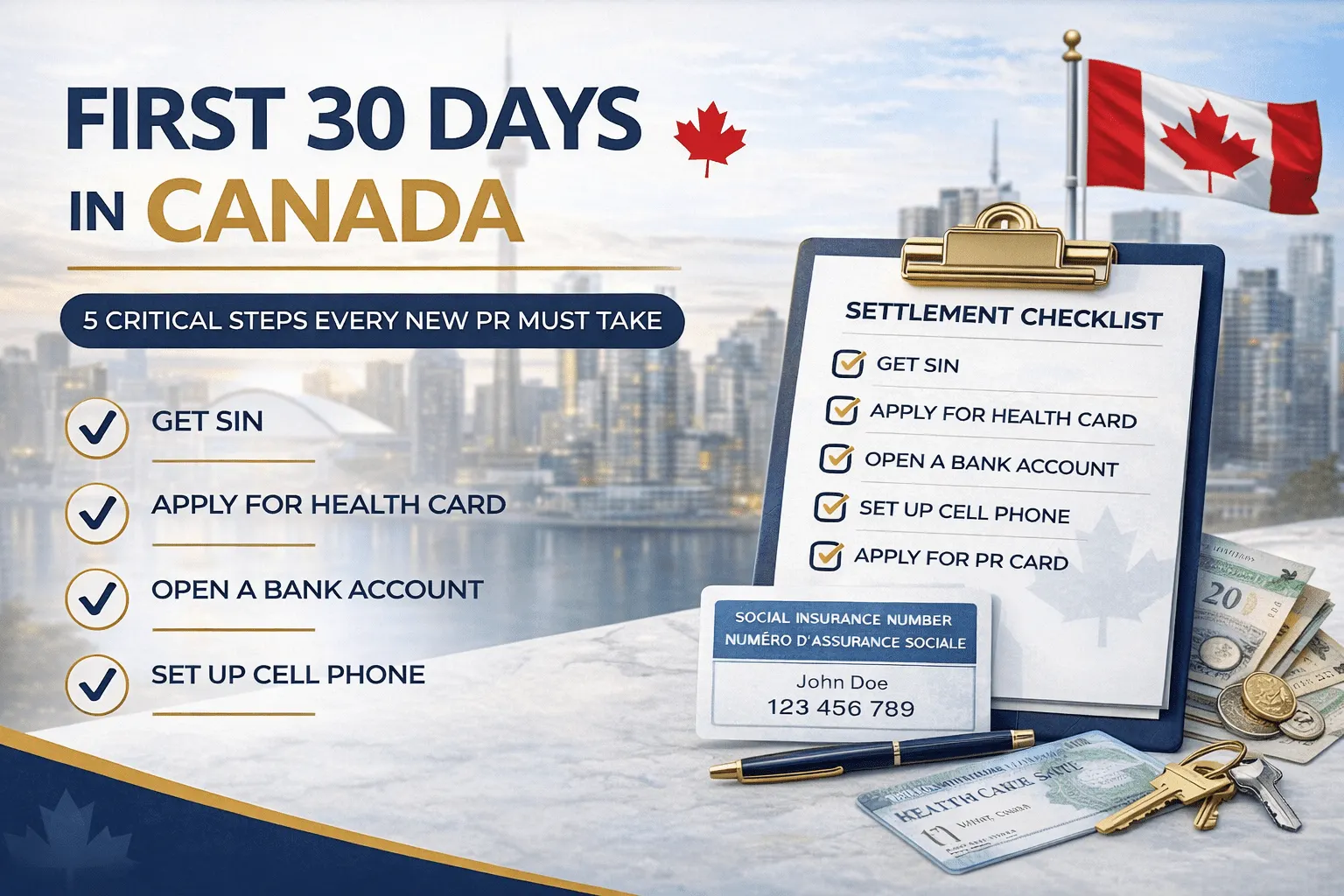
Table of Contents
- Why Your First 30 Days in Canada Set the Foundation for Everything Else
- Step 1 – Apply for Your Social Insurance Number Immediately
- Step 2 – Register for Provincial Health Insurance
- Step 3 – Open a Canadian Bank Account
- Step 4 – Confirm Your PR Card Mailing Address
- Step 5 – Register Children for School and Access Settlement Services
- FAQ
- Final Thoughts
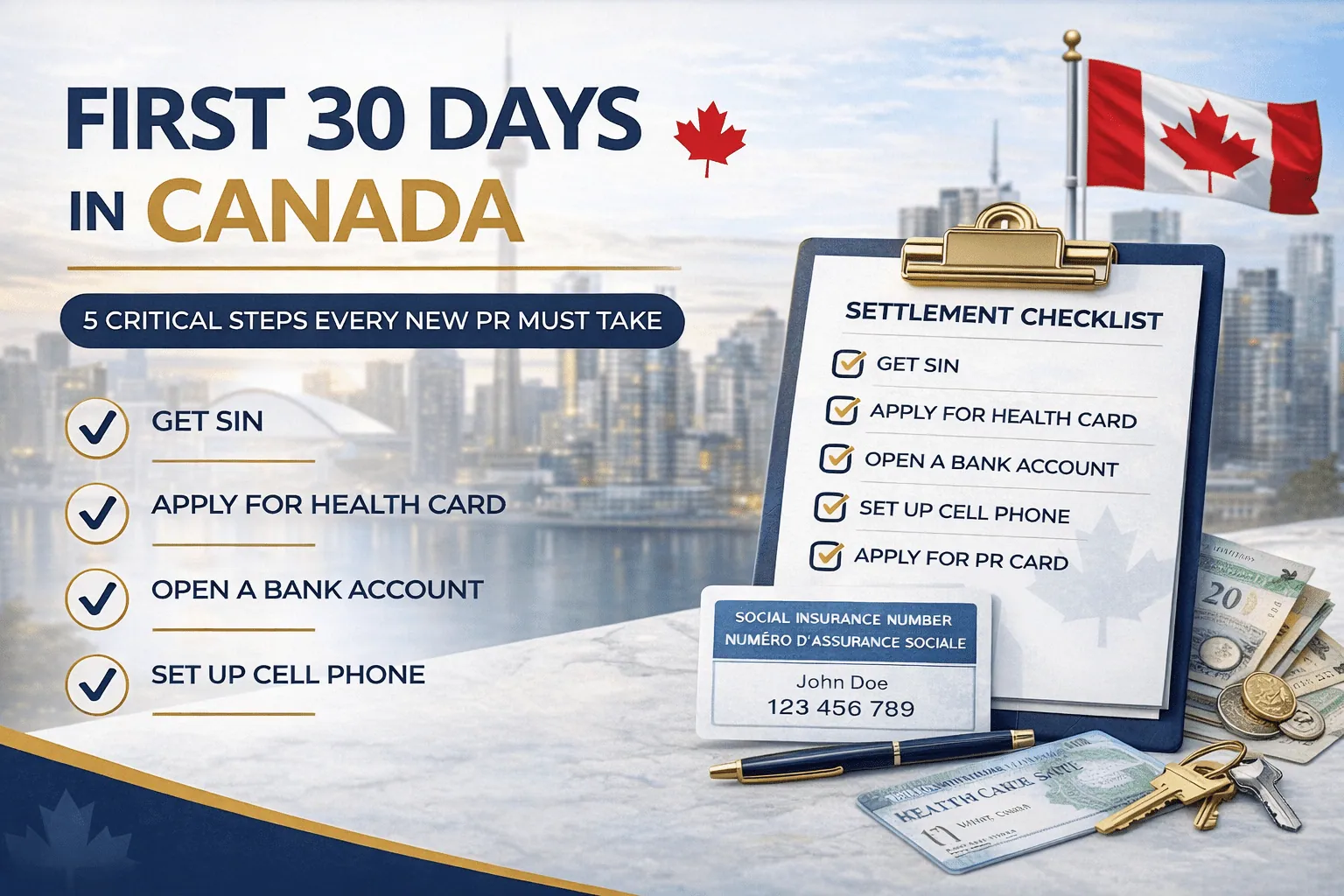
Your first 30 days in Canada as a new permanent resident are more administrative than most people expect. The excitement of landing is real – but so is the list of registrations, applications, and appointments that need to happen within specific timeframes. Missing any of them does not just cause inconvenience. Some have consequences that take months to correct, and a few affect your access to employment and healthcare from day one.
This checklist covers the five most critical steps and when each one must happen.
Why Your First 30 Days in Canada Set the Foundation for Everything Else
The administrative tasks in your first 30 days in Canada are not bureaucratic formalities. They are the foundation of your legal, financial, and social infrastructure in your new country. Without a Social Insurance Number you cannot legally work. Without provincial health insurance registration you have no coverage during the waiting period that follows. Without a Canadian bank account you cannot receive payroll, pay rent, or set up utilities.
Each step below feeds into the next. Completing them in order and on time means your settlement proceeds smoothly. Delays compound – a late SIN application delays your first paycheck, which delays your ability to establish a credit history, which delays your access to financial products you will need sooner than you think.
Before this checklist begins, make sure your landing itself went smoothly. If you have questions about what happened at the border or about your customs declarations, the flying to Canada with COPR guide and the declaring money Canada airport guide cover those steps in full detail.
Step 1 – Apply for Your Social Insurance Number Immediately
Your Social Insurance Number (SIN) is the single most important document you need in your first 30 days in Canada. Without it, no employer can legally pay you, and you cannot file taxes, access government benefits, or open certain financial accounts.
Service Canada issues SINs and the process is straightforward. You can apply in person at a Service Canada Centre or online. In person is faster – you can often receive your SIN the same day. Bring your COPR, your passport, and proof of your Canadian address.
As a new permanent resident, your SIN will begin with a number that reflects your status. When it arrives, verify the name and date of birth on the document against your passport exactly. An error in your SIN record causes significant problems with your employer, CRA, and any government services you access. Report discrepancies to Service Canada immediately.
Apply for your SIN within the first week of landing if at all possible. There is no legal deadline, but every day you delay is a day you cannot legally begin paid employment.
Step 2 – Register for Provincial Health Insurance
Provincial health insurance is administered differently in each province, but one rule applies everywhere: there is a waiting period before coverage begins. In most provinces this waiting period is three months from the date you establish residency. In some provinces coverage begins immediately. Check the rules for your specific province on arrival.
During your first 30 days in Canada, registering for provincial health insurance starts the clock on that waiting period. If you delay registration by two weeks, your coverage start date moves two weeks later. There is no benefit to waiting.
During the waiting period, you are not covered by provincial health insurance. If you have international travel insurance or private health coverage through a former employer, keep it active until your provincial coverage begins. The cost of a single uninsured medical visit in Canada can be significant.
To register, contact your provincial Ministry of Health or equivalent. You will need your COPR, your passport, and proof of your provincial address. Some provinces allow online registration, others require an in-person visit.
Step 3 – Open a Canadian Bank Account
Opening a Canadian bank account is one of the highest-priority tasks in your first 30 days in Canada because almost everything else depends on it. Your employer needs a Canadian account for direct deposit. Your landlord needs a Canadian account for rent transfers. Your SIN registration and tax filing both tie back to your banking information.
Canadian banks are required by law to open a basic bank account for any person with valid identification, regardless of credit history. As a new permanent resident, you qualify. Bring your passport, your COPR, and your SIN once it has been issued. Some banks will open an account before your SIN arrives if you provide it within a set timeframe.
Consider opening accounts at two institutions – a major chartered bank for day-to-day banking and a credit union if one serves your community well. Credit unions sometimes offer better rates for newcomers and can be more flexible with mortgage qualification later.
Within your first 30 days in Canada, also apply for a secured credit card if you do not already have Canadian credit history. A secured card requires a deposit but reports to the credit bureaus, which begins building your Canadian credit score immediately. This matters more than most newcomers realize – a thin credit file affects your ability to rent an apartment, get a cell phone plan, and eventually qualify for a mortgage.
Step 4 – Confirm Your PR Card Mailing Address
Your PR card is mailed by IRCC to the Canadian address you provided at the port of entry during your landing. It typically takes four to six weeks to arrive. During your first 30 days in Canada, confirm that the address on file with IRCC is accurate and that you will be at that address to receive mail.
If you provided a temporary address at landing – a hotel, an Airbnb, or a family member’s home – and you have since moved, update your address with IRCC through your online account immediately. A PR card mailed to an outdated address is not automatically reissued. You must apply for a replacement, which takes additional weeks and costs a fee.
Your PR card is your proof of permanent residence for travel outside Canada. Without it, you cannot board a flight back to Canada as a permanent resident. Until your card arrives, keep your COPR document safe – it serves as temporary proof of your status in combination with your passport.
Do not travel outside Canada until your PR card has arrived, unless it is an unavoidable emergency. Returning to Canada without a PR card requires a special authorization called a Permanent Resident Travel Document (PRTD), which must be applied for at a Canadian embassy or consulate abroad.
Step 5 – Register Children for School and Access Settlement Services
If you have dependent children, school registration is a time-sensitive task in your first 30 days in Canada. Canadian public schools are free for permanent resident children, and registration is handled through your local school board. Contact the school board for your area as soon as you have a confirmed address.
Settlement services are a resource that many new permanent residents underuse. Government-funded settlement agencies offer free language assessment, employment counseling, credential recognition guidance, and community connection programs. These services exist specifically for newcomers and are available to permanent residents at no cost.
Find your local settlement service provider through the IRCC website or by contacting a local newcomer centre. Accessing these services early – within your first 30 days in Canada – connects you to networks and support systems that would otherwise take months to find independently.
If your settlement planning includes reviewing any outstanding immigration documents or ensuring your file is complete before any follow-up IRCC interactions, the DIY Document Review service provides structured support for post-landing document needs.
FAQ
What is the most important thing to do in your first 30 days in Canada as a new PR? The highest priority in your first 30 days in Canada is applying for your Social Insurance Number. Without it, you cannot legally work, file taxes, or access most government services. Apply within the first week of landing at a Service Canada Centre or online.
When does provincial health insurance start in your first 30 days in Canada? Most provinces have a three-month waiting period before provincial health insurance coverage begins. The waiting period starts from the date you register, not the date you landed. Register immediately upon arrival to start the clock as early as possible.
Can you travel outside Canada during your first 30 days? Technically yes, but it is strongly advisable to remain in Canada until your PR card arrives, typically four to six weeks after landing. Leaving Canada without a PR card requires a Permanent Resident Travel Document to return, which must be obtained from a Canadian embassy abroad.
How long does it take to get a PR card after landing? Your PR card typically arrives within four to six weeks of your landing date. It is mailed to the address you provided at the port of entry. If your address changes during your first 30 days in Canada, update it immediately through your IRCC online account.
What settlement services are available in your first 30 days in Canada? Government-funded settlement agencies provide free services including language assessment, employment counseling, credential recognition support, and community programs. These are available to all permanent residents at no cost and can be found through the IRCC website or local newcomer centres.
Final Thoughts
Your first 30 days in Canada will pass faster than you expect. The administrative tasks feel overwhelming at first, but each one has a clear process and a clear outcome. SIN, health insurance, bank account, PR card address, and settlement services – complete these five in order and your foundation is set.
The mistakes that cost new permanent residents the most time and money in their first 30 days in Canada are almost always the result of delay, not complexity. Waiting a week to apply for your SIN, forgetting to update your PR card mailing address, skipping health insurance registration because the waiting period feels discouraging – these are all avoidable.
Treat your first 30 days in Canada as a project with a deadline. The deadline is 30 days. The deliverable is a functioning life infrastructure. Get it done early, get it done right, and everything that follows becomes easier.
This article is for educational purposes only and does not constitute legal or immigration advice. For guidance specific to your situation, consult a licensed RCIC or immigration lawyer.