
Table of Contents
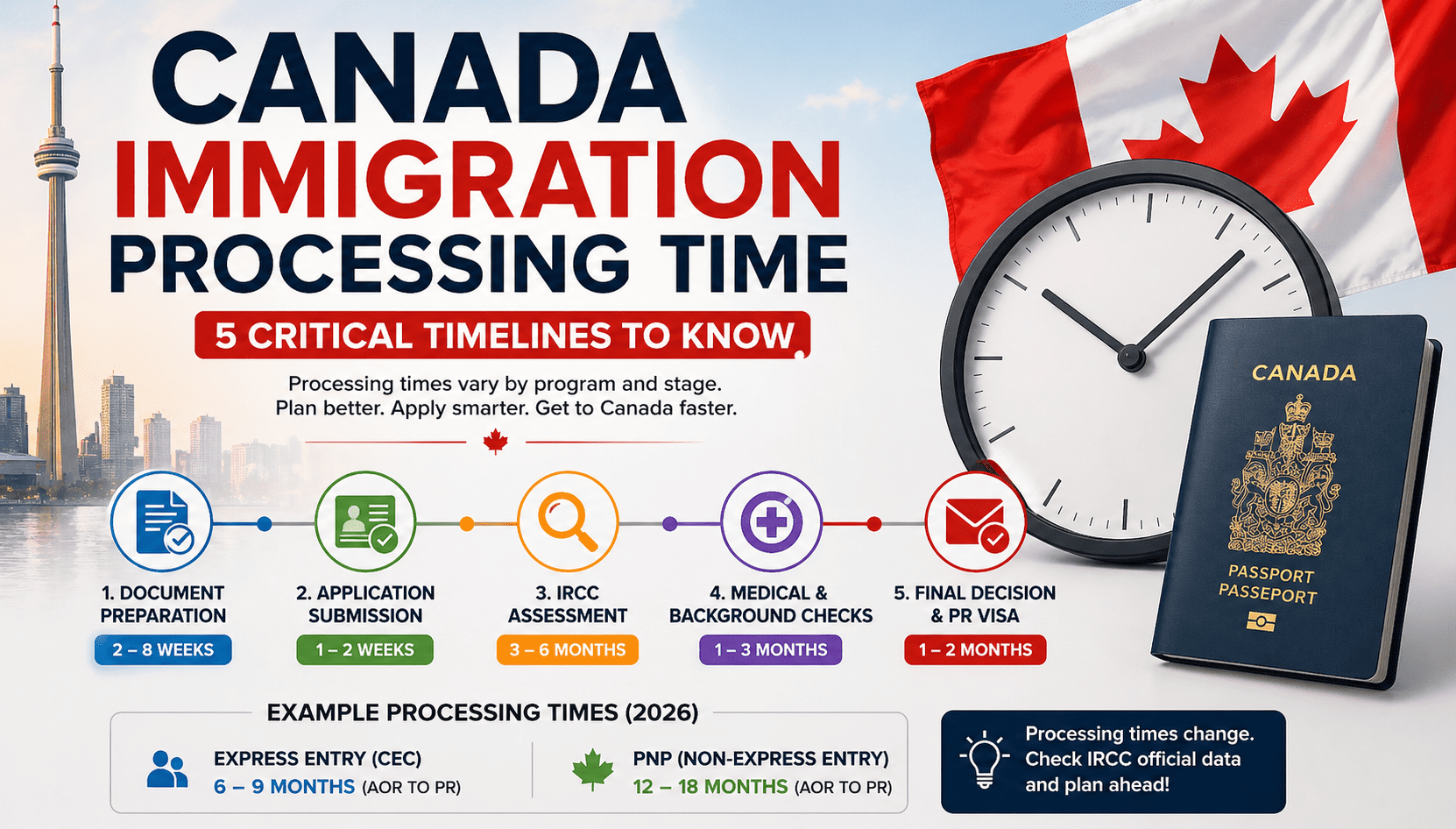
Canada immigration processing time is one of the most searched topics among DIY applicants – and one of the most misunderstood. The figure IRCC publishes on its website is only one part of a much longer timeline that begins months before you submit your application and continues after IRCC makes its decision. Applicants who plan around the published processing time alone routinely underestimate how long the full process takes and make decisions that create pressure on their own deadlines.
This article breaks down the five timeline stages every applicant must understand, and what actually drives the total time from decision to permanent residence.
Why Canada Immigration Processing Time Is Longer Than Most Applicants Expect
The IRCC website shows processing times for specific application stages – typically the time from submission of a complete application to a final decision. For Express Entry, this is often quoted as six months. That figure is accurate for what it measures. The problem is what it does not measure.
Before you can submit an application, you must build an Express Entry profile, receive an Invitation to Apply (ITA), and gather a complete document package. Before you can build a competitive profile, you must complete language testing and an Educational Credential Assessment. Each of these steps has its own timeline, and none of them are included in the IRCC processing time figure.
The total canada immigration processing time from the moment you decide to apply to the moment you become a permanent resident is typically 12 to 24 months for most applicants – not six months. Understanding why helps you plan realistically.
Timeline 1 – Pre-Profile Preparation: 3 to 9 Months
The first stage of your canada immigration processing time is the preparation phase before your Express Entry profile even exists. This stage includes two mandatory components that most applicants underestimate.
Language testing takes two to four weeks to complete the test itself, plus an additional one to three weeks for results to be issued. IELTS and CELPIP both offer accelerated result delivery, but standard processing runs two to three weeks. If you are unhappy with your scores and need to retest, add another four to six weeks minimum.
An Educational Credential Assessment (ECA) is required for all foreign-educated applicants under FSWP. Processing times vary by organization – WES typically takes four to seven weeks for standard service, longer for complex credentials. Expedited services are available but add cost. Starting your ECA before your language test results arrive is one of the most effective ways to compress this stage.
If you are also gathering proof of funds documentation, six months of bank statements are required. This is not a processing delay – it is a calendar constraint. You cannot manufacture six months of statements faster than time allows.
For Express Entry documents requirements across all stages, the Express Entry documents checklist covers exactly what needs to be ready at each point.
Timeline 2 – Express Entry Pool Wait Time: 1 to 18 Months
Once your profile is in the Express Entry pool, the wait time for an ITA is entirely dependent on your CRS score relative to the cutoff scores in each draw. This is the most unpredictable component of the canada immigration processing time because it is driven by draw frequency and cutoff score fluctuations, not by IRCC administrative timelines.
Applicants with CRS scores well above recent cutoffs – typically 500 or higher – can receive an ITA within the first few draws after their profile is submitted, sometimes within weeks. Applicants with scores near or below recent cutoffs may wait many months, and some wait over a year without receiving an ITA.
This stage can be compressed by improving your CRS score – additional language testing, completing a Canadian degree, or securing a provincial nomination. It cannot be hurried by contacting IRCC or submitting additional documents. The pool is a competitive ranking system, not a queue.
For current draw history and CRS cutoff trends, the Express Entry draw history guide shows how cutoff scores have moved and what that means for your profile positioning.
Timeline 3 – Post-ITA Document Gathering: 60 Days
When you receive an ITA, IRCC gives you 60 days to submit a complete application. This is a fixed deadline – there are no extensions. The 60-day window is your canada immigration processing time for assembling and submitting your full application package.
Sixty days sounds sufficient until you account for what needs to happen within that window. Police certificates must be obtained from every country where you have lived for six months or more in the past ten years. Medical examinations must be completed by an IRCC-designated panel physician. Documents in languages other than English or French must be translated by a certified translator. Bank letters must be recently dated.
Many of these steps cannot be done in parallel. Police certificates from some countries take two to six weeks. Medical examination appointments may not be available immediately. If any document is delayed, you are submitting an incomplete application – which IRCC will reject.
The solution is to begin gathering post-ITA documents before you receive your ITA. Police certificates, in particular, should be initiated as soon as your profile is competitive. They do not expire immediately, and having them ready removes one of the most common 60-day bottlenecks.
Timeline 4 – IRCC Application Processing: 6 to 12 Months
The canada immigration processing time that IRCC publishes – currently approximately six months for Express Entry – refers to this stage. It begins when IRCC receives your complete application and ends when a final decision is made.
Six months is the median target, not a guarantee. Applications that require additional review – background checks, medical follow-up, requests for additional information – take longer. Applications submitted with incomplete or inconsistent documents are returned or delayed for clarification, which restarts the processing clock.
Provincial Nominee Program (PNP) applications have different processing timelines. Provincial processing – the nomination stage – varies widely by province and stream, ranging from a few weeks to over a year. Federal processing of the subsequent PR application typically runs six to twelve months after the nomination is issued.
Work permit holders in Canada transitioning through CEC have a significant advantage: they can continue working legally while their PR application is in process, which removes the urgency that affects applicants applying from outside Canada.
If you want to ensure your application is submitted without the inconsistencies and document gaps that trigger delays, the DIY Document Review service provides a pre-submission check against IRCC’s actual assessment criteria.
Timeline 5 – Post-Approval Landing Requirements
The final stage of canada immigration processing time is often overlooked entirely. After IRCC approves your application, you receive a COPR with an expiry date – typically tied to your passport or medical exam expiry. You must land in Canada before that date.
Coordinating travel, giving notice at your current job, arranging housing, and shipping household goods all take time. Applicants who receive approval with a short COPR window – sometimes as little as two to three months – have limited flexibility.
After landing, your PR card takes four to six weeks to arrive by mail. Until it arrives, you cannot board a flight back to Canada if you travel internationally. This creates a practical constraint on travel plans in your first weeks as a permanent resident.
Planning your landing timeline as part of your overall canada immigration processing time calculation – not as an afterthought after approval – avoids the avoidable pressure that many new permanent residents experience.
FAQ
How long does Canada immigration processing time take for Express Entry in 2026? The IRCC-published canada immigration processing time for Express Entry is approximately six months from complete application submission to decision. However, the total timeline from preparation to landing as a permanent resident typically ranges from 12 to 24 months, depending on CRS score, pool wait time, and document preparation.
Does canada immigration processing time include the Express Entry pool wait? No. The published canada immigration processing time only covers IRCC’s review of your submitted application. Pool wait time – the period between submitting your Express Entry profile and receiving an ITA – is not included and can range from weeks to over a year depending on your CRS score.
Can I speed up canada immigration processing time? The pre-profile preparation stage can be compressed by running language testing and ECA preparation in parallel. Pool wait time can be reduced by improving your CRS score. IRCC application processing time cannot be accelerated by applicants – it is controlled by IRCC’s internal review process.
Is canada immigration processing time different for PNP applicants? Yes. Provincial Nominee Program applicants face two processing stages: provincial nomination processing, which varies widely by province and stream, and subsequent federal PR application processing. The total canada immigration processing time for PNP is often longer than Express Entry but varies significantly by province.
What happens if my documents expire during canada immigration processing time? If a document expires during processing – such as a language test result, medical examination, or police certificate – you are required to provide updated documentation. Expired documents can delay your application and in some cases require resubmission. Monitor expiry dates throughout the process and update proactively.
Final Thoughts
Canada immigration processing time is not a single number. It is a sequence of stages, each with its own timeline drivers, and the total is the sum of all of them – not just the figure IRCC publishes.
The applicants who manage this process most effectively are those who treat canada immigration processing time as a project plan rather than a wait. They start language testing and ECA preparation early, begin police certificate applications before their ITA arrives, and submit complete, consistent applications that do not trigger delays at the IRCC review stage.
Plan for 12 to 18 months as a realistic baseline for most Express Entry applicants. Build buffer into every stage where delays are possible. And treat your 60-day post-ITA window as the highest-stakes deadline in the entire canada immigration processing time sequence – because it is.
This article is for educational purposes only and does not constitute legal or immigration advice. For guidance specific to your situation, consult a licensed RCIC or immigration lawyer.
