
Table of Contents
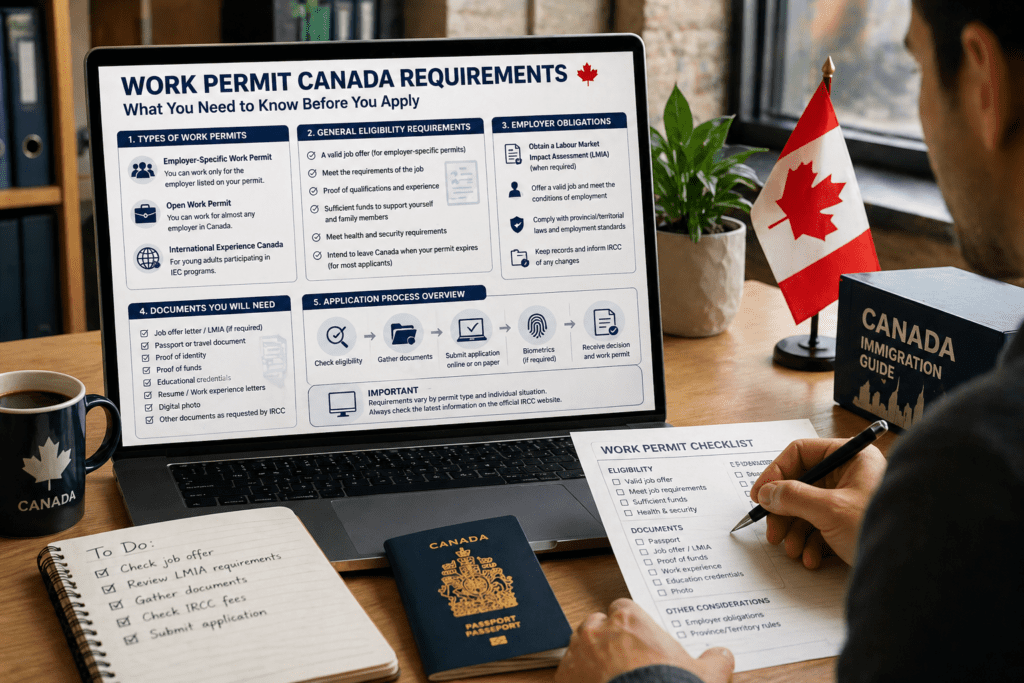
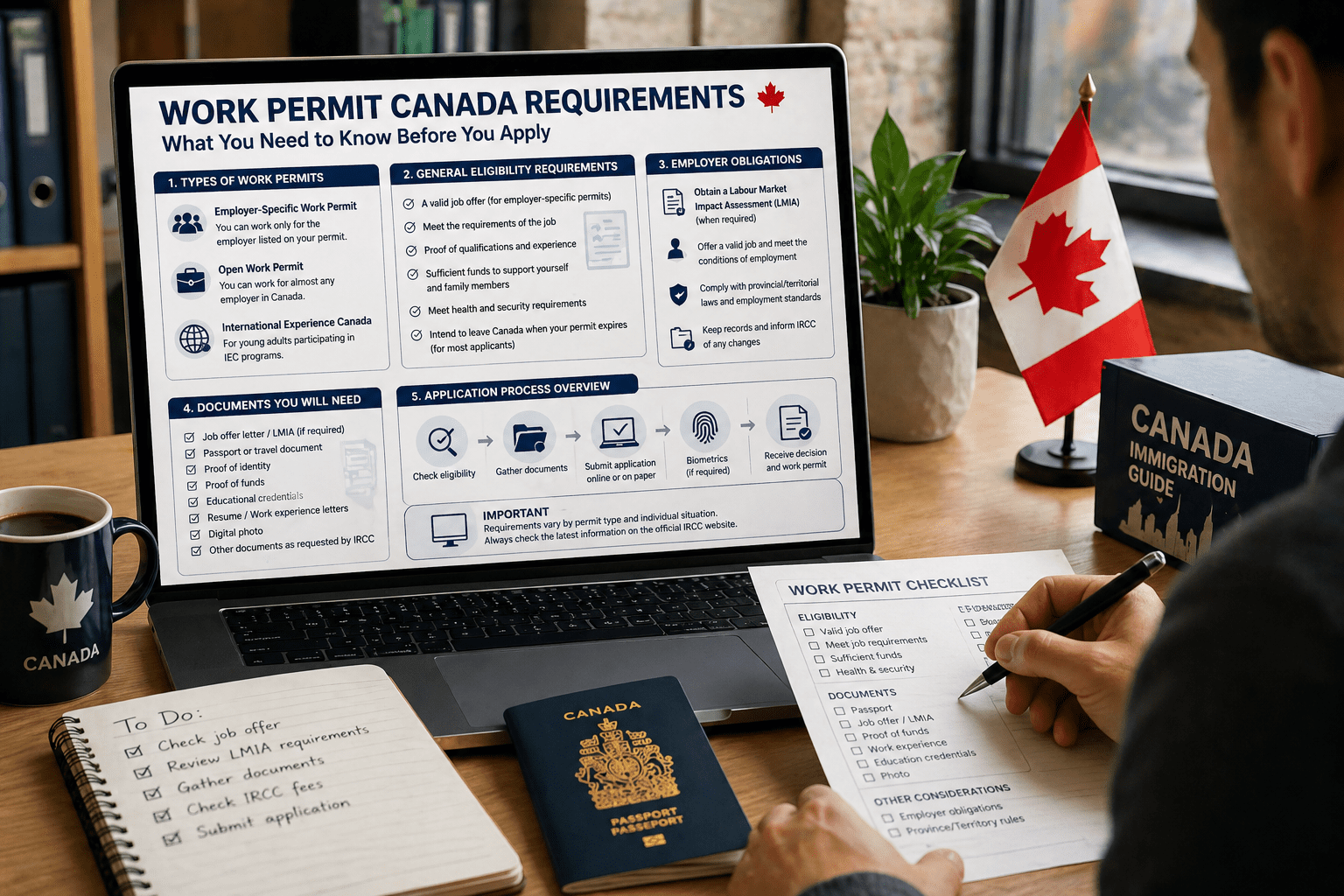
Work permit Canada requirements are more varied and more nuanced than most applicants expect. Canada issues multiple types of work permits, each with its own eligibility criteria, employer obligations, and application process. Applying for the wrong type of work permit – or applying without understanding which requirements apply to your situation – results in refusals, delays, and in some cases, unauthorized work status that affects future immigration applications.
This article covers the five most critical things every foreign national must understand about work permit Canada requirements before submitting any application.
Why Work Permit Canada Requirements Differ by Permit Type
Canada’s work permit system is not a single program. It is a framework covering two fundamentally different categories of work authorization, each with distinct work permit Canada requirements, processing pathways, and eligibility criteria.
Employer-specific work permits – also called closed work permits – authorize you to work for a specific employer in a specific location in a specific occupation. Changing employers, locations, or job duties while holding a closed work permit without authorization is a violation of your permit conditions and constitutes unauthorized work.
Open work permits authorize you to work for any employer in Canada, with some restrictions in certain categories. Open work permits are issued under specific eligibility streams – they are not available to all foreign nationals simply by request.
Understanding which category of work permit applies to your situation is the first and most important work permit Canada requirement to establish. The wrong category application will be refused regardless of how complete your documentation is.
Requirement 1 – Determine Whether You Need an LMIA or Are LMIA-Exempt
The Labour Market Impact Assessment LMIA is a document that many employer-specific work permit Canada requirements hinge on. An LMIA is an assessment conducted by Employment and Social Development Canada ESDC that confirms a Canadian employer has demonstrated a genuine need to hire a foreign worker because no qualified Canadian citizen or permanent resident is available for the position.
Most employer-specific work permits require a positive LMIA before the work permit application can be submitted. Obtaining an LMIA is the employer’s responsibility – not the worker’s – but it is a prerequisite that affects your entire application timeline. LMIA processing times vary by stream and can run from a few weeks to several months.
However, many work permit categories are LMIA-exempt. LMIA exemptions apply to workers covered by international trade agreements such as CUSMA formerly NAFTA for US and Mexican citizens, intra-company transferees, significant benefit workers including researchers and artists, and several other categories. LMIA-exempt applications are processed under the International Mobility Program and are generally faster than LMIA-based applications.
Confirming whether your work permit category requires an LMIA or qualifies for an exemption is the first practical step in any work permit Canada requirements assessment.
Requirement 2 – Meet the Occupation and Qualification Standards for Your Permit
Every work permit Canada requirements assessment includes confirming that your occupation and qualifications match what the permit category covers. This requirement applies differently depending on whether you are applying for an employer-specific or open work permit.
For employer-specific work permits: your qualifications must match the NOC code of the position your employer is offering. If the job offer is for a NOC TEER 0 or 1 occupation, IRCC expects your education and work experience to support that occupational level. A position requiring a licensed professional – engineer, nurse, teacher – also requires proof of provincial licensing or eligibility for licensing in Canada.
For open work permits: eligibility is determined by the stream rather than a specific job offer. Common open work permit streams include post-graduation work permits PGWP for international graduates of eligible Canadian institutions, spousal open work permits for spouses of certain temporary workers and students, and bridging open work permits for permanent residence applicants whose current work permit is expiring.
Each open work permit stream has its own qualification requirements. PGWP eligibility depends on the length and type of your study program. Spousal open work permits depend on your spouse’s permit category and NOC level. Bridging open work permits depend on the stage of your permanent residence application.
Requirement 3 – Provide a Valid Job Offer Letter Meeting IRCC Standards
For employer-specific work permits, a valid job offer letter is a mandatory work permit Canada requirement and one of the most commonly deficient documents in work permit applications. IRCC has specific expectations for what a job offer letter must contain, and a letter that does not meet those standards results in processing delays or refusal.
A qualifying job offer letter must include: the employer’s full legal name and business address, the job title and NOC code, the start date and whether the position is permanent or temporary, the hours of work per week, the wage offered, the work location, and a description of the main job duties. For positions that require an LMIA, the LMIA number must be referenced in the job offer letter.
The wage offered must meet or exceed the prevailing wage for the occupation in the province where the work will be performed. ESDC publishes prevailing wage data by occupation and region. An offer below the prevailing wage is a red flag that triggers additional scrutiny and may result in a negative LMIA or work permit refusal.
Requirement 4 – Meet Admissibility Standards Including Medical and Criminal Clearance
Work permit Canada requirements include federal admissibility standards that apply to all temporary resident applications. Criminal inadmissibility and medical inadmissibility can result in work permit refusal regardless of how strong the rest of your application is.
Criminal inadmissibility for work permit applicants follows the same rules as permanent residence applications. A conviction in any country for an offense equivalent to a Canadian criminal law violation may render you inadmissible. Some criminal inadmissibility can be overcome through a Temporary Resident Permit TRP or Criminal Rehabilitation, but these are separate processes.
Medical examinations are required for work permit applicants in specific circumstances: if you are applying for a work permit valid for six months or longer in certain occupations – particularly healthcare, childcare, and other sectors involving vulnerable populations – or if you are from a country designated by IRCC as requiring medical examination regardless of occupation.
If a medical examination is required, it must be completed by an IRCC-designated panel physician. The medical results are submitted directly to IRCC by the physician and do not need to be included in your work permit application package.
Requirement 5 – Demonstrate Temporary Intent if Applying From Outside Canada
The final work permit Canada requirement that catches many applicants by surprise applies specifically to those applying from outside Canada at a visa office or port of entry: demonstrating that you intend to leave Canada when your authorized stay ends.
Canada’s temporary resident framework requires applicants to demonstrate that they have sufficient ties to their home country – employment, family, property, financial obligations – that make it credible they will return when their work permit expires. Applicants who cannot demonstrate genuine temporary intent are refused on the grounds that they are likely to overstay.
This requirement is assessed differently by different visa offices and ports of entry. Applicants from countries with higher visa overstay rates face more scrutiny. Strong ties that support temporary intent include a stable employment history in your home country, property ownership, immediate family members remaining at home, and a clear explanation of why you are seeking temporary work in Canada rather than pursuing permanent residence.
For workers who are using a Canadian work permit as a stepping stone to permanent residence through CEC or Express Entry, the express entry eligibility guide explains how Canadian work experience gained on a work permit feeds into your permanent residence eligibility. If you want a pre-submission review of your work permit application package before submitting to IRCC, the DIY Document Review service provides a structured assessment against IRCC’s actual review criteria.
FAQ
What are the basic work permit Canada requirements for a closed work permit? The core work permit Canada requirements for an employer-specific closed work permit include: a valid job offer from a Canadian employer, a positive LMIA or confirmation of an LMIA exemption, qualifications matching the NOC code of the offered position, admissibility with no criminal or medical bars, and demonstrated temporary intent if applying from outside Canada.
Can I apply for a work permit Canada without a job offer? Yes, through open work permit streams. Open work permits are available to international graduates through the Post-Graduation Work Permit program, spouses of certain temporary workers and international students, and permanent residence applicants holding bridging open work permits. Each stream has its own eligibility criteria independent of a specific job offer.
How long does work permit Canada processing take? Processing times vary significantly by permit type and application method. Online applications for LMIA-exempt employer-specific permits through the International Mobility Program typically process in two to eight weeks. LMIA-based applications add LMIA processing time on top of work permit processing, which can extend the total timeline to several months. Check IRCC’s current processing time tool for your specific permit type.
Do work permit Canada requirements include language testing? Language testing is not a universal work permit Canada requirement. It is required for some specific open work permit streams – including certain bridging open work permits linked to Express Entry – and may be required for occupations where language proficiency is a licensing or regulatory requirement. Most employer-specific work permit applications do not require a formal language test.
Can I change employers while holding a work permit in Canada? If you hold an employer-specific closed work permit, changing employers without authorization violates your permit conditions and constitutes unauthorized work. You must apply for a new work permit before starting work with a new employer. Open work permit holders can change employers freely within the conditions of their permit.
Final Thoughts
Work permit Canada requirements are permit-type specific and situation-dependent. The five requirements covered in this article – LMIA status, occupation and qualification match, job offer letter standards, admissibility clearance, and temporary intent – apply across the most common work permit categories, but the specifics vary by your situation, your country of citizenship, and the type of permit you are applying for.
The most common work permit Canada failures are not eligibility failures. They are documentation failures – a job offer letter missing required fields, an LMIA number not referenced correctly, a medical examination completed by a non-designated physician, or a temporary intent statement that does not address the officer’s likely concerns.
Prepare your work permit Canada application as a complete package before submitting. Verify every document against IRCC’s specific requirements for your permit type. The work permit Canada requirements are clear – the documentation must match them precisely.
This article is for educational purposes only and does not constitute legal or immigration advice. For guidance specific to your situation, consult a licensed RCIC or immigration lawyer.
