
Table of Contents
The post graduate work permit is one of the most valuable immigration benefits available to international students in Canada – and one of the most easily lost through avoidable mistakes. A PGWP gives eligible graduates the right to work for any employer in Canada for up to three years, providing the Canadian work experience that feeds directly into Express Entry eligibility under the Canadian Experience Class. But PGWP eligibility is not automatic. It depends on your institution, your program length, your study permit history, and how quickly you apply after graduation.
This article covers the five most critical PGWP rules every international student must understand before and after graduation.
Why the Post Graduate Work Permit Is So Valuable
The post graduate work permit sits at the intersection of Canada’s international education system and its permanent residence pathways. Unlike employer-specific work permits, a PGWP gives you open work authorization – you can work for any employer in any occupation without being tied to a specific job offer.
More importantly, work experience gained on a PGWP in an eligible NOC TEER 0, 1, 2, or 3 occupation counts directly toward Canadian Experience Class CEC eligibility under Express Entry. One year of Canadian skilled work experience on a PGWP is sufficient to meet the CEC minimum work experience requirement, making the PGWP the most common bridge between international study and permanent residence in Canada.
For a full breakdown of how CEC eligibility works and how PGWP work experience feeds into your Express Entry profile, the express entry eligibility guide covers every requirement in detail.
Rule 1 – Your Institution Must Be a Designated Learning Institution That Issues Degrees or Diplomas
The first and most critical post graduate work permit rule is institution eligibility. Not every school in Canada produces PGWP-eligible graduates. Your institution must be a Designated Learning Institution DLI that is authorized to issue degrees, diplomas, or certificates that qualify for PGWP purposes.
Public post-secondary institutions – universities, colleges, and institutes of technology – are generally PGWP-eligible. Private institutions must be specifically authorized by their province to issue degrees and must appear on IRCC’s list of PGWP-eligible institutions. Language schools, short-term private career colleges, and most online-only programs do not qualify.
Before enrolling in any program with the intention of using it as a PGWP pathway, verify the institution’s PGWP eligibility directly on IRCC’s designated learning institution list. Enrollment deposits and tuition fees are not recoverable if you discover after starting your program that your institution or program does not qualify.
Rule 2 – Program Length Determines PGWP Duration
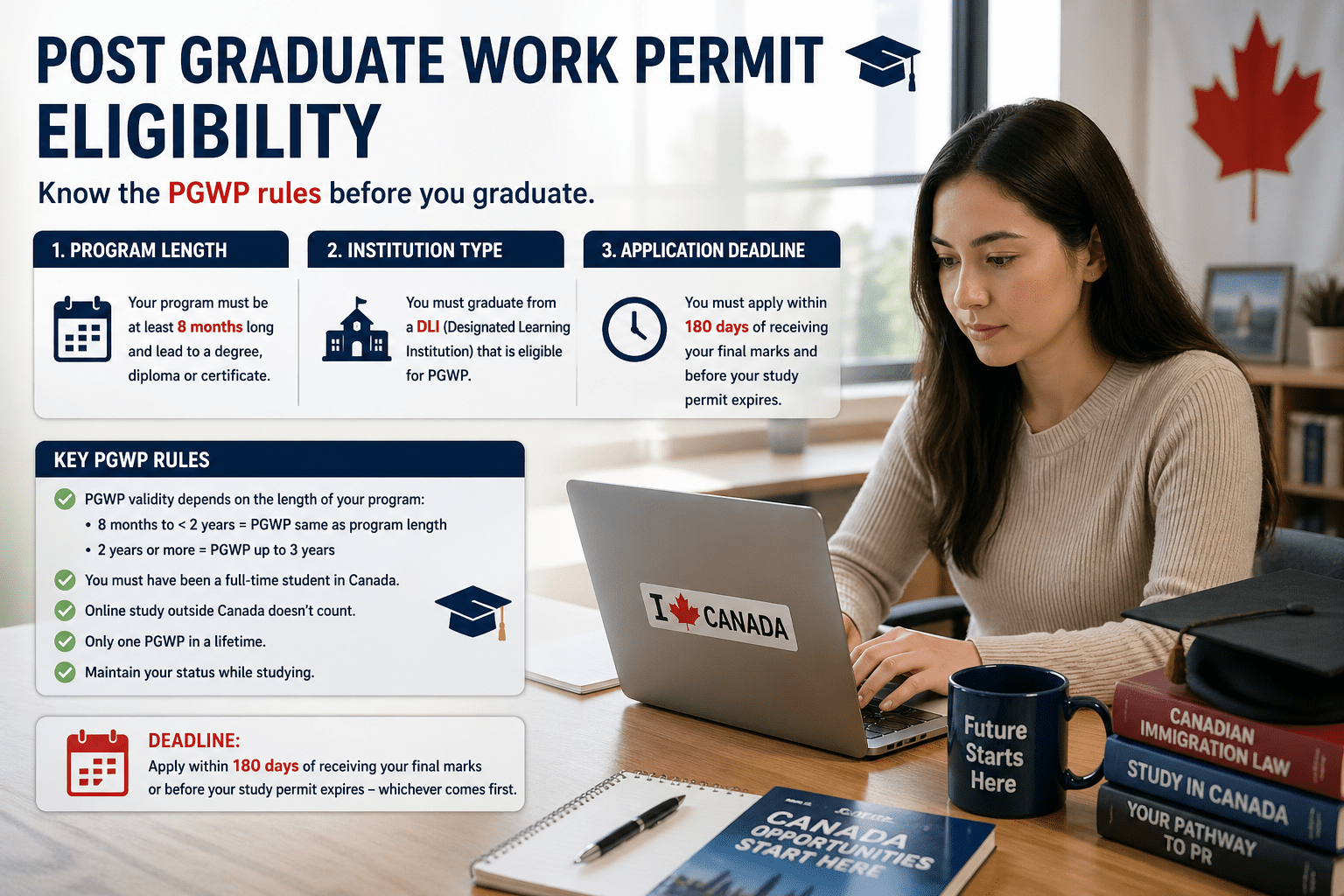
Post graduate work permit duration is tied directly to the length of your completed study program – not to your total time in Canada as a student. The rules are as follows.
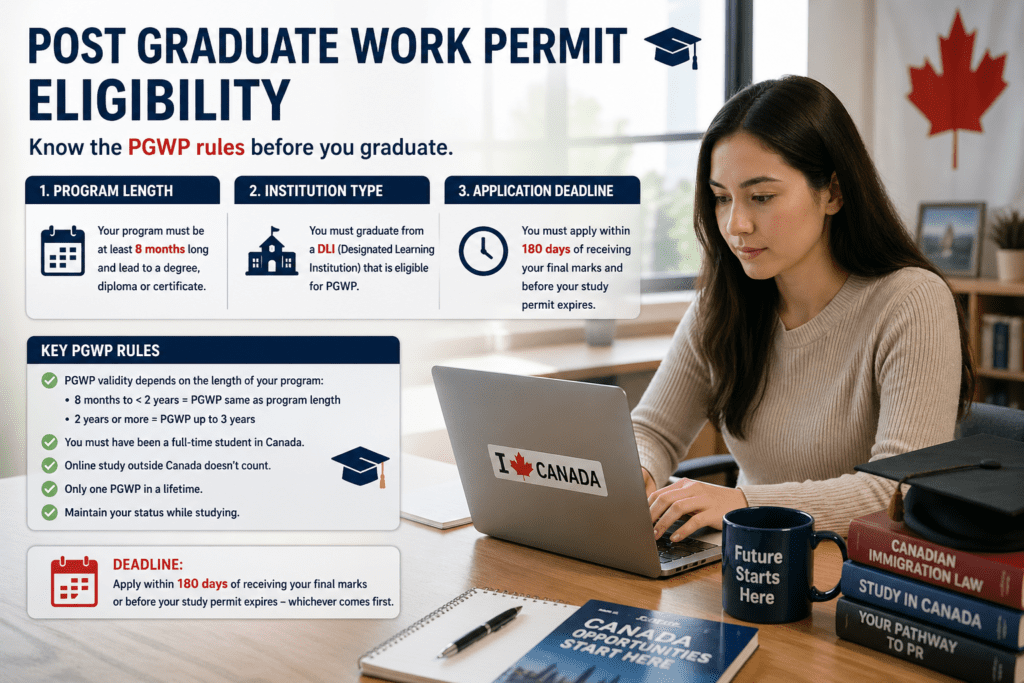
Programs of less than eight months do not qualify for a PGWP. Programs of eight months to two years produce a PGWP of the same length as the program – a one-year program produces a one-year PGWP, a two-year program produces a two-year PGWP. Programs of two years or longer produce a PGWP of three years, which is the maximum duration available.
If you completed multiple programs at eligible institutions, the combined program length may qualify you for a longer PGWP than any single program would on its own – but only if the programs were completed consecutively without a significant gap and each program was at least eight months long. The rules for combining programs are specific and should be verified against current IRCC guidelines before relying on this calculation.
Rule 3 – You Must Have Held a Valid Study Permit Throughout Your Studies
A valid study permit for the duration of your studies is a mandatory post graduate work permit requirement. Applicants who allowed their study permit to expire and continued studying without authorization – even briefly – may be ineligible for a PGWP.
Study permit renewals must be submitted before the current permit expires. If your study permit expired and you submitted a renewal application before expiry, you are covered under maintained status and this does not affect PGWP eligibility. However, if your permit expired and you did not have a renewal application pending, you may have a gap in authorized study status that creates a PGWP eligibility issue.
If you transitioned between programs or institutions during your studies, ensure your study permit was updated to reflect the change. A study permit issued for Institution A does not automatically authorize study at Institution B, even if both are PGWP-eligible.
Rule 4 – Apply Within 180 Days of Receiving Proof of Graduation
The post graduate work permit application deadline is one of the most frequently missed and most consequential rules. You must apply for your PGWP within 180 days of receiving written confirmation of graduation – your official transcript, degree certificate, or a letter from your institution confirming completion.
The 180-day clock starts from the date you receive the written confirmation – not from your graduation ceremony date, not from when your grades were posted, and not from when you submitted your final exam. The written confirmation document is the trigger.
Missing the 180-day deadline means losing PGWP eligibility permanently. There are no extensions, no exceptions for extenuating circumstances, and no appeals process. Once the window closes, it is closed. Set a calendar reminder the day you receive your graduation confirmation and submit your PGWP application well before the deadline.
You can apply for your PGWP from inside or outside Canada within the 180-day window. Applying from outside Canada means you will receive a single-entry or multiple-entry visa along with your PGWP authorization letter, which you present at the port of entry to receive your work permit.
Rule 5 – A PGWP Can Only Be Issued Once Per Graduate
The final critical post graduate work permit rule is the one-time issuance rule. A PGWP is issued once per person, for one program of study. You cannot obtain a second PGWP by completing a second Canadian degree or diploma after your first PGWP expires.
This rule has significant implications for career planning. If you complete a two-year college diploma and receive a two-year PGWP, returning to Canada for a Master’s degree will not produce a second PGWP. Your PGWP is a one-time benefit tied to your first qualifying program.
Given this constraint, maximizing your PGWP duration from your initial program is strategically important. A program of two years or longer produces the maximum three-year PGWP. Three years of open work authorization gives you substantial time to accumulate Canadian work experience, reach CEC eligibility, and submit a competitive Express Entry profile for permanent residence.
For workers planning the transition from PGWP to permanent residence, the open work permit Canada guide covers how PGWP fits within the broader open work permit framework. If you want a pre-submission review of your PGWP application documents before submitting to IRCC, the DIY Document Review service provides a structured assessment against IRCC’s actual review criteria.
FAQ
What is the post graduate work permit and who qualifies?
The post graduate work permit is an open work permit issued to eligible graduates of designated learning institutions in Canada. Qualifying graduates must have completed a program of at least eight months at an eligible institution, held a valid study permit throughout their studies, and applied within 180 days of receiving written confirmation of graduation.
How long is a post graduate work permit valid for?
Post graduate work permit duration matches the length of your completed study program, up to a maximum of three years. Programs of eight months to two years produce a PGWP of equal duration. Programs of two years or longer produce the maximum three-year PGWP.
Can I work for any employer on a post graduate work permit?
Yes. A post graduate work permit is an open work permit, meaning you can work for any eligible employer in Canada in any occupation without being tied to a specific job offer. This flexibility is one of the PGWP’s most significant advantages over employer-specific work permits.
What happens if I miss the 180-day post graduate work permit application deadline?
Missing the 180-day deadline after receiving written confirmation of graduation results in permanent loss of PGWP eligibility. There are no extensions or exceptions. If the deadline is missed, you must pursue another work permit stream or leave Canada.
Does a post graduate work permit lead to permanent residence?
A PGWP does not lead directly to permanent residence, but it enables the Canadian work experience needed to qualify for Express Entry under the Canadian Experience Class. One year of skilled Canadian work experience on a PGWP in a NOC TEER 0, 1, 2, or 3 occupation meets the CEC minimum work experience requirement.
Final Thoughts
The post graduate work permit is not a guaranteed benefit of graduating in Canada. It is an eligibility-based authorization that depends on your institution, your program, your study permit history, and your application timing.
The five rules in this article cover the most critical post graduate work permit requirements. Institution eligibility cannot be assumed – verify it before enrolling. Program length determines your PGWP duration – maximize it from your initial program selection. Study permit validity must be maintained throughout your studies without gaps. The 180-day application deadline is absolute. And the one-time issuance rule means your first PGWP is your only one.
Plan your post graduate work permit strategy from the moment you choose your Canadian study program, not after you graduate. The decisions you make during enrollment directly determine the work authorization you receive after graduation.
This article is for educational purposes only and does not constitute legal or immigration advice. For guidance specific to your situation, consult a licensed RCIC or immigration lawyer.
