
Table of Contents
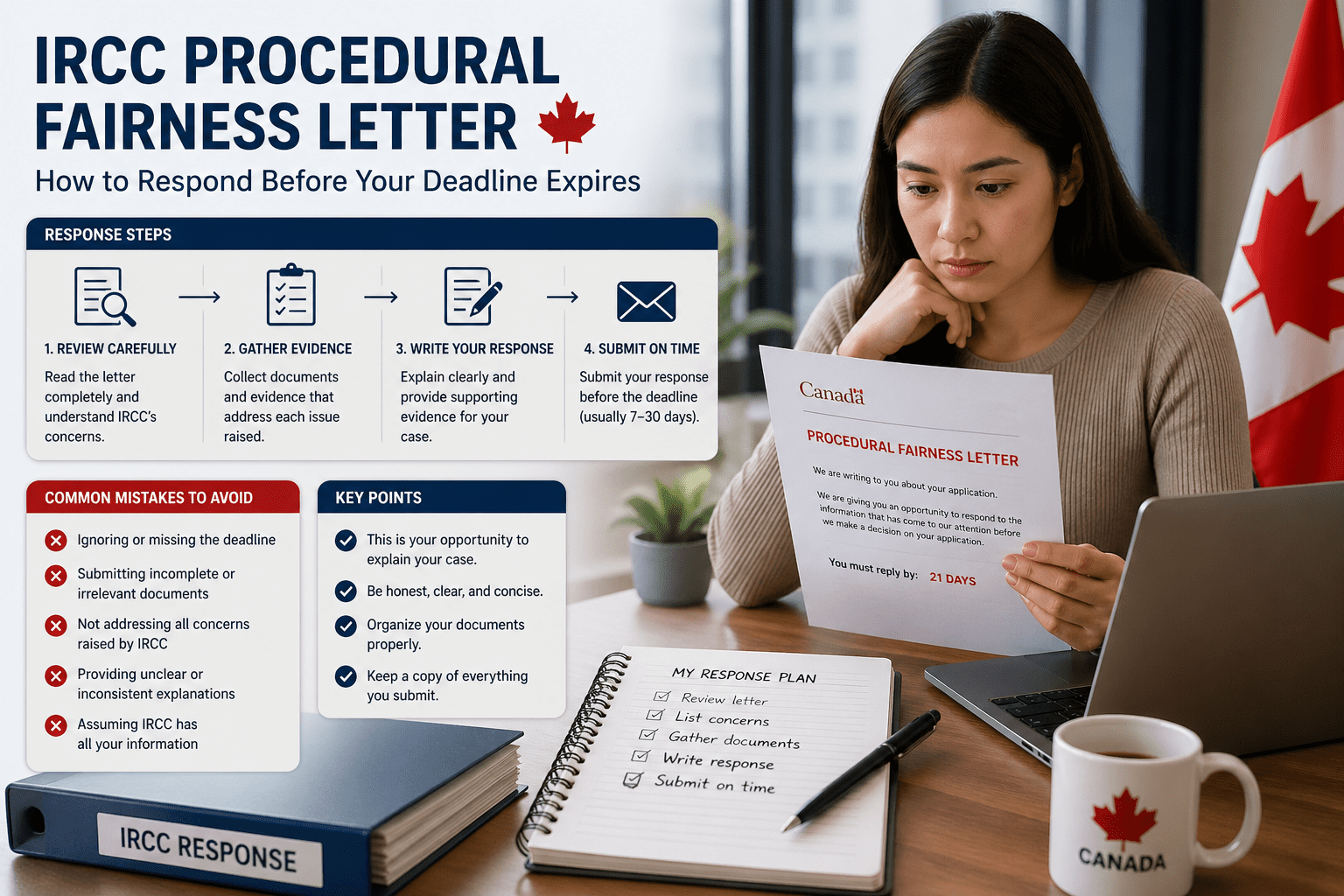
An IRCC procedural fairness letter is one of the most consequential documents you can receive during a Canadian immigration application. It means the officer reviewing your application has identified concerns serious enough that they are required by law to give you an opportunity to respond before making a final decision. This is not a refusal. It is a warning – and a time-limited opportunity to prevent a refusal.
Most applicants who receive an ircc procedural fairness letter panic. The most effective response is the opposite: read carefully, understand precisely what the officer is asking, and respond specifically and completely before the deadline.
What an IRCC Procedural Fairness Letter Actually Means
The ircc procedural fairness letter is issued when an officer has concerns that could lead to a negative decision and is legally required to give you notice before acting. The duty of procedural fairness is a legal obligation under Canadian administrative law – officers cannot refuse an application based on concerns the applicant had no opportunity to address.
Receiving an ircc procedural fairness letter does not mean your application will be refused. It means there is a specific concern that needs to be addressed. Applicants who respond completely and compellingly to the officer’s concerns can and do receive positive decisions after receiving these letters. Applicants who miss the deadline, respond incompletely, or fail to understand what the officer is actually asking almost always receive refusals.
For context on why immigration applications attract officer scrutiny and what document quality issues lead to concerns, the article on why immigration applications get refused covers the systematic patterns that officers identify during review.
Step 1 – Read the Letter Multiple Times and Identify Every Specific Concern
The first and most important step after receiving an ircc procedural fairness letter is to read it carefully – more than once – and extract every specific concern the officer has identified. Officers are required to be specific about their concerns. The letter will identify what information or evidence they find insufficient, inconsistent, or problematic.
Common concerns raised in an ircc procedural fairness letter include: doubt about the genuineness of a relationship in spousal or family class applications, concern about the authenticity or accuracy of employment documents or reference letters, questions about the source or ownership of declared funds, doubt about the applicant’s intent to leave Canada after a temporary resident application, or a finding that a material fact was misrepresented.
Make a list of every distinct concern raised. Each concern requires its own specific response. A general response that does not address the officer’s specific questions will be treated as an inadequate response and the refusal will follow.
Step 2 – Note the Response Deadline and Work Backward
The ircc procedural fairness letter specifies a response deadline. This deadline is absolute. IRCC does not grant extensions except in extraordinary circumstances, and requests for extension are rarely successful. If you miss the deadline, the officer will make their decision based on the information available – which means the concerns they raised will go unaddressed and the application will almost certainly be refused.
The response deadline is typically 30 days from the date of the letter for applications outside Canada, and sometimes shorter for applications inside Canada. Some letters give as little as 14 days. Check the specific deadline in your letter and calculate backward from that date to determine how much time you have for each stage of your response preparation.
If legal representation is not already involved in your application, the ircc procedural fairness letter deadline may not leave enough time to engage a lawyer and have them prepare a complete response. In that case, focus on preparing the strongest factual response you can with the evidence available, and consider whether legal assistance can at least provide a review of your draft response before submission.
Step 3 – Gather Evidence That Directly Addresses Each Specific Concern
Each concern in the ircc procedural fairness letter requires specific evidence – not general reassurances. If the officer questions the authenticity of your employment, you need employment records, pay stubs, tax documents, and a detailed reference letter that confirms your duties against the NOC description. If the officer questions your proof of funds, you need complete bank statements, a current bank letter, and source of funds documentation for any large deposits.
The evidence you provide must be more than what was in your original application – if it had been sufficient, the letter would not have been issued. You are not re-submitting your original documents. You are providing additional or stronger evidence that resolves the specific concern the officer identified.
If the concern involves an inconsistency between documents – your reference letter describes different duties than your tax records suggest, or your travel history does not align with your stated employment dates – you must address the inconsistency directly with an explanation and supporting evidence. Ignoring an inconsistency and providing additional documents that do not address it will not resolve the officer’s concern.
Step 4 – Write a Clear, Specific, and Evidence-Referenced Response Letter
Your response to an ircc procedural fairness letter must include a written response letter that addresses each concern explicitly, references the supporting evidence you are providing, and explains clearly why that evidence resolves the officer’s concern. The letter should be organized to mirror the concerns raised – address them one by one, not in a general narrative.
The tone of the response letter should be factual and professional. Do not argue with the officer’s assessment or express frustration. Focus entirely on providing facts, evidence, and explanations that address the specific concerns. Officers are not evaluating your feelings about the situation – they are evaluating whether you have provided sufficient evidence to resolve their concerns.
Every claim in your response letter must be supported by the evidence you are attaching. Do not include claims you cannot document. An unsupported assertion is not evidence – it is a statement of position that the officer is not required to accept.
Step 5 – Submit Before the Deadline and Confirm Receipt
Submit your ircc procedural fairness letter response through the same channel specified in the letter – typically your IRCC online account or by email to the case processing centre that issued the letter. Do not submit by mail if an electronic submission method is available, as mail can be delayed and the deadline is based on receipt, not postmark.
After submitting, obtain confirmation of receipt. If submitting through your IRCC online account, save the submission confirmation. If submitting by email, request a read receipt or delivery confirmation. Keep a complete copy of everything you submitted – the response letter, every supporting document, and the submission confirmation – in case there are questions about your submission later.
If you want a review of your ircc procedural fairness letter response before submission to ensure it addresses the officer’s concerns completely and is supported by appropriate evidence, the DIY Document Review service provides a structured assessment of your response package before it reaches IRCC.
FAQ
What is an IRCC procedural fairness letter and what does it mean?
An ircc procedural fairness letter is a formal notice from an IRCC officer that they have concerns about your application serious enough to potentially lead to a negative decision. Canadian administrative law requires officers to give applicants an opportunity to respond to such concerns before making a final decision. Receiving this letter does not mean your application will be refused – it means you have an opportunity to address the officer’s concerns before a decision is made.
How long do I have to respond to an IRCC procedural fairness letter?
The response deadline is specified in the ircc procedural fairness letter itself. Deadlines are typically 14 to 30 days from the date of the letter. The deadline is absolute – IRCC rarely grants extensions. Calculate your available time immediately upon receiving the letter and begin preparing your response without delay.
What happens if I miss the IRCC procedural fairness letter deadline?
If you miss the response deadline, the officer will make their decision based on the information available. Since the concerns raised in the ircc procedural fairness letter will have gone unaddressed, the decision will almost certainly be a refusal. Missing the deadline effectively forfeits your opportunity to prevent the refusal.
Do I need a lawyer to respond to an IRCC procedural fairness letter?
Legal representation is not mandatory for responding to an ircc procedural fairness letter, but it is strongly advisable for complex concerns – particularly misrepresentation findings or admissibility issues. For concerns about document sufficiency or minor inconsistencies, a well-prepared factual response with strong supporting evidence can be effective without legal representation.
Can an IRCC procedural fairness letter result in a positive decision?
Yes. Applicants who respond completely and compellingly to the officer’s concerns regularly receive positive decisions after an ircc procedural fairness letter. The letter is not a predetermined path to refusal – it is a legal requirement to give you notice and an opportunity to be heard. The quality and completeness of your response determines the outcome.
Final Thoughts
An ircc procedural fairness letter is the most important document you will receive during an immigration application after the application itself. It identifies exactly what is standing between you and a positive decision. That specificity is valuable – it tells you precisely what you need to address.
The five steps in this article are not complicated. Read the letter carefully. Note the deadline. Gather specific evidence for each concern. Write a clear, evidence-referenced response. Submit before the deadline and confirm receipt.
An ircc procedural fairness letter is a second chance. Most applicants who receive one and respond effectively receive the decision they were hoping for. Most applicants who miss the deadline or respond incompletely do not. The difference is preparation.
This article is for educational purposes only and does not constitute legal or immigration advice. For guidance specific to your situation, consult a licensed RCIC or immigration lawyer.
