
Table of Contents
Your noc code canada selection is one of the most consequential decisions in your Express Entry application. The National Occupational Classification code you claim determines which Express Entry program you qualify for, how many CRS points you receive for work experience, and whether your reference letters will withstand officer scrutiny during application review. A NOC code that accurately reflects your actual job duties supports your entire application. A NOC code selected to maximize CRS points without matching your actual duties is misrepresentation – and IRCC officers are specifically trained to identify the gap between claimed NOC codes and the evidence provided.
This article covers the five critical steps for finding the right noc code canada for your Express Entry application.
What the NOC System Is and Why It Matters for Express Entry
The National Occupational Classification NOC is Canada’s standardized system for describing and organizing occupations. Every job in Canada is classified under a specific NOC code based on the duties performed, the skills required, and the level of training and education typically associated with the role.
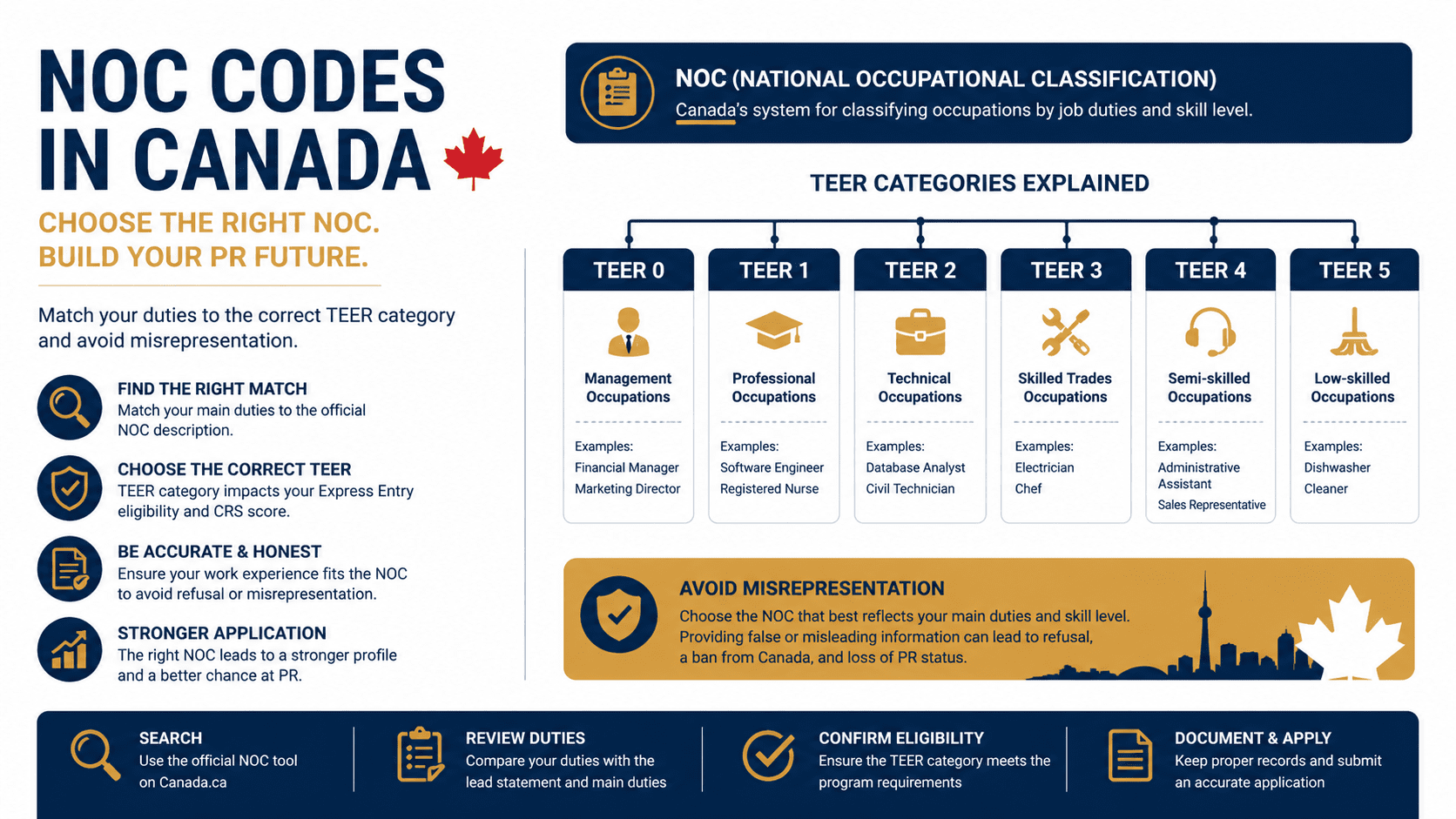
For Express Entry, your noc code canada determines two critical eligibility factors. First, it determines which program you qualify for – FSWP and CEC require work experience in NOC TEER 0, 1, 2, or 3 occupations, and FSTP requires experience in specific NOC TEER 2 or 3 trade occupations. Second, it affects your CRS score calculation through the skill transferability factors that reward certain combinations of education, language, and work experience in specific NOC TEER categories.
The NOC was restructured in 2022 with the introduction of the TEER Training, Education, Experience and Responsibilities system, which replaced the previous skill level categories. If you are using NOC research from before 2022, verify that the codes and categories you are referencing still apply under the current TEER system.
Step 1 – Start With the Lead Statement, Not the Job Title
The most common noc code canada selection mistake is matching by job title rather than by job duties. Job titles vary enormously across industries, companies, and countries – the same title can describe very different actual work depending on the context. IRCC does not assess your title. It assesses whether your actual duties match the NOC description.
Every NOC code in the Canadian system has a lead statement – a one-sentence summary of what workers in that occupation do. The lead statement is the first filter for any noc code canada search. If the lead statement does not accurately describe what you do at work, that NOC code is not the right match regardless of how closely the title matches.
Start your NOC search by describing what you actually do in your job in plain language, then look for the lead statement that best captures that description. Do not start with your job title and search for an NOC that sounds similar – start with your duties and find the lead statement that describes them.
Step 2 – Verify Against the Main Duties List
After identifying candidate NOC codes based on lead statements, the second step in noc code canada selection is verifying your actual duties against the main duties list in the NOC description. The main duties list describes the specific tasks that workers in the occupation typically perform.
Your reference letters – the employment documentation that will accompany your Express Entry application – must explicitly confirm that you performed duties consistent with the NOC main duties list. Officers reviewing your application compare your reference letters against the NOC description. A reference letter that describes general job responsibilities without referencing the specific duties in the NOC main duties list is a common ground for work experience refusal.
A practical rule: you should be able to identify at least three to five main duties from the NOC description that accurately describe work you performed regularly. If you can only identify one or two, or if the main duties list describes work you only performed occasionally, the NOC code may not be the right match.
Step 3 – Confirm the TEER Level and Express Entry Eligibility
Once you have identified a noc code canada that matches your lead statement and main duties, confirm the TEER level of that code. The TEER level determines your Express Entry program eligibility and your CRS score factors.
TEER 0 covers most management and senior leadership occupations. TEER 1 covers occupations that typically require a university degree. TEER 2 covers occupations that typically require a college diploma, apprenticeship training, or significant on-the-job training. TEER 3 covers occupations that typically require secondary school and short-duration occupation-specific training. TEER 4 and 5 cover lower-skilled occupations that do not qualify for FSWP or CEC eligibility.
For Express Entry eligibility under FSWP and CEC, your noc code canada must be in TEER 0, 1, 2, or 3. If your occupation falls in TEER 4 or 5, you do not meet the work experience requirement for these programs under that occupation. You may still qualify if you have other work experience in TEER 0 through 3 occupations from previous positions.
Step 4 – Address Multi-Role and Complex Job Situations
Many professionals perform duties that span multiple NOC codes. A project manager who also does significant technical work, a business analyst who also manages a team, or a healthcare professional who also performs administrative duties – all of these situations require careful noc code canada analysis to determine the best single code for Express Entry purposes.
Express Entry requires you to claim a primary NOC code for each period of work experience. For roles that span multiple NOC codes, choose the code whose lead statement and main duties most closely reflect the dominant focus of your role – the duties you spent the most time on and that were most central to your position. Secondary duties that fall under a different NOC code do not disqualify you from claiming the primary code, as long as the primary code’s main duties genuinely describe your role.
In complex situations, the reference letter from your employer becomes particularly important. It should describe your actual duties in enough detail that an officer can see the connection to the claimed NOC code – even if some of what you did could theoretically fall under a different code.
Step 5 – Ensure Your Reference Letters Support the Claimed NOC
The final and most practically important step in noc code canada selection is ensuring that your reference letters explicitly support the code you are claiming. This is where many Express Entry applications fail – the applicant correctly identifies the right NOC code but the reference letter does not provide sufficient evidence to connect the actual work performed to that code’s description.
A strong reference letter for noc code canada purposes includes: your exact start and end dates of employment, your hours of work per week, your job title and NOC code explicitly stated, your annual or hourly compensation, and a description of your main duties that mirrors the language in the NOC main duties list without being a word-for-word copy.
Letters on company letterhead signed by a direct supervisor or HR representative carry more weight than generic employment confirmation letters. If your employer is no longer operating, you can substitute a statutory declaration or sworn affidavit, but this requires additional explanation and carries more risk of scrutiny.
For a complete overview of how to build and optimize your Express Entry profile once your NOC selection is confirmed, the express entry profile guide covers every step of the profile creation process. For a full overview of Express Entry eligibility requirements including work experience standards, the express entry eligibility guide covers all five program requirements in detail.
If you want a pre-submission review of your work experience documentation and NOC code alignment before submitting your Express Entry application, the DIY Document Review service provides a structured assessment against IRCC’s actual review criteria.
FAQ
What is a NOC code Canada and why does it matter for Express Entry?
A noc code canada is a standardized classification code from the National Occupational Classification system that categorizes your occupation based on the duties you perform. For Express Entry, your NOC code determines which program you qualify for, how your work experience contributes to your CRS score, and whether your reference letters will support your eligibility claim during application review.
How do I find the right NOC code Canada for my job?
Start with the lead statement in the NOC system – a one-sentence description of what workers in the occupation do – rather than matching by job title. Find the lead statement that best describes your actual duties, then verify against the main duties list. Your reference letters must explicitly confirm duties consistent with the main duties list of your claimed NOC code.
What happens if I claim the wrong NOC code Canada on my Express Entry application?
Claiming a noc code canada that does not match your actual duties is misrepresentation – a serious immigration offense that can result in application refusal and a five-year ban from Canadian immigration applications. IRCC officers compare your reference letters against the NOC description and will identify discrepancies between what you claimed and what your employer documented.
Can I claim multiple NOC codes Canada for different jobs in my work history?
Yes. You can claim different noc code canada codes for different positions in your work history. Each position in your Express Entry profile requires a separate NOC code that accurately reflects the duties of that specific role. You can also claim the same NOC code for multiple positions if the roles were in the same occupational category.
What is the difference between TEER levels in the NOC code Canada system?
TEER Training, Education, Experience and Responsibilities levels in the noc code canada system range from TEER 0 for management occupations to TEER 5 for low-skill occupations. For Express Entry eligibility under FSWP and CEC, your work experience must be in TEER 0, 1, 2, or 3 occupations. TEER 4 and 5 occupations do not qualify for these programs.
Final Thoughts
Your noc code canada selection is not a technicality – it is the foundation of your work experience claim in the Express Entry system. Every other element of your application, from your reference letters to your CRS score calculation to your program eligibility, connects back to the accuracy of your NOC code selection.
The five steps in this article – start with the lead statement, verify against main duties, confirm TEER level, address complex roles, and ensure reference letter alignment – give you a systematic framework for making the right noc code canada selection. Use them in order, and verify your selection against the actual NOC description before you enter it in your Express Entry profile.
An accurate noc code canada is not a limitation. It is the evidence base for your entire work experience claim. Get it right, document it thoroughly, and it becomes one of the strongest foundations in your application.
This article is for educational purposes only and does not constitute legal or immigration advice. For guidance specific to your situation, consult a licensed RCIC or immigration lawyer.
