
Table of Contents
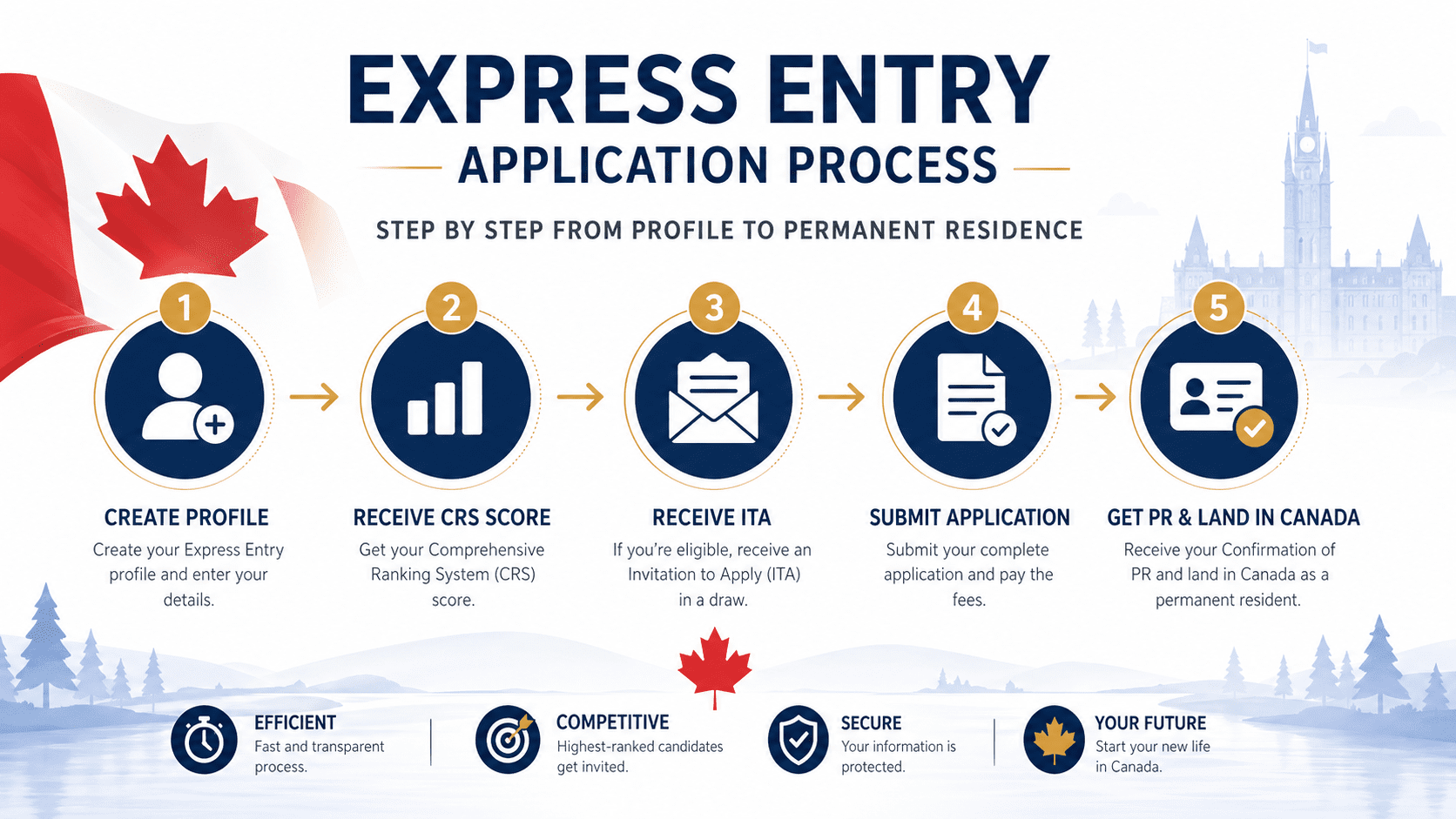
The express entry application process is not a single event – it is a multi-stage system where each stage has its own requirements, timelines, and potential failure points. Many DIY applicants understand individual stages in isolation but do not have a clear picture of how the stages connect, what triggers each transition, and what actions are required at each point. This article maps the complete express entry application process from your first profile submission to your landing as a permanent resident, with specific attention to what applicants must do and what mistakes to avoid at each stage.
Stage 1 – Building and Submitting Your Express Entry Profile
The express entry application process begins with the creation and submission of your profile in IRCC’s Express Entry system. Your profile is not an application for permanent residence – it is a declaration of your qualifications that IRCC uses to calculate your CRS score and enter you into the pool of candidates being considered for ITAs.
Before submitting your profile, ensure all mandatory pre-application steps are complete: language test results are available and current, ECA is complete if required for FSWP, and proof of funds figures are accurate and documented. Entering placeholder or estimated information in your profile to get it submitted faster is a mistake that creates inconsistencies between your profile and your eventual application documents.
For the complete profile creation and optimization guide including CRS score verification, the express entry profile guide covers every step in detail.
Stage 2 – Waiting in the Pool and Managing Your Profile
After profile submission, the express entry application process enters the pool management stage. Your profile is ranked by CRS score alongside other candidates. IRCC conducts draws regularly and issues ITAs to candidates above the cutoff score for that draw.
Active pool management means monitoring draw results and your own CRS score relative to recent cutoffs. If your score is below recent cutoffs, identify and implement improvement strategies – language retesting, spousal factor addition, or provincial nomination pursuit – while your profile is active. A profile that sits in the pool for 12 months without score improvement activity is a missed optimization opportunity.
Your profile expires after 12 months. If you do not receive an ITA within 12 months, you must resubmit. Resubmission resets your entry date but recalculates your CRS score based on your current qualifications – which may be higher or lower than your original score depending on what has changed.
Stage 3 – Responding to Your ITA and Gathering Documents
Receiving an ITA is the critical transition point in the express entry application process. You have 60 days from the ITA issuance date to submit a complete application. This deadline is fixed. The 60-day window is where most express entry application process failures occur – not because applicants lack the qualifications, but because they run out of time to gather complete, current documentation.
Initiate the time-consuming documents immediately upon receiving your ITA. Police certificates from countries with longer processing times should be requested the same day you receive your ITA. Medical examination appointments should be booked within the first week. Reference letters should be requested from employers with enough lead time for HR departments to respond. Documents that can be prepared immediately – bank letters, translated documents, civil status certificates – should be completed in parallel.
For the complete list of all required documents organized by category, the express entry requirements guide covers every document required for each Express Entry program.
Stage 4 – Submitting Your Complete Application
The application submission stage of the express entry application process is where document quality determines outcomes. IRCC officers review every document in your package against program-specific standards. The portal does not prevent you from submitting an application with deficient documents – it only checks for presence, not quality.
Before submitting, cross-check your application package as a whole. Employment dates in your reference letters must match your declared work history. Bank statement balances must support the proof of funds amount you declared. Names and dates of birth across all identity documents must match your passport exactly. Language test CLB scores must match what was entered in your profile. Every document must tell the same story as every other document.
A pre-submission review by a document assessment service that understands IRCC’s officer review standards is the most effective final check before submission. The DIY Document Review service provides exactly this structured assessment of your complete package against IRCC’s criteria before you submit.
Stage 5 – IRCC Processing and Landing Preparation
After submission, the express entry application process moves into IRCC’s processing stage. Current processing time is approximately six months from complete application submission to a final decision. During this period, IRCC may issue additional document requests – respond promptly and completely to any requests to avoid delays.
Prepare for landing in parallel with processing. Coordinate your travel plans with your COPR expiry date – your confirmation of permanent residence must be used before its expiry. Arrange housing in Canada, research the settlement services available in your destination city, and begin the administrative preparation for your first 30 days as a permanent resident.
When you receive your COPR and travel to Canada to land, the express entry application process is complete at the border. Your permanent resident status begins the moment the CBSA officer validates your COPR at the port of entry.
FAQ
How long does the complete Express Entry application process take?
The complete express entry application process from profile submission to landing typically runs 12 to 24 months. Profile and pool wait time varies by CRS score – from weeks to over a year. IRCC processing after ITA takes approximately 6 months. Landing coordination adds additional weeks. Plan for 18 months as a realistic baseline for most applicants.
What happens if I miss the 60-day deadline in the Express Entry application process?
Missing the 60-day post-ITA submission deadline in the express entry application process results in the ITA expiring. Your profile re-enters the pool, but your profile entry date is reset and you must wait for a new ITA. Missing the deadline does not permanently damage your application, but it delays your timeline by however long you wait for the next ITA at your score level.
Can I update my Express Entry profile during the application process?
Yes, you can update your Express Entry profile until you accept an ITA. After accepting an ITA, your profile is locked and you cannot make changes. Updates before ITA acceptance may change your CRS score – upward if you improve language scores or gain additional qualifying factors, downward if a factor such as age changes negatively.
What triggers IRCC to issue a procedural fairness letter during the Express Entry application process?
IRCC issues a procedural fairness letter during the express entry application process when an officer identifies concerns serious enough to potentially lead to refusal – typically inconsistencies between documents, questions about the authenticity of employment records, or concerns about proof of funds adequacy. The letter gives you an opportunity to respond before a final decision is made.
What is the difference between an ITA and a COPR in the Express Entry application process?
An Invitation to Apply ITA is IRCC’s invitation to submit a complete application – it triggers the 60-day document submission window and confirms your CRS score was above the draw cutoff. A Confirmation of Permanent Residence COPR is issued after your application is approved and authorizes you to enter Canada as a permanent resident. The ITA starts the application process; the COPR ends it.
Final Thoughts
The express entry application process is a five-stage system, and each stage has a different primary risk. Profile submission risks inaccurate information that creates inconsistencies. Pool management risks passive waiting when score improvement is available. The 60-day window risks document gathering delays. Application submission risks quality gaps the portal does not catch. IRCC processing risks inadequate responses to additional document requests.
Understanding the specific risk at each stage of the express entry application process allows you to take targeted preventive action at each point. Submit an accurate profile. Manage your score actively. Start document gathering before your ITA arrives. Submit a quality-checked complete application. Respond to processing requests immediately.
The express entry application process rewards preparation. Every stage where you are prepared ahead of the deadline is a stage where you are in control of the outcome.
This article is for educational purposes only and does not constitute legal or immigration advice. For guidance specific to your situation, consult a licensed RCIC or immigration lawyer.
