
Table of Contents
Canada PNP – the Provincial Nominee Program – is one of the most misunderstood pathways to Canadian permanent residence. Many applicants treat it as a backup option for those who cannot qualify for Express Entry, or assume it is slower and more complicated than the federal system. Neither assumption is accurate. Canada PNP offers genuine advantages for the right applicant profile, and in some cases it is the fastest and most accessible route to permanent residence available.
This article covers the five most critical facts about Canada PNP that every DIY applicant must understand before deciding which immigration pathway to pursue.
What Canada PNP Actually Is and How It Fits the Immigration System
Canada PNP is a federal-provincial partnership that allows individual provinces and territories to nominate immigrants who meet their specific economic and demographic needs. The federal government sets the overall framework and issues the final permanent residence approval. Each province operates its own streams with its own eligibility criteria, application processes, and selection priorities.
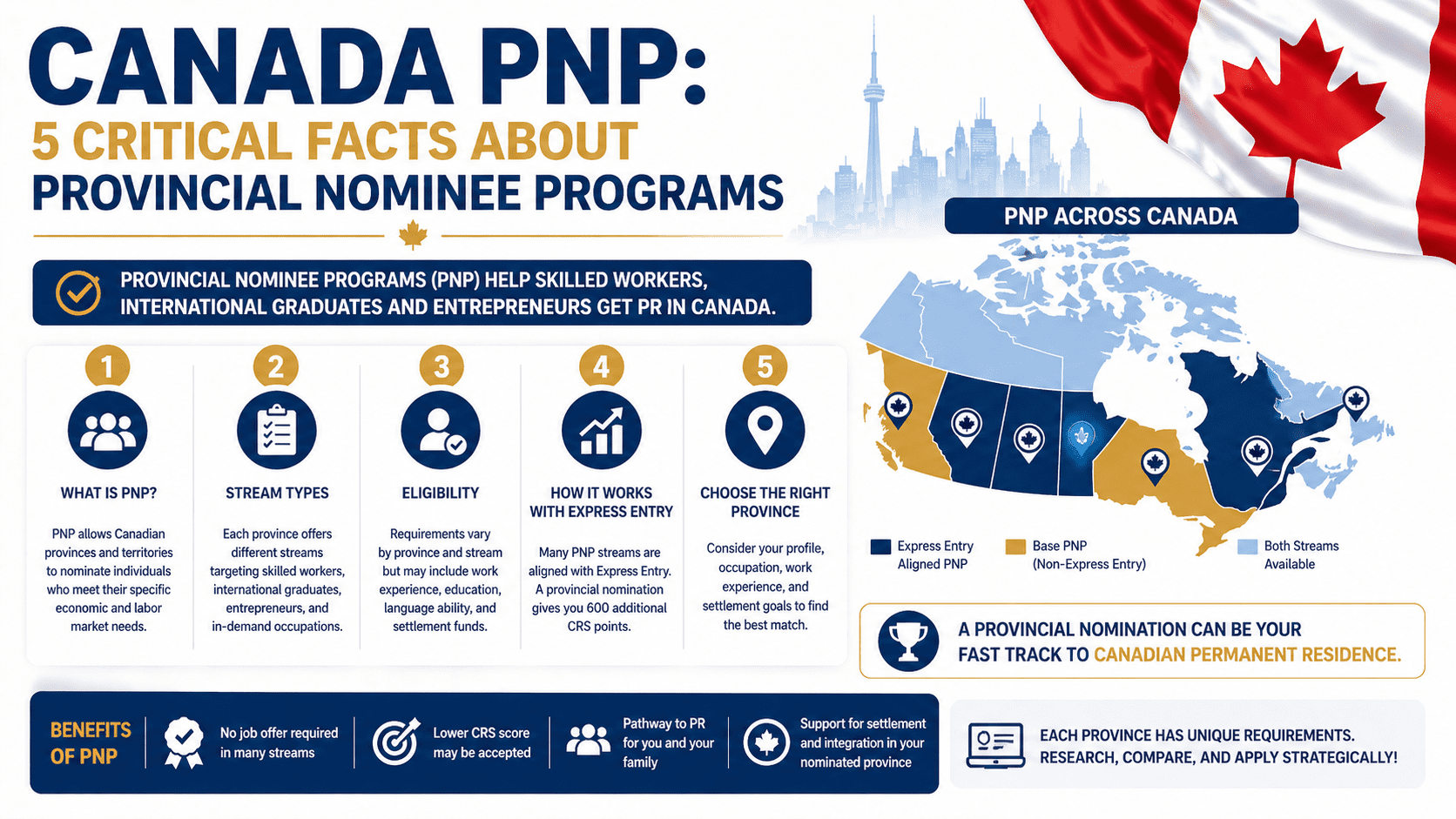
There are currently over 80 active PNP streams across Canada’s provinces and territories. Each stream targets a specific type of applicant – skilled workers in particular occupations, international graduates, entrepreneurs, semi-skilled workers in high-demand sectors, or Express Entry candidates with ties to the province.
Canada PNP nominations carry significant weight in the immigration system. A valid provincial nomination adds 600 points to an Express Entry CRS score, which is effectively a guaranteed ITA in the next available draw. For applicants who receive a nomination through an Express Entry-linked stream, the path from nomination to permanent residence application typically takes six to eight months of federal processing.
Fact 1 – Canada PNP Has Two Distinct Application Streams
The most important structural fact about Canada PNP is that it operates through two fundamentally different types of streams, and understanding which type you are applying through determines your timeline, your process, and your federal application pathway.
Express Entry-linked streams are also called enhanced streams. Provinces use these streams to select candidates directly from the federal Express Entry pool based on their own criteria – occupation, education level, connection to the province, or CRS score. If you receive a nomination through an enhanced stream, IRCC adds 600 CRS points to your profile, guaranteeing an ITA at the next draw. Your federal application then proceeds through the Express Entry system with standard federal processing times.
Base streams – also called non-Express Entry streams – operate entirely outside the federal Express Entry system. Applicants apply directly to the province, receive a nomination, and then submit a separate federal permanent residence application outside the Express Entry pool. Base stream processing is generally slower than Express Entry-linked processing, often taking 18 to 24 months for the federal stage, but they provide access to permanent residence for applicants who do not qualify for Express Entry.
Understanding which stream type you are applying through is essential for realistic timeline planning.
Fact 2 – Each Province Has Different Canada PNP Priorities
Canada PNP is not a single national program with uniform criteria. Each province designs its streams to address its specific labor market needs and demographic priorities. What qualifies you for a nomination in one province may not qualify you in another.
Ontario PNP – officially the Ontario Immigrant Nominee Program OINP – is the largest PNP in Canada by nomination volume. It includes Express Entry-linked streams for skilled workers, international students who graduated from Ontario institutions, and in-demand occupations. Ontario regularly issues Notifications of Interest to Express Entry candidates with specific profiles.
British Columbia PNP – the BC PNP – operates a points-based Skills Immigration Registration System that scores candidates on factors including job offer, education, language scores, and regional connections. BC PNP is highly competitive and moves quickly for candidates with valid job offers in eligible occupations.
Alberta, Saskatchewan, Manitoba, Nova Scotia, and other provinces each operate their own streams with their own occupation priority lists, language minimums, and selection criteria. Some provinces actively recruit in specific occupation categories that are underrepresented in the federal system.
For applicants targeting a specific province, researching that province’s current stream priorities and draw history is more valuable than understanding Canada PNP in general terms.
Fact 3 – A Canada PNP Nomination Does Not Guarantee Permanent Residence
This is the most important misconception about Canada PNP to correct. A provincial nomination is a significant advantage – it adds 600 CRS points in Express Entry-linked streams, or provides a pathway to a federal application outside Express Entry in base streams. But the federal government makes the final decision on every permanent residence application, and a nomination can be withdrawn or a federal application refused.
IRCC reviews every Canada PNP application against federal admissibility requirements. Criminal inadmissibility, medical inadmissibility, misrepresentation, or failure to meet the conditions of the nomination can all result in federal refusal even after a valid provincial nomination has been issued.
The conditions of the nomination also matter. Most provinces require nominees to intend to settle and work in the nominating province. While there is no legal requirement to remain in a specific province after receiving permanent residence, misrepresenting your intention to settle – applying to a province you have no connection to and no plan to live in – is treated as misrepresentation and can result in refusal.
Fact 4 – Canada PNP Processing Has Two Stages With Different Timelines
Canada PNP involves two separate processing stages, each with its own timeline. Applicants who plan only for the federal processing time routinely underestimate how long the full process takes.
The provincial stage covers your application to the province, the province’s review and decision on your nomination, and issuance of the nomination certificate. Provincial processing times vary enormously by province and stream – from a few weeks for some Express Entry-linked streams to over 12 months for some base streams. Check the current processing time for your specific province and stream before planning your timeline.
The federal stage covers IRCC’s review of your permanent residence application after you have received your nomination. For Express Entry-linked stream nominees, federal processing runs approximately six months from complete application submission. For base stream nominees applying outside Express Entry, federal processing typically runs 18 to 24 months.
Total Canada PNP processing time from initial provincial application to federal approval typically runs 12 to 24 months for most applicants, depending on the province, stream, and whether the application goes through the Express Entry system.
Fact 5 – Your Connection to the Province Matters More Than Most Applicants Realize
Canada PNP selection is not purely based on qualifications. Most provincial streams place significant weight on your connection to the province – whether you have previously lived there, studied there, worked there, or have a valid job offer from an employer in that province.
Applicants who target a province based solely on its nomination volume or processing speed, without a genuine connection or intention to settle there, often find their applications deprioritized or refused at the provincial stage. Provinces are designed to address their own labor market needs – they select nominees who are likely to settle and contribute to the local economy, not those using the province as a stepping stone to a preferred destination elsewhere.
If you have a valid job offer in a province, previous study or work experience there, or family connections, those are genuine advantages in the Canada PNP selection process. Build your provincial strategy around real connections, not just pathway optimization.
For applicants navigating both Canada PNP and Express Entry options simultaneously, the Express Entry eligibility guide clarifies which federal program requirements you must meet alongside any provincial stream criteria. If you want a pre-submission review of your Canada PNP document package before submitting to the province or to IRCC, the DIY Document Review service provides a structured assessment against the standards both levels of government apply.
FAQ
What is Canada PNP and how does it work? Canada PNP is the Provincial Nominee Program, a federal-provincial immigration partnership that allows provinces to nominate immigrants who meet their specific labor market needs. Nominees receive a provincial nomination certificate and then apply to the federal government for permanent residence. Express Entry-linked nominations add 600 CRS points, effectively guaranteeing an ITA.
How long does Canada PNP take from application to permanent residence? Canada PNP processing has two stages. Provincial processing ranges from a few weeks to over 12 months depending on the province and stream. Federal processing runs approximately six months for Express Entry-linked nominees and 18 to 24 months for base stream nominees. Total Canada PNP processing typically runs 12 to 24 months end to end.
Do I need a job offer to apply for Canada PNP? A job offer is required for some Canada PNP streams but not all. Many provinces operate streams specifically for candidates with valid job offers in eligible occupations. Other streams target international graduates, Express Entry candidates with provincial connections, or workers in specific in-demand sectors without requiring a pre-existing job offer.
Can I apply for Canada PNP and Express Entry at the same time? Yes. You can maintain an active Express Entry profile while simultaneously applying to provincial PNP streams. If you receive a provincial nomination through an Express Entry-linked stream, the 600 CRS points added to your profile will trigger an ITA at the next draw. Applying through both pathways simultaneously is a common strategy for applicants with mid-range CRS scores.
Do I have to stay in the province that nominated me under Canada PNP? There is no legal requirement to remain in the nominating province after receiving permanent residence. However, you must genuinely intend to settle in the province at the time of application. Applying to a province with no real intention to settle there is treated as misrepresentation and can result in refusal of both the nomination and the federal application.
Final Thoughts
Canada PNP is not a consolation prize for applicants who cannot qualify for Express Entry. It is a parallel pathway with genuine advantages – particularly for applicants with provincial connections, valid job offers, or mid-range CRS scores that would require a long pool wait under the federal system alone.
The five facts in this article frame what Canada PNP actually is and what it is not. A nomination is a significant advantage, not a guarantee. Provincial connections matter as much as qualifications. Processing has two stages, and the total timeline is longer than the federal processing time alone suggests.
Approach Canada PNP as a strategic option to evaluate alongside Express Entry – not as a fallback, and not as an automatic choice. The right pathway depends on your specific profile, your provincial connections, and your timeline priorities.
This article is for educational purposes only and does not constitute legal or immigration advice. For guidance specific to your situation, consult a licensed RCIC or immigration lawyer.
