
Canada PR Refusal: 5 Critical Steps After Your Application
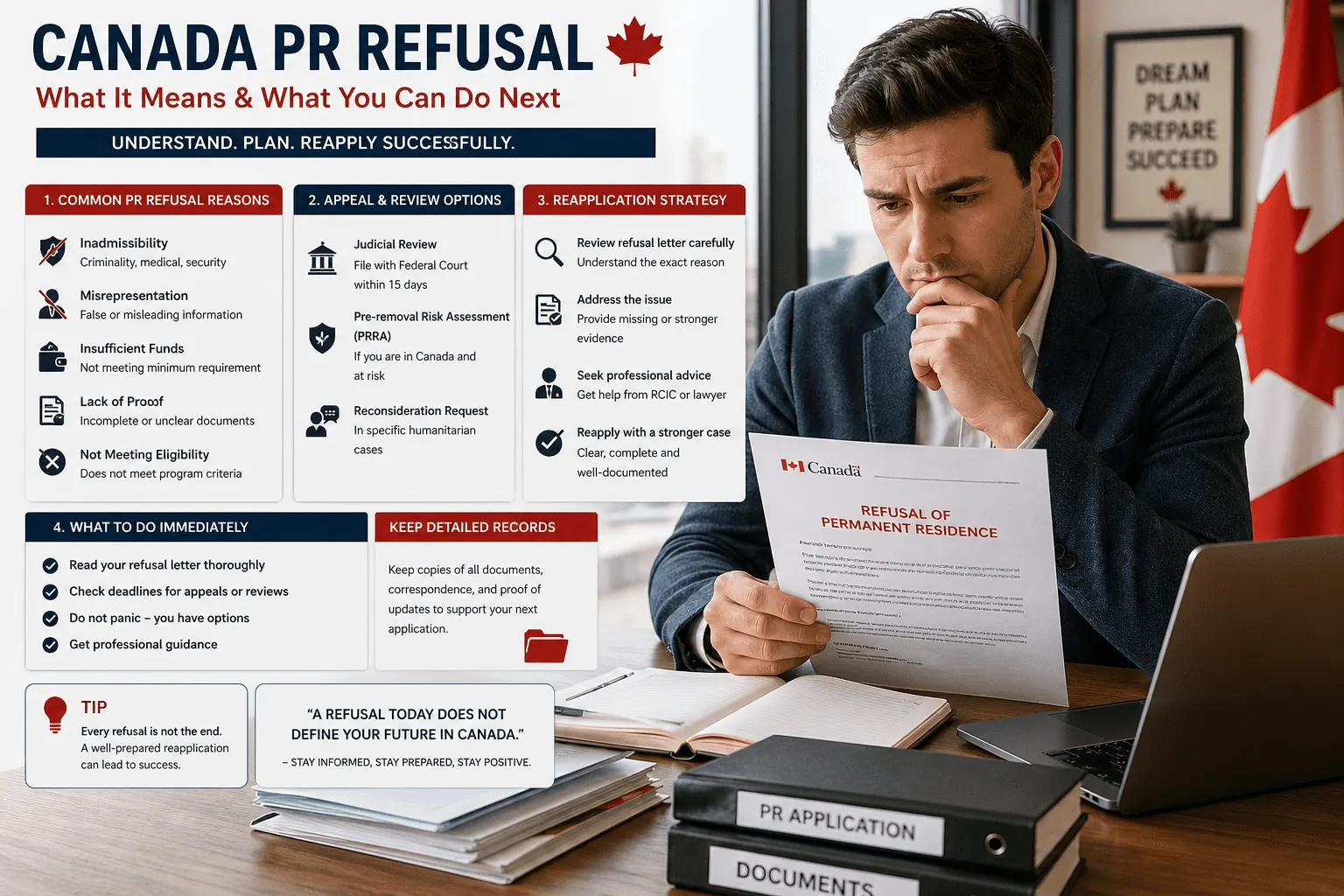
Table of Contents
- Why a Canada PR Refusal Is Not Necessarily Final
- Step 1 – Read the Refusal Letter Carefully and Identify the Exact Reason
- Step 2 – Request Your GCMS Notes
- Step 3 – Assess Your Appeal and Review Options
- Step 4 – Address the Root Cause Before Reapplying
- Step 5 – Build a Stronger Application Before Resubmitting
- FAQ
- Final Thoughts
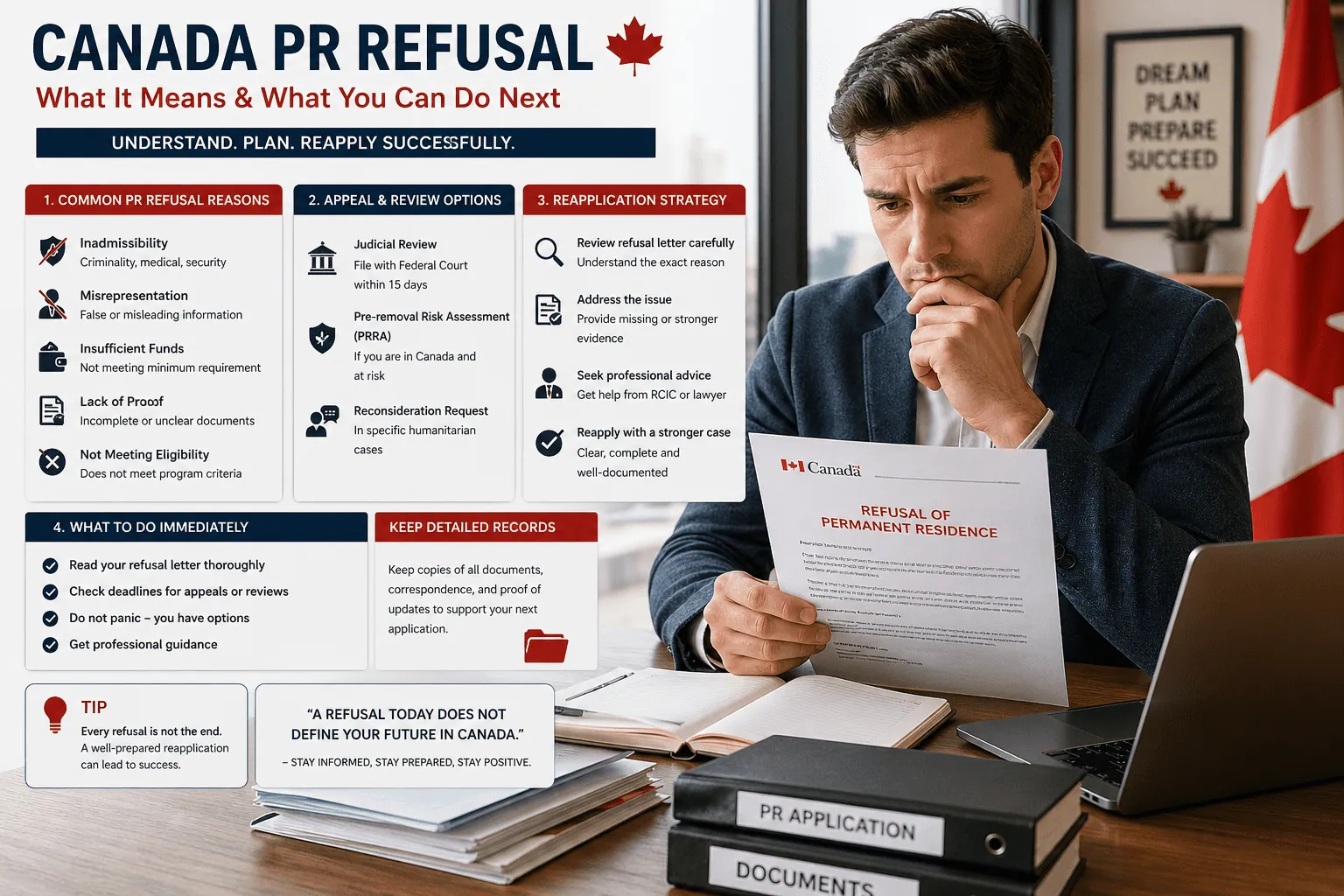
A Canada PR refusal is not the end of your immigration journey. It is a setback with a specific cause – and in most cases, a cause that can be addressed. IRCC issues refusal letters that identify the reason for the decision, and that reason is the starting point for everything that follows. Applicants who receive a canada pr refusal and immediately reapply without understanding why they were refused make the same mistake twice. Applicants who read the refusal letter carefully, identify the actual problem, and address it systematically give themselves a genuine second chance.
This article covers the five critical steps every applicant must take after receiving a canada pr refusal.
Why a Canada PR Refusal Is Not Necessarily Final
IRCC’s refusal of a permanent residence application is an administrative decision – not a judicial one. It can be challenged, addressed, and in many cases overcome. The pathway forward depends entirely on the reason for the refusal and the options available under Canadian immigration law for that specific situation.
Some refusals are procedural – missing documents, expired credentials, or an incomplete application. These are typically the most straightforward to address because the underlying eligibility is not in question. Other refusals are substantive – inadmissibility, misrepresentation, or failure to meet program requirements. These require more careful analysis and in some cases legal intervention.
Understanding what type of canada pr refusal you have received is the first analytical step. The refusal letter is your primary source of information.
Step 1 – Read the Refusal Letter Carefully and Identify the Exact Reason
The IRCC refusal letter is the most important document you will receive in the aftermath of a canada pr refusal. It identifies the officer’s reason for the decision and, in most cases, the specific section of the Immigration and Refugee Protection Act IRPA or its regulations under which the refusal was made.
Common canada pr refusal reasons include: failure to meet program requirements such as work experience or language thresholds, inadmissibility on criminal or medical grounds, misrepresentation of a material fact, failure to provide sufficient proof of funds, inconsistencies between application documents and supporting evidence, and procedural failures such as missed deadlines or incomplete applications.
Read the refusal letter multiple times. Identify the specific reason stated. Determine whether the reason is factual – the officer correctly identified a genuine deficiency – or whether it appears to be based on an error or misunderstanding of your documents. This distinction determines your next step.
For context on the most common reasons IRCC refuses applications and how officers assess document quality, the article on why immigration applications get refused covers the systematic patterns that lead to refusal decisions.
Step 2 – Request Your GCMS Notes
A canada pr refusal letter provides the formal reason for the decision, but it often does not provide the full picture of the officer’s reasoning. The Global Case Management System GCMS notes are the internal IRCC record of your application – they contain the officer’s assessment, their specific concerns, and the factors that drove the decision.
You can request your GCMS notes through an Access to Information and Privacy ATIP request to IRCC. The request is free and the notes are typically provided within 30 to 60 days. Reading your GCMS notes alongside your refusal letter gives you a far more complete picture of what went wrong and why.
GCMS notes are particularly valuable when the refusal reason in the letter is vague or when you believe the officer may have misunderstood your documents. The notes reveal whether the officer reviewed specific documents, what concerns they had, and whether their reasoning appears to be based on an error that could support an appeal.
Step 3 – Assess Your Appeal and Review Options
After a canada pr refusal, you may have several options depending on the program under which you applied and the reason for the refusal. These options are time-sensitive – missing the deadline for an appeal or judicial review forfeits the option.
Judicial review at the Federal Court of Canada is available for most canada pr refusal decisions. You must file for judicial review within 15 days of the refusal decision if you are in Canada, or within 60 days if you are outside Canada. Judicial review is not an appeal on the merits – the Federal Court reviews whether the officer made a legal error, applied the wrong standard, or acted unreasonably. Judicial review requires legal representation in virtually all cases.
Humanitarian and Compassionate H and C grounds applications are available in some circumstances for applicants who do not qualify under standard programs but have compelling reasons for remaining in Canada. H and C applications are discretionary and success rates vary.
Reapplication without appeal is the most common path after a canada pr refusal where the reason is a fixable deficiency – a stronger language score, additional work experience documentation, or corrected proof of funds. If the refusal reason can be addressed, reapplying with a stronger application is often more practical than pursuing a legal challenge.
Step 4 – Address the Root Cause Before Reapplying
The most common mistake after a canada pr refusal is reapplying without addressing the root cause of the original refusal. IRCC maintains records of all previous applications. A second application that does not address the reason for the first refusal will typically be refused again – and a pattern of refusals can make future applications harder.
If the refusal was for insufficient proof of funds, ensure your financial documentation meets IRCC’s standards in full before reapplying – six months of complete bank statements, a current bank letter, and documented source of funds for any large deposits. For a detailed breakdown of what IRCC expects from financial documentation, the article on IRCC application refused reasons covers the document quality standards that drive officer decisions.
If the refusal was for work experience inconsistencies, obtain reference letters that explicitly confirm your NOC-matching duties, hours, and employment dates. If the refusal was for language score insufficiency, retest and achieve scores that meet or exceed the program minimum before reapplying.
If the refusal was for misrepresentation – intentional or unintentional – this is the most serious situation and requires careful assessment before any further action. A misrepresentation finding typically carries a five-year ban from Canadian immigration applications. Legal guidance is essential in this situation.
Step 5 – Build a Stronger Application Before Resubmitting
A reapplication after a canada pr refusal is not simply a copy of the original application with the identified deficiency fixed. It is an opportunity to build a comprehensively stronger application that addresses not just the stated refusal reason but any other weaknesses that may have existed in the original application.
Review your original application against the standards IRCC applies to every document category. Work experience reference letters should explicitly confirm your NOC main duties. Language results should be current and as strong as possible. Proof of funds should show a stable balance pattern over a full six months with no unexplained large deposits. Personal history documentation should be complete with no unexplained gaps.
A pre-submission review of your reapplication package before it reaches IRCC is one of the most effective ways to catch remaining weaknesses. The DIY Document Review service provides a structured assessment of your complete document package against the standards IRCC officers apply – the same assessment that should have happened before the original application was submitted.
FAQ
What should I do immediately after receiving a Canada PR refusal?
Read the refusal letter carefully to identify the exact reason. Request your GCMS notes through an ATIP request for the full picture of the officer’s reasoning. Assess your appeal and review options and their deadlines. Do not reapply until you have identified and addressed the root cause of the canada pr refusal.
Can I appeal a Canada PR refusal?
Judicial review at the Federal Court of Canada is available for most canada pr refusal decisions. You must file within 15 days if in Canada or 60 days if outside Canada. Judicial review is not an appeal on the merits – it reviews whether the officer made a legal error. Most judicial review applications require legal representation.
How long after a Canada PR refusal can I reapply?
There is no mandatory waiting period before reapplying after a canada pr refusal in most cases, unless the refusal included a finding of misrepresentation which carries a five-year ban. However, reapplying immediately without addressing the refusal reason is unlikely to succeed. Address the root cause first, regardless of how long that takes.
Does a Canada PR refusal affect future applications?
IRCC maintains records of all previous applications including refusals. A previous canada pr refusal does not automatically bar future applications, but it creates a record that officers reviewing future applications can see. A well-documented explanation of what changed between the refused and resubmitted application is important for contextualizing the history.
What is the most common reason for Canada PR refusal?
The most common canada pr refusal reasons include insufficient or inconsistent proof of funds, work experience documentation that does not clearly support the claimed NOC code, expired or insufficient language test results, and document inconsistencies that raise credibility concerns. Misrepresentation findings are less common but carry the most serious consequences.
Final Thoughts
A canada pr refusal is a specific decision with a specific reason. Treating it as a general rejection of your immigration case is the wrong response. Reading the letter carefully, obtaining your GCMS notes, understanding your appeal options, addressing the root cause, and building a stronger reapplication are the five steps that turn a refusal into a recoverable setback.
The applicants who successfully navigate a canada pr refusal are not those with the strongest original applications – by definition, those applications were not refused. They are the applicants who responded to the refusal methodically, understood what went wrong, fixed it properly, and resubmitted with a package that addressed the officer’s concerns directly.
A canada pr refusal is information. Use it.
This article is for educational purposes only and does not constitute legal or immigration advice. For guidance specific to your situation, consult a licensed RCIC or immigration lawyer.