
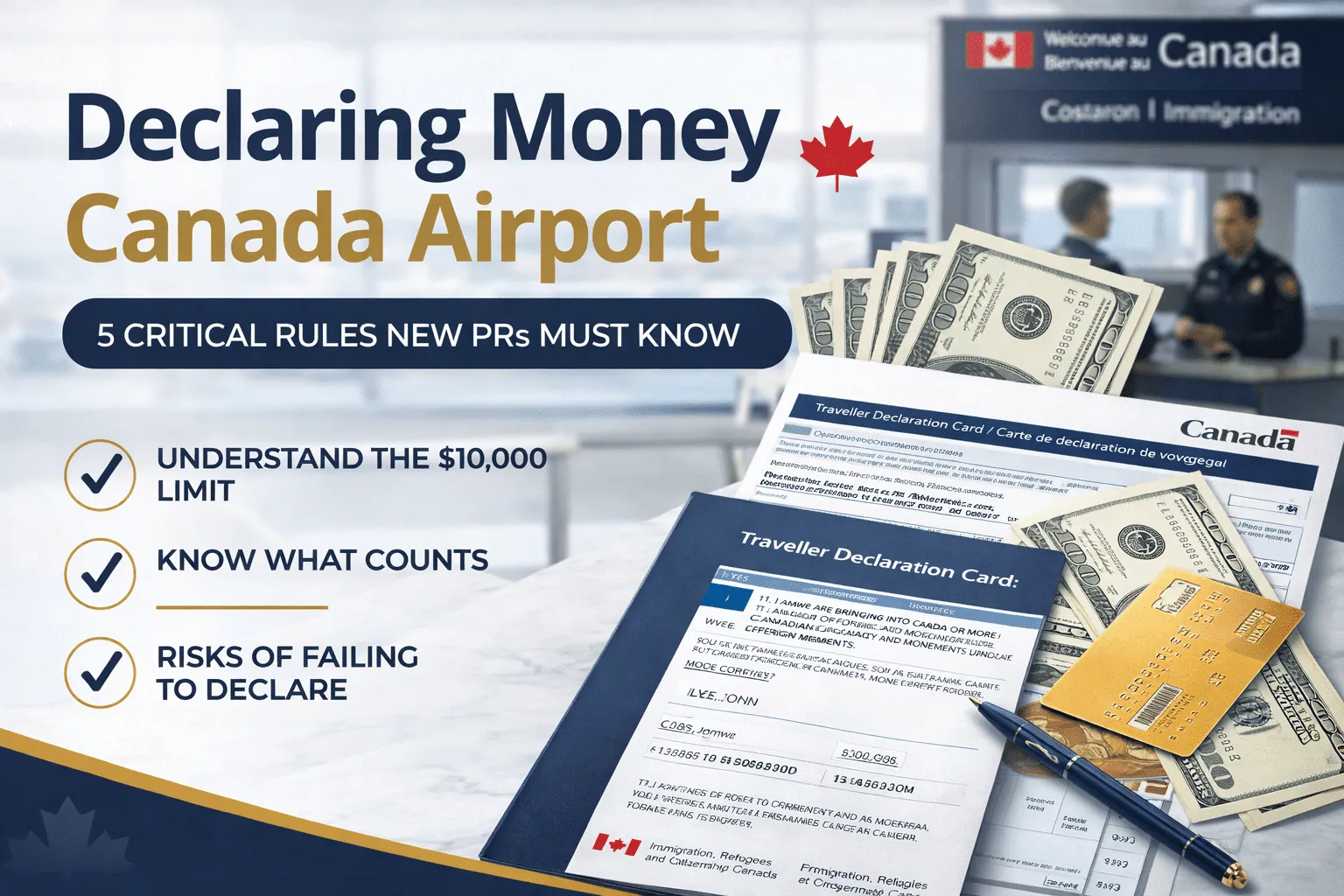
Declaring Money Canada Airport: 5 Critical Rules New PRs Must Know
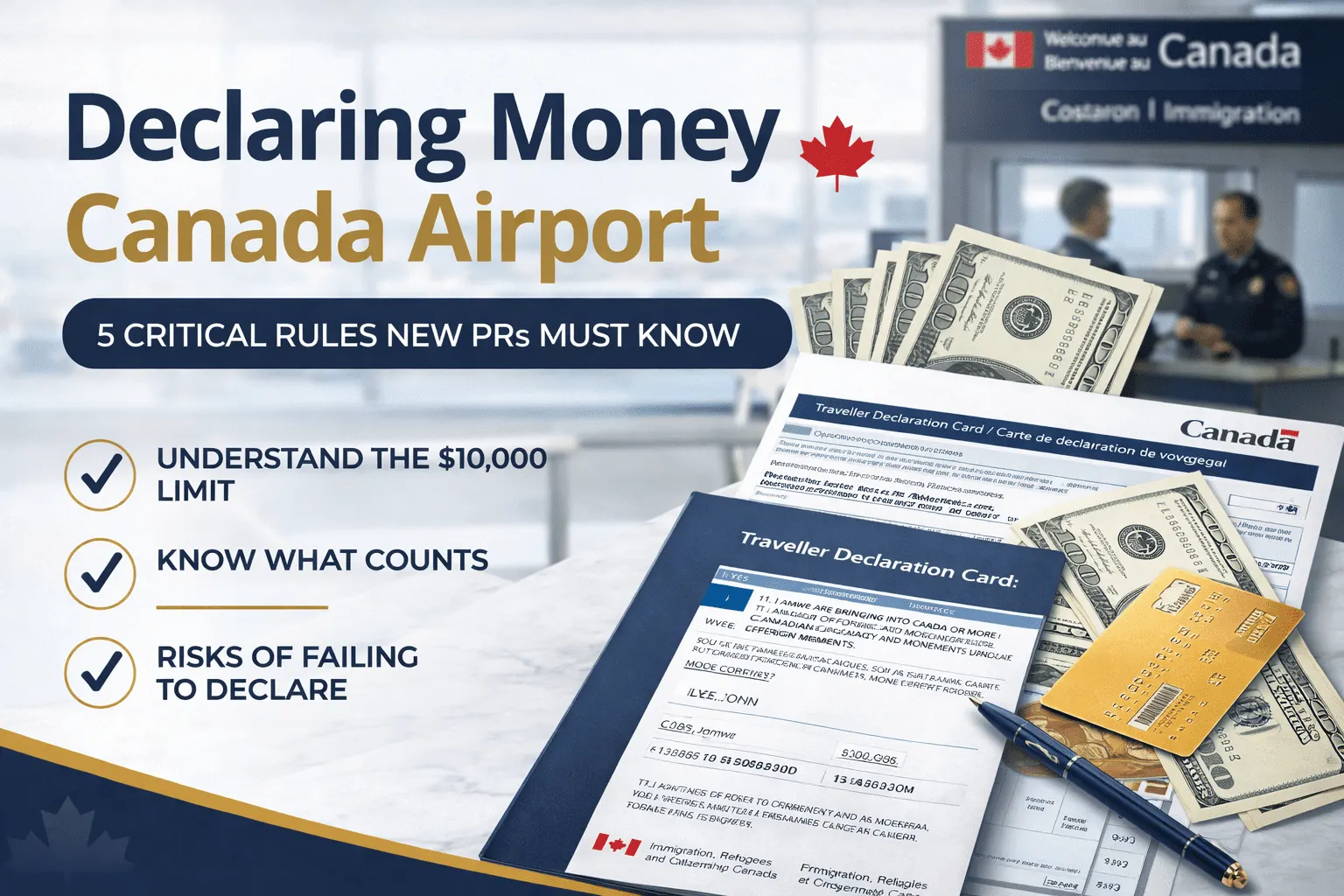
Table of Contents
- Why Declaring Money Canada Airport Matters More for New PRs
- Rule 1 – The $10,000 Threshold Applies to All Monetary Instruments Combined
- Rule 2 – Failing to Declare Has Serious Consequences
- Rule 3 – Declaring Does Not Mean Your Money Will Be Seized or Taxed
- Rule 4 – Goods and Funds Being Shipped Later Must Also Be Declared
- Rule 5 – You Must Declare Even if the Money Belongs to Someone Else
- FAQ
- Final Thoughts
Declaring money Canada airport is a legal obligation that applies to every person entering Canada – including new permanent residents arriving with their COPR for the first time. Many DIY applicants focus entirely on their immigration documents and overlook the customs declaration requirements that kick in the moment they step off the plane. Getting this wrong does not just result in a fine. It can result in seizure of your funds and a permanent record that affects future border crossings.
This article covers the five rules every new permanent resident must understand before landing.
Why Declaring Money Canada Airport Matters More for New PRs
New permanent residents are in a unique position at the border. Unlike tourists or temporary residents, you are arriving to settle. You may be carrying more cash, more financial instruments, and more assets than a typical traveler. CBSA officers are aware of this, and the customs declaration process is designed to capture exactly that situation.
The rules around declaring money Canada airport apply regardless of your immigration status. Whether you are a visitor, a temporary worker, or a brand new permanent resident landing for the first time, the same thresholds and obligations apply. What changes is the volume and type of funds you are likely to be carrying – which makes understanding the rules more important, not less.
Arriving prepared also signals to the CBSA officer that you are a cooperative and organized applicant. A clean, complete declaration with no surprises is the fastest path through customs. For everything else you need to carry on your first landing, the flying to Canada with COPR guide covers the full document package in detail.
Rule 1 – The $10,000 Threshold Applies to All Monetary Instruments Combined
The most important rule for declaring money Canada airport is the $10,000 CAD threshold. Any person entering Canada with CAD $10,000 or more in cash or monetary instruments is legally required to declare it to CBSA. This is not a suggestion. It is a federal requirement under the Proceeds of Crime (Money Laundering) and Terrorist Financing Act.
The threshold applies to the combined total of all monetary instruments you are carrying – not each type separately. This means if you have $6,000 in cash, $3,000 in traveler’s cheques, and a $2,000 bank draft, your total is $11,000 and you must declare.
Monetary instruments that count toward the threshold include: cash in any currency, traveler’s cheques, money orders, bank drafts, and bearer bonds. Personal cheques made out to a specific person generally do not count, but confirm this with CBSA if you are unsure.
Foreign currency counts toward the threshold when converted to Canadian dollars. Use the Bank of Canada exchange rate on your date of entry for the conversion. If you are carrying multiple foreign currencies, convert each one separately and add the totals.
Rule 2 – Failing to Declare Has Serious Consequences
The penalty for not declaring money Canada airport is not a small administrative fine. CBSA has the authority to seize the entire amount you failed to declare. The minimum penalty for a first-time non-declaration is typically 25 percent of the seized amount, but penalties can reach up to the full value of the funds depending on the circumstances.
Beyond the financial penalty, a non-declaration is recorded in CBSA’s enforcement database. This record can affect your treatment at future border crossings and in some cases can be referenced in subsequent immigration applications.
The most common reason applicants fail to declare is a genuine misunderstanding of what counts. They assume the threshold applies only to cash, or that foreign currency does not count, or that funds being carried on behalf of a family member do not need to be declared. None of these assumptions are correct. If you are physically carrying it across the border, it must be declared if the combined total meets or exceeds $10,000 CAD.
Rule 3 – Declaring Does Not Mean Your Money Will Be Seized or Taxed
A widespread misconception about declaring money Canada airport is that declaring triggers taxation or automatic scrutiny of your funds. It does not. Declaration is an administrative process, not an accusation.
When you declare an amount above $10,000, the CBSA officer will ask you standard questions about the source of the funds, the purpose for bringing them into Canada, and where the money will be held or used. You answer, the declaration is recorded, and in the vast majority of cases you proceed through customs normally with your funds intact.
The declaration process exists to help CBSA identify money laundering and terrorist financing – not to penalize legitimate settlers bringing their savings. New permanent residents arriving with settlement funds have a completely legitimate reason to carry large amounts, and officers understand this context. Declare openly, answer questions directly, and the process is straightforward.
Rule 4 – Goods and Funds Being Shipped Later Must Also Be Declared
Declaring money Canada airport on your first landing as a permanent resident extends beyond what is in your pockets or carry-on. If you are having funds transferred electronically from abroad after your landing, those transfers do not require a border declaration – electronic transfers are handled through different reporting channels by financial institutions.
However, if you are shipping physical monetary instruments – cash, traveler’s cheques, or bearer instruments – in a parcel or container arriving separately, those must be declared at the time of their entry into Canada through the appropriate CBSA process. You cannot send undeclared cash through international mail or courier and avoid the declaration requirement.
For goods you are shipping as settler’s effects, the declaration process at your first landing covers those items on your BSF186 settler’s effects form. Funds being carried physically must be declared separately on your customs declaration form at the time of your landing.
Rule 5 – You Must Declare Even if the Money Belongs to Someone Else
If you are carrying cash or monetary instruments on behalf of another person – a family member, a business partner, or anyone else – you are still required to declare it if the combined total meets or exceeds $10,000 CAD. The declaration obligation applies to whoever is physically transporting the funds, not whoever owns them.
This rule catches many applicants by surprise. A common scenario for new permanent residents is arriving with funds that partly belong to a spouse who is following on a later flight. If the total amount you are personally carrying exceeds $10,000, you must declare – regardless of whose name is on the bank account the funds came from.
If you want an independent review of your full landing preparation – documents, funds declaration strategy, and settlement fund evidence – the DIY Document Review service provides a structured pre-landing check against CBSA and IRCC standards.
FAQ
What is the limit for declaring money at a Canada airport? The limit for declaring money Canada airport is CAD $10,000. Any person carrying $10,000 or more in cash or monetary instruments – including foreign currency converted to CAD – must declare the full amount to CBSA upon entry. There is no exemption for new permanent residents.
What happens if I forget to declare money at a Canadian airport? Failing to declare money at a Canada airport can result in seizure of the undeclared funds and a penalty of up to the full value of the amount. A first-time non-declaration typically results in a penalty of 25 percent of the seized amount, plus a record in CBSA’s enforcement database.
Does declaring money Canada airport mean I will be taxed on it? No. Declaring money Canada airport does not trigger any tax obligation. The declaration is an administrative record for anti-money laundering purposes. CBSA will ask questions about the source and purpose of the funds, but declaration alone does not result in taxation or seizure of legitimate settlement funds.
Do traveler’s cheques count toward the $10,000 declaration limit in Canada? Yes. Traveler’s cheques, money orders, bank drafts, and bearer bonds all count toward the $10,000 declaration threshold when declaring money Canada airport. The limit applies to the combined total of all monetary instruments, not just cash.
Can I split my money with a travel companion to avoid declaring at a Canada airport? No. Deliberately splitting funds between travelers to keep each person’s amount below the $10,000 threshold is called structuring and is illegal under Canadian law. Each person must declare the full amount they are personally carrying, and CBSA officers are trained to identify structuring patterns.
Final Thoughts
Declaring money Canada airport is one of the simplest compliance obligations in the entire immigration and settlement process – but it is also one of the most misunderstood. The rules are clear, the threshold is fixed, and the consequences of non-compliance are disproportionately severe relative to how easy it is to get right.
New permanent residents arriving with settlement funds have nothing to hide and nothing to fear from the declaration process. Declare everything you are carrying above $10,000, answer the CBSA officer’s questions directly, and move through customs without incident.
The one mistake worth avoiding at all costs when declaring money Canada airport is assuming the threshold does not apply to you because your funds are in a foreign currency, belong partially to someone else, or are in the form of monetary instruments rather than cash. The threshold is total, it is combined, and it applies to everyone crossing the border.
This article is for educational purposes only and does not constitute legal or immigration advice. For guidance specific to your situation, consult a licensed RCIC or immigration lawyer.