
Express Entry Requirements: 5 Critical Criteria to Meet in 2026
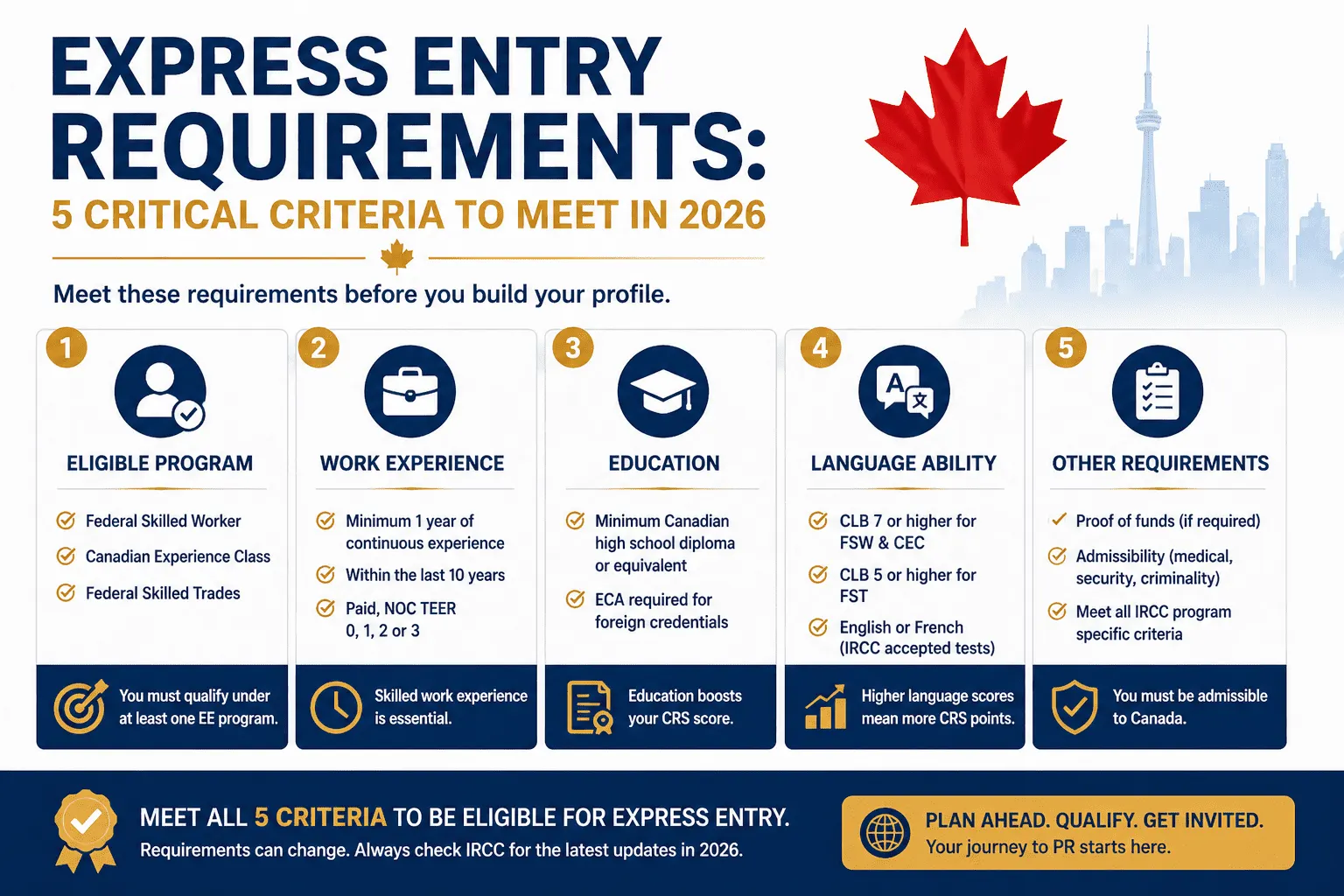
Table of Contents
- Why Express Entry Requirements Differ by Program
- Requirement 1 – Skilled Work Experience in an Eligible Occupation
- Requirement 2 – Language Proficiency at Program Minimums
- Requirement 3 – Education at the Required Level
- Requirement 4 – Proof of Funds Unless Exempt
- Requirement 5 – Admissibility With No Criminal or Medical Bars
- FAQ
- Final Thoughts
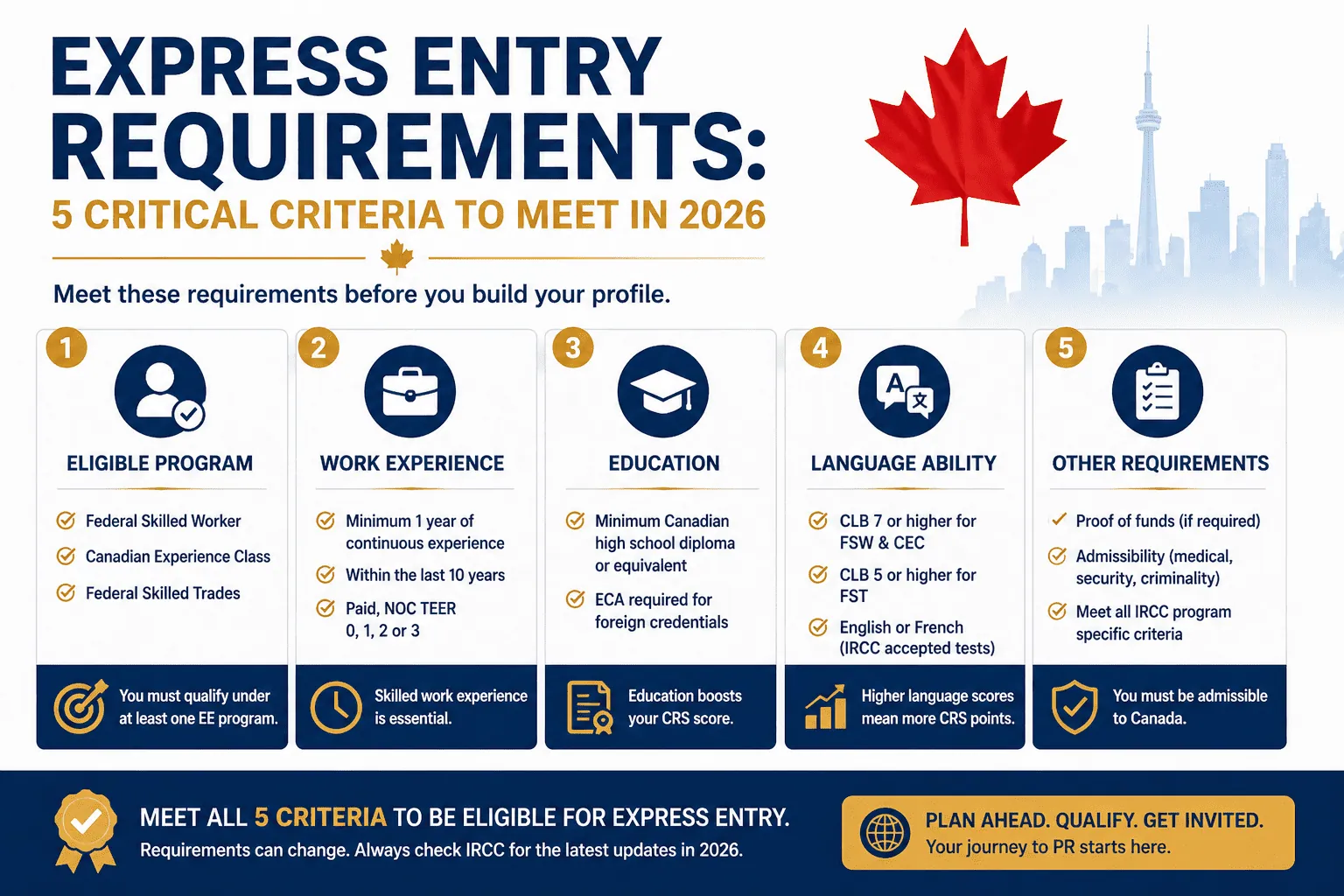
Express entry requirements are the gatekeeping criteria that determine whether you can enter the pool for Canadian permanent residence – and which of the three federal programs you qualify under. Many DIY applicants build an Express Entry profile without fully understanding which program they qualify for or whether they meet the minimum thresholds. The result is a profile that either receives no ITA or creates inconsistencies that surface during application review.
This article covers the five express entry requirements that matter most, how they differ by program, and what each one means for your specific situation in 2026.
Why Express Entry Requirements Differ by Program
Express Entry is not a single program. It is a management system covering three distinct federal immigration programs, each with its own express entry requirements. The Federal Skilled Worker Program FSWP, the Federal Skilled Trades Program FSTP, and the Canadian Experience Class CEC each have different minimum thresholds for work experience, language ability, and other eligibility factors.
You must meet the requirements of at least one program to enter the Express Entry pool. Meeting multiple programs simultaneously does not change your CRS score calculation, but it gives you broader eligibility and more flexibility if your qualifications shift over time.
Understanding which program you qualify for before building your profile is the most important step in the entire Express Entry process. Applying under the wrong program – or submitting a profile without confirming eligibility first – wastes time and creates risk.
For a complete guide to building and optimizing your profile once eligibility is confirmed, the express entry profile guide covers every step in detail.
Requirement 1 – Skilled Work Experience in an Eligible Occupation
Work experience is the foundation of express entry requirements across all three programs. The National Occupational Classification NOC system categorizes occupations by TEER Training, Education, Experience and Responsibilities level.
For FSWP: at least one year of continuous full-time paid work experience in a NOC TEER 0, 1, 2, or 3 occupation within the past ten years. Experience can be inside or outside Canada. Part-time work qualifies if total hours equal at least 1,560 hours.
For FSTP: at least two years of full-time work experience in an eligible skilled trade within the past five years, in a NOC TEER 2 or 3 trade occupation. A valid job offer in Canada or a certificate of qualification in the trade is also required.
For CEC: at least one year of skilled work experience gained inside Canada within the past three years, in a NOC TEER 0, 1, 2, or 3 occupation, while legally authorized to work in Canada.
The NOC code you claim must match your actual job duties – not just your title. IRCC officers review reference letters against the NOC description during application processing. A reference letter that does not confirm the main duties listed in the NOC description is one of the most common grounds for work experience refusal.
Requirement 2 – Language Proficiency at Program Minimums
CRS changes from November 3, 2026. IRCC has announced changes to how CRS points are awarded (official details): (1) a new Labour Market Integration factor gives points for Canadian work experience or an eligible job offer, not both, up to 150 points (140 with a spouse or common-law partner); (2) work-length points for Canadian experience stay the same, and at least 12 months in an eligible high-wage occupation adds 20, 40 or 70 points; (3) job offer points return for eligible high-wage occupations only, at 50, 70 or 100 points depending on the wage level; an LMIA is no longer needed, and having one no longer adds points; (4) when the changes take effect, IRCC will recalculate existing profiles, which could take up to two weeks, and invitation rounds pause during that time. The rest of this section reflects the rules in force until November 2, 2026.
Language proficiency is a mandatory express entry requirement for all three programs, with different minimum thresholds depending on which program you are applying under.
For FSWP: minimum Canadian Language Benchmark CLB 7 in all four abilities – reading, writing, listening, and speaking – using IELTS General Training or CELPIP General for English, or TEF Canada or TCF Canada for French.
For FSTP: minimum CLB 5 in speaking and listening, and CLB 4 in reading and writing. The lower threshold reflects the trade-based nature of the program, where language demands differ from professional occupations.
For CEC: minimum CLB 7 in all four abilities for NOC TEER 0 or 1 occupations, or CLB 5 in all four abilities for NOC TEER 2 or 3 occupations.
Language scores also contribute significantly to your CRS score beyond the minimum eligibility threshold. Achieving CLB 9 or higher across all four abilities adds substantial points and is one of the highest-return improvements available to most applicants. Language test results must be valid – not expired – at the time your profile is submitted and throughout the application process.
Requirement 3 – Education at the Required Level
Education requirements vary across the three programs and represent one of the most misunderstood express entry requirements among DIY applicants.
For FSWP: a minimum of a Canadian secondary school certificate or its foreign equivalent, assessed by an IRCC-designated ECA organization such as WES, IQAS, or ICES. Higher levels of education contribute more CRS points and significantly improve competitiveness in the pool.
For FSTP: formal education requirements are minimal – a secondary school certificate is generally sufficient. However, trade-specific certification may be required depending on the occupation.
For CEC: there is no minimum education requirement. Education is assessed for CRS points only, not eligibility.
Foreign-educated applicants under FSWP must obtain an ECA before submitting their profile. The ECA report must be from an IRCC-designated organization and must be dated within five years of the application. Entering an education level in your profile that does not match your ECA report is a misrepresentation that will be identified during application review.
Requirement 4 – Proof of Funds Unless Exempt
Proof of funds is a mandatory express entry requirement for FSWP and FSTP applicants who do not hold a valid job offer from a Canadian employer or current authorized work status in Canada. CEC applicants are exempt from the proof of funds requirement entirely.
The minimum settlement fund amounts are set by IRCC based on family size and updated annually. For a single applicant, the current minimum (in effect since July 7, 2025) is $15,263 CAD. For a family of four, it is $28,362 CAD. Funds must be liquid, accessible, held in qualifying account types, and documented through six months of official bank statements and a bank-issued confirmation letter.
Funds that do not qualify include pension accounts with early withdrawal restrictions, locked-in GICs that have not yet matured, and real estate equity. Only liquid assets held in accessible accounts count toward the threshold.
For a complete breakdown of which accounts qualify and what documentation IRCC expects, the proof of funds Canada requirements guide covers the financial evidence standard in full detail.
Requirement 5 – Admissibility With No Criminal or Medical Bars
The final express entry requirement is admissibility – the absence of factors in your background that would make you inadmissible to Canada under the Immigration and Refugee Protection Act IRPA.
Criminal inadmissibility arises from convictions in any country for offenses that correspond to Canadian criminal law violations. A single conviction for an offense treated as serious under Canadian law – including offenses that might be considered minor in your home country – can render you inadmissible. Admissibility assessment must happen before you invest significant time and money in the Express Entry process.
Medical inadmissibility arises from conditions that pose a public health or safety risk, or that would cause excessive demand on Canadian health or social services. All applicants must complete a medical examination through an IRCC-designated panel physician as part of the application process after receiving an ITA.
Some forms of inadmissibility are not permanent and can be overcome through Criminal Rehabilitation or a Temporary Resident Permit. These are separate legal processes that add significant time and cost to your application. If any inadmissibility concern applies to your situation, assess it carefully before proceeding.
If you want a pre-submission review of your documents to confirm they support all five express entry requirements accurately before your application reaches IRCC, the DIY Document Review service provides a structured assessment against the actual criteria IRCC officers apply.
FAQ
What are the minimum express entry requirements for FSWP in 2026? The minimum express entry requirements for FSWP in 2026 are: at least one year of skilled work experience in a NOC TEER 0, 1, 2, or 3 occupation within the past ten years; minimum CLB 7 language scores in all four abilities; a Canadian secondary school certificate or foreign equivalent assessed by an ECA organization; proof of settlement funds unless exempt; and admissibility with no criminal or medical bars.
Do express entry requirements include a minimum CRS score? No. Express entry requirements determine eligibility to enter the pool – not your CRS score threshold for receiving an ITA. You can enter the pool with any CRS score if you meet the program requirements. Your score determines how long you wait for an ITA relative to draw cutoffs.
Can I meet express entry requirements with self-employment experience? Self-employment experience generally does not count toward the express entry requirements for FSWP or CEC. IRCC requires paid employment with an arm’s-length employer. Business owners who paid themselves a salary through a corporation may qualify in some circumstances, but this requires careful documentation and is assessed case by case.
Are express entry requirements the same for all provinces? Federal express entry requirements are the same regardless of which province you intend to settle in. However, if you receive a Provincial Nominee Program nomination through an Express Entry-linked provincial stream, the province has its own eligibility criteria in addition to the federal express entry requirements.
What happens if my situation changes after I enter the Express Entry pool? If your qualifications change after you submit your express entry profile – you gain additional work experience, retest language scores, or your marital status changes – you can update your profile to reflect the change. Updates may increase or decrease your CRS score. Material changes must be reflected accurately in your profile and subsequent application.
Final Thoughts
Express entry requirements are the starting point for the entire Canadian permanent residence process. Meeting them gets you into the pool. Your CRS score determines when you receive an ITA. Your document package determines whether the application is approved.
The applicants who navigate Express Entry most efficiently confirm their express entry requirements eligibility before building their profile, optimize their CRS score before submitting, and prepare their document package before their ITA arrives.
Confirm your NOC, your language scores, your ECA status, your proof of funds, and your admissibility before you start. Express entry requirements are clear and publicly available. The only question is whether your preparation meets the standard they set.
This article is for educational purposes only and does not constitute legal or immigration advice. For guidance specific to your situation, consult a licensed RCIC or immigration lawyer.