
IRCC Document Review: 5 Things Officers Look for Before Approving Your Application

Table of Contents
- What IRCC Document Review Actually Means
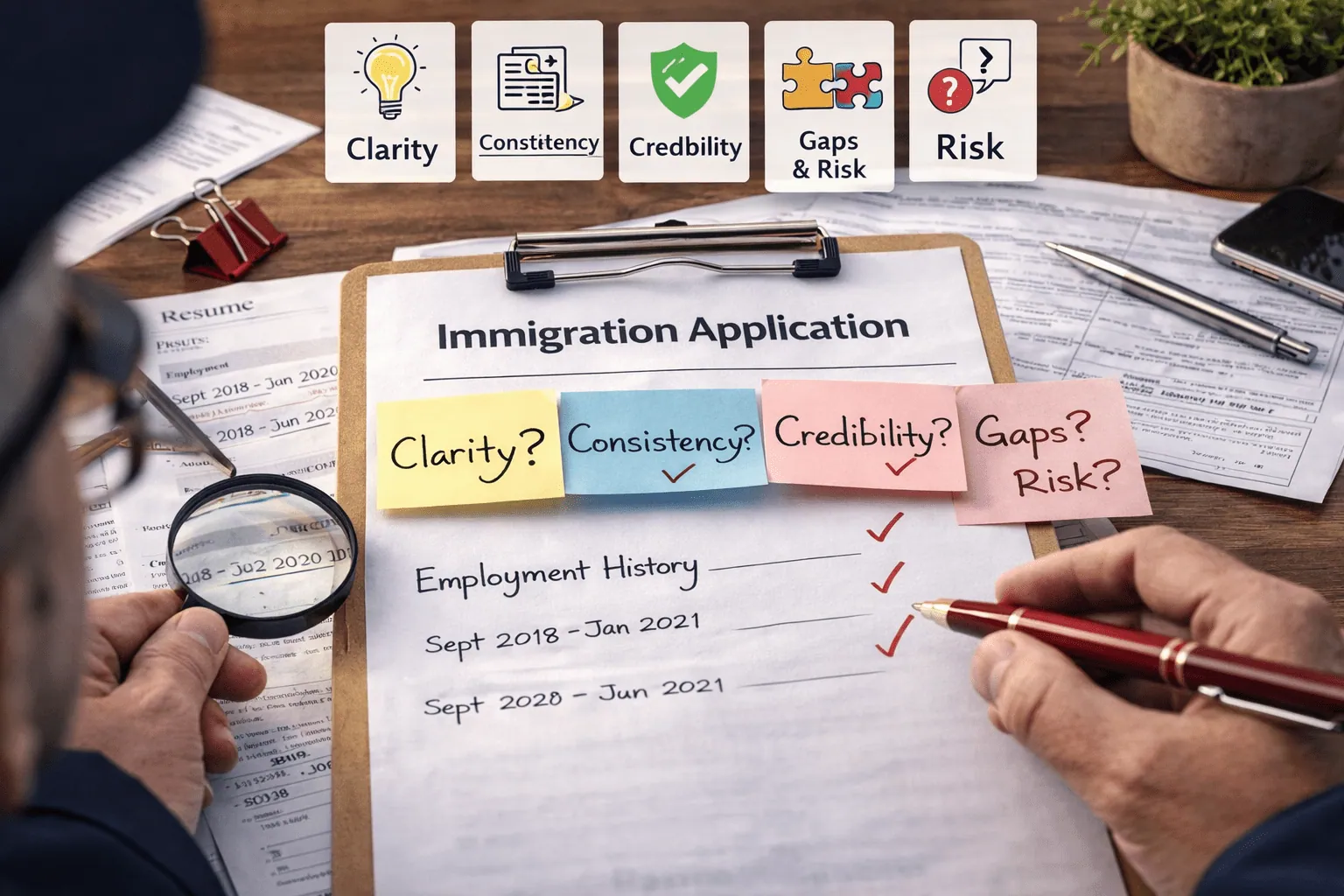
- 5 Things IRCC Officers Look for During Document Review
- What Officers Do Not Prioritize
- How a Pre-Submission Document Review Reduces Risk
- Frequently Asked Questions
- Final Thoughts
Many applicants preparing a Canadian immigration application assume that a pre-submission IRCC document review is simply about confirming that all required forms and documents are present.
From an officer’s perspective, that assumption is incorrect, and it explains why many applications that appear complete on paper still result in refusal.
An IRCC document review is not about counting files. It is about whether the documents in the file allow an officer to make a positive decision without speculation, inference, or unresolved doubt. Understanding the difference between these two standards is essential for any DIY applicant preparing to submit.
What IRCC Document Review Actually Means
When your application enters processing, an IRCC officer reviews the materials submitted. There is no separate formal pre-submission review conducted by IRCC, but the factors officers look for during processing are the same factors a professional pre-submission document review is designed to address.
Those factors fall into five categories. Each one can independently influence whether your application is approved or refused.
5 Things IRCC Officers Look for During Document Review
1. Clarity of Information
The first thing an officer assesses during IRCC document review is whether the information in the file is clear.
Officers work under procedural and time constraints. They are not required to interpret unclear or ambiguous materials in the applicant’s favor. When documentation is confusing or poorly organized, that uncertainty is resolved through officer discretion, not benefit of the doubt.
Clear documentation means timelines are easy to follow, explanations directly address the issues they are meant to resolve, and the overall file can be assessed without requiring the officer to fill in information gaps through inference.
For Express Entry applicants, clarity is especially important in employment reference letters, which must clearly demonstrate that the duties performed match the NOC classification being claimed. A letter that confirms a job title without describing specific responsibilities fails this standard.
2. Internal Consistency Across All Documents
Consistency is a core focus of every IRCC document review.
Officers compare information across every part of the file: application forms, letters of explanation, employment records, study records, and financial documentation. They are specifically looking for discrepancies between what different documents say.
Even small inconsistencies can raise concerns. A job title that differs slightly between your employment letter and your tax records, education dates that do not align between your ECA report and your personal history, or overlapping periods of employment and study that are never explained. Each of these creates a question that the officer must resolve.
When multiple small inconsistencies accumulate, they compound into a credibility concern that can override the strength of individual documents.
3. Logical Support for Applicant Claims
During IRCC document review, officers assess whether documents actually support what the applicant claims, not merely whether they exist in the file.
This distinction matters significantly. A document that is technically present but fails to support the underlying claim provides limited value. Officers consider whether the documents reinforce the stated purpose of the application, align with the applicant’s employment or study history, and support any financial explanations provided.
For applicants claiming skilled work experience under Express Entry, this means that employment letters must go beyond confirming employment dates. They must demonstrate, through specific duty descriptions, that the work performed genuinely qualifies under the claimed NOC code.
4. Identification of Gaps, Changes, and Unresolved Issues
A significant part of IRCC document review involves identifying what is missing or unexplained, not just what is present.
Officers flag gaps in employment or education timelines that are not accounted for, unexplained changes in career direction or study plans, and periods where documentation is absent or weak. These issues do not automatically lead to refusal. However, they require explanation, and if no explanation is provided, the officer must draw their own conclusion.
Unresolved gaps are one of the most common sources of procedural fairness concerns in IRCC processing. Addressing them proactively, before submission, is significantly more effective than responding to officer concerns after they have been raised.
5. Overall Credibility and Coherence of the File
The final dimension of IRCC document review is the most holistic: does the entire application present a credible and coherent picture?
Officers do not assess documents individually in isolation. They evaluate whether the file, read as a whole, tells a consistent story that is supported by the evidence. This includes assessing whether individual documents reinforce each other, whether explanations are proportionate and reasonable given the circumstances, and whether unresolved doubts remain after the review is complete.
When doubts remain, officers in close cases rely on professional discretion and risk assessment, and discretion in close cases is rarely exercised in the applicant’s favor.
What Officers Do Not Prioritize
It is equally useful to understand what an IRCC document review does not focus on.
Officers do not assess the volume of documents submitted. Submitting more documents does not strengthen an application if those documents do not address the relevant concerns. Officers do not prioritize formatting aesthetics beyond basic readability. And excessive or irrelevant supporting materials can complicate a review rather than improve it.
More is not better. Relevant, clear, and consistent is better.
How a Pre-Submission Document Review Reduces Risk
A professional pre-submission IRCC document review applies the same five assessment criteria that officers use during processing, before your application is submitted.
A review conducted before submission can identify credibility gaps before they become refusal reasons, improve the clarity and internal consistency of the file, and flag explanations that are technically present but unconvincing to an officer’s eye.
For DIY applicants preparing a Canadian permanent residence application, a pre-submission review is one of the most practical ways to reduce avoidable risk before the 60-day ITA deadline creates time pressure.
For applicants preparing for Express Entry, understanding how document quality affects your overall profile starts with understanding how the ranking system works. Read the Express Entry Strategy Guide →
Learn more about the DIY Document Review service for IRCC applications.
Frequently Asked Questions
What does IRCC look for during a document review? IRCC officers assess five main factors: clarity of information, internal consistency across documents, logical support for applicant claims, identification of gaps and unresolved issues, and overall credibility and coherence of the application file.
Does submitting more documents improve my chances? Not necessarily. Officers prioritize relevant, clear, and consistent documentation over volume. Excessive or irrelevant materials can complicate the review process without improving outcomes.
What is the difference between a complete application and a strong application? A complete application includes all required forms and documents. A strong application goes further: the documents are clear, internally consistent, and convincingly support all claims being made. Completeness is the floor, not the approval standard.
Can a pre-submission document review prevent refusal? A review cannot guarantee approval or override officer judgment. However, it can identify and address preventable issues before submission, which is significantly more effective than responding to officer concerns after they have been raised in a procedural fairness letter.
Final Thoughts
An IRCC document review is not a checklist exercise. It is an assessment of whether the application materials allow an officer to reach a positive decision without speculation, unresolved doubt, or the need to exercise discretion in a close case.
Understanding what officers look for during IRCC document review helps applicants prepare files that actively support assessment, rather than files that simply satisfy the document list and hope for the best. The five factors covered in this article represent the standard your application will be measured against. Preparing to meet that standard before submission is the most effective risk reduction strategy available to any DIY applicant.
This article is for educational purposes only and does not constitute legal or immigration advice. For guidance specific to your situation, consult a licensed RCIC or immigration lawyer.