
IRCC Gaps and Inconsistencies: 4 Critical Ways Officers Assess Your Application
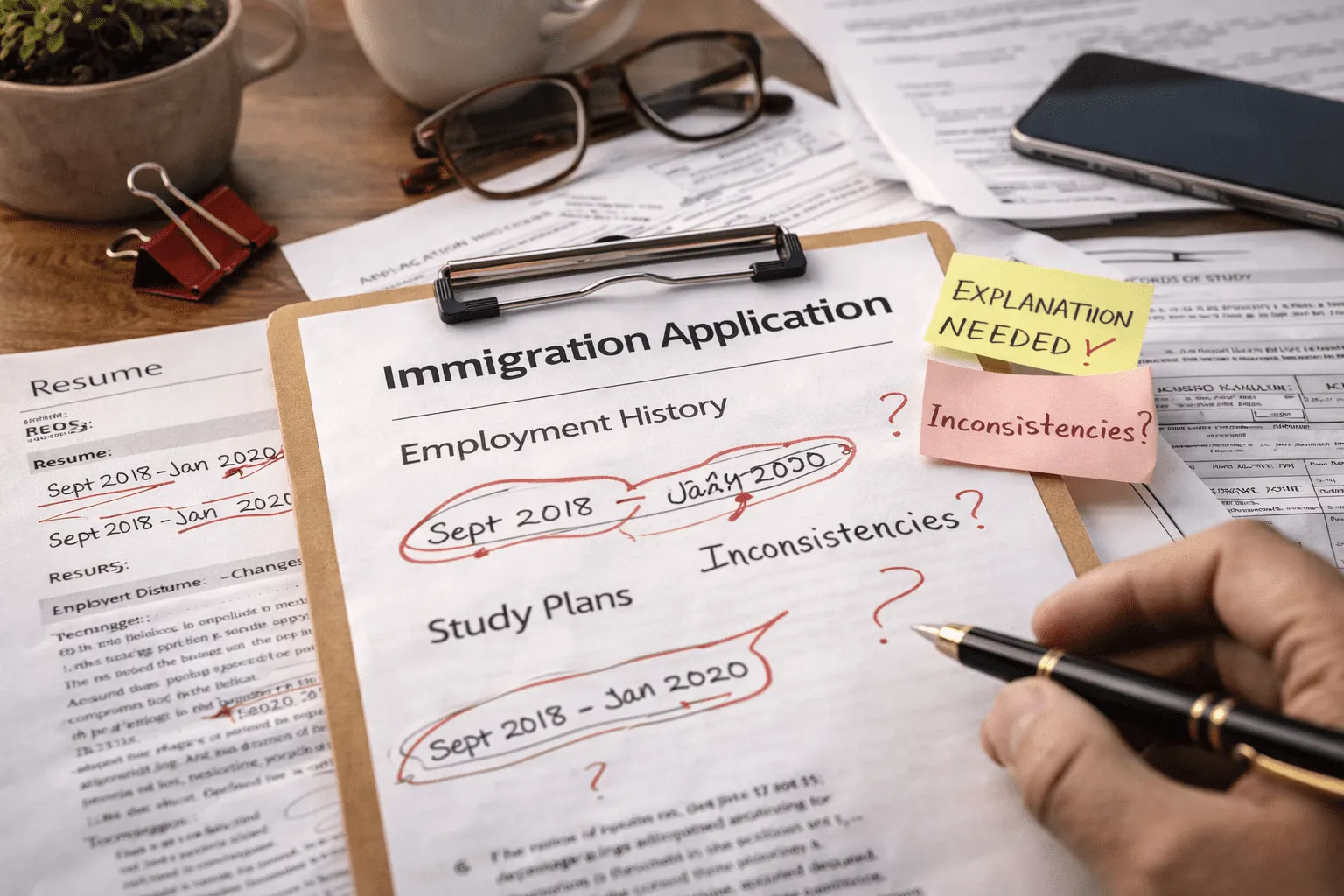
Table of Contents
- What IRCC Gaps and Inconsistencies Actually Include
- 4 Critical Ways Officers Assess IRCC Gaps and Inconsistencies
- Common IRCC Inconsistencies Officers Encounter Most Often
- How a Pre-Submission Review Helps Identify Gaps and Inconsistencies
- How to Reduce Risk From Gaps and Changes Before Submission
- Frequently Asked Questions
- Final Thoughts
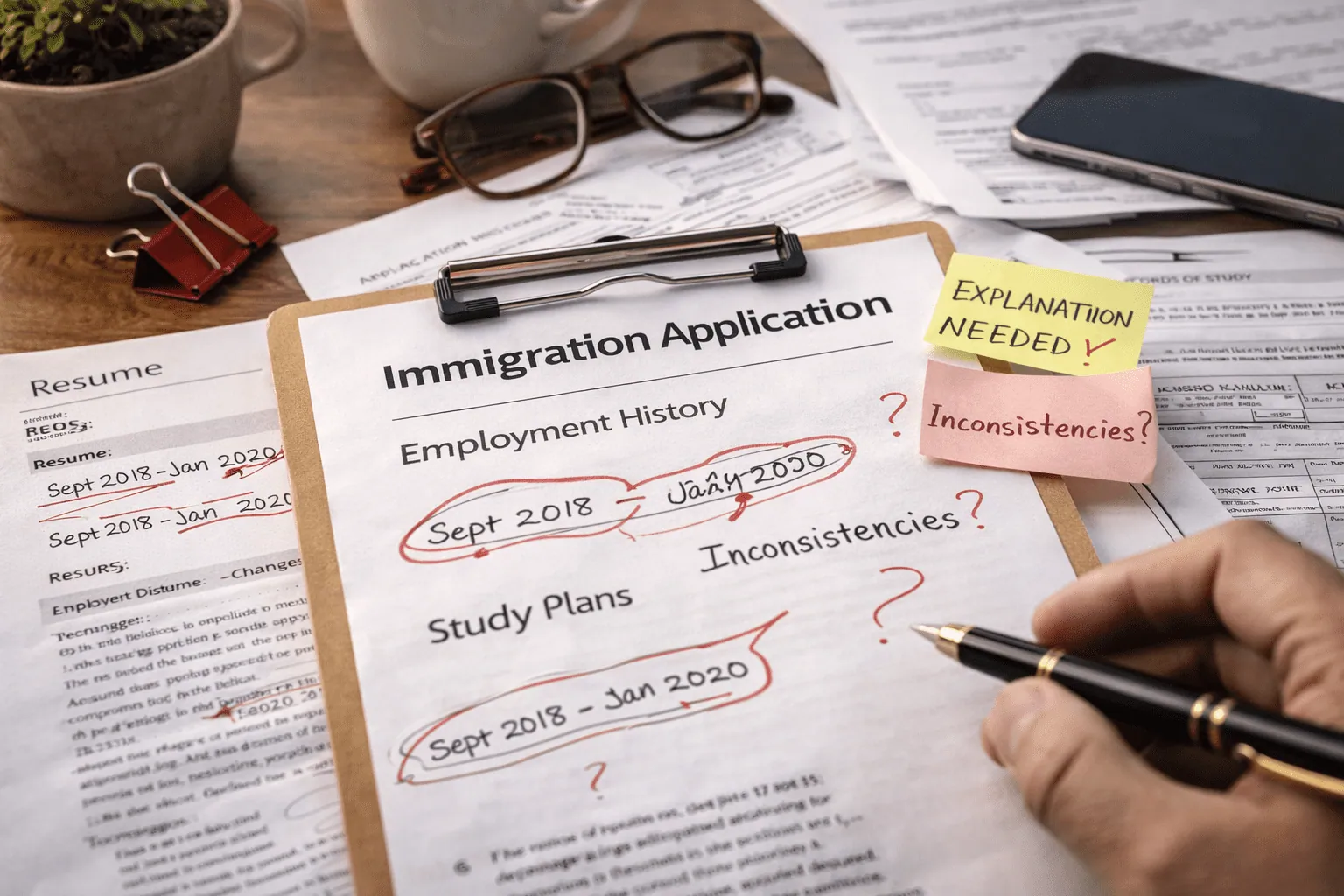
One of the most common concerns among DIY immigration applicants is whether employment gaps, career changes, or inconsistencies between documents will automatically trigger a refusal.
The answer is no – but with an important condition. IRCC gaps and inconsistencies are not refusal triggers on their own. What determines the outcome is whether those gaps and inconsistencies are explained clearly, credibly, and consistently across the entire application file.
Understanding how officers actually assess these elements helps applicants prepare applications that withstand scrutiny – rather than hoping that gaps and changes will simply go unnoticed.
What IRCC Gaps and Inconsistencies Actually Include
Officers encounter a wide variety of application histories. The elements that attract the most attention fall into four categories.
Employment gaps are the most common – periods between jobs that are not accounted for in the employment history. Career changes and shifts in field of study are also frequently flagged, particularly when they appear abrupt or when no explanation accompanies the transition. Periods of informal work, self-employment, or reduced employment that are not supported by documentation create similar concerns.
The fourth category – inconsistencies between documents – is often the most damaging. This includes differences in dates, job titles, or personal information that appear differently across application forms, reference letters, tax records, and personal history sections.
None of these elements are inherently negative. Officers focus on whether they make sense in context, not on whether they exist at all.
4 Critical Ways Officers Assess IRCC Gaps and Inconsistencies
1 – Whether the Explanation Is Logical and Proportionate
The first thing an officer evaluates when encountering a gap or change is whether the explanation provided is logical given the circumstances.
Officers assess whether the explanation is proportionate to the significance of the gap. A brief explanation for a two-week employment gap between jobs is sufficient. A two-year unexplained gap requires considerably more detail – the nature of the circumstances, the timeline, what the applicant was doing during that period, and any supporting documentation available.
The explanation does not need to describe a perfect or straightforward situation. Officers understand that life circumstances are complex. What they require is that the explanation be specific, internally consistent, and supported to a reasonable degree by the documentation in the file.
For Express Entry applicants, gaps and changes in employment history are particularly consequential because they directly affect the credibility of the work experience claim underlying the entire application. Understanding how the competitive ranking system evaluates work experience starts with the fundamentals. Read the Express Entry Strategy Guide
2 – Whether Information Is Consistent Across All Documents
Consistency is one of the most important dimensions of how officers assess IRCC gaps and inconsistencies.
Officers compare information across every document in the file – application forms, letters of explanation, employment records, study records, and financial documentation. When the same fact appears differently across documents, even by small amounts, it raises questions about the reliability of the entire file.
Common consistency failures include employment start or end dates that differ by even one month between the application form and the reference letter, job titles that appear differently across the NOC explanation and the employment record, and periods of overlap between employment and study that are never acknowledged or explained.
These inconsistencies most commonly arise from poor coordination across documents rather than intentional misrepresentation. But from an officer’s perspective, the effect is the same – a credibility concern that must be resolved before a positive decision can be made.
The solution is building a master timeline before completing any application forms. Every date, title, and institution should be drawn from a single source of truth, ensuring that every document tells the same story.
3 – Whether the Gap or Change Affects Applicant Intent or Credibility
IRCC gaps and inconsistencies are never assessed in isolation. Officers evaluate them in the context of the overall application narrative.
The central question is whether the gap or change undermines the credibility of the application or raises doubts about the applicant’s intent. A career change from engineering to project management, for example, may raise no concerns if the transition is explained logically and the NOC classification reflects the actual work performed. The same career change left unexplained may suggest that the applicant selected a NOC code strategically rather than based on genuine work history.
This is why applications with unexplained gaps are sometimes refused even when the applicant is genuinely eligible. The eligibility exists, but the credibility concern created by the unexplained gap prevents the officer from being satisfied on a balance of probabilities.
4 – Whether Inconsistencies Suggest a Deeper Reliability Problem
A single minor inconsistency is unlikely to determine the outcome of a well-prepared application. Multiple inconsistencies, or inconsistencies that compound across different parts of the file, create a different situation.
When officers identify recurring discrepancies across an application, they begin to question the reliability of the file as a whole – not just the specific documents that contain the errors. This is the compounding effect of inconsistency, and it is one of the most common reasons that applications with strong underlying eligibility result in refusals based on credibility concerns.
Officers are not required to assume that inconsistencies are innocent mistakes. When doubts accumulate, they are resolved through officer discretion – and discretion in close cases does not typically favor the applicant.
Common IRCC Inconsistencies Officers Encounter Most Often
The inconsistencies that appear most frequently in DIY immigration applications include employment dates that differ across documents, job descriptions that do not align with the experience being claimed under the NOC code, study plans or educational history that conflict with the employment timeline, and financial explanations that contradict declared income levels.
These issues arise frequently not because applicants are trying to mislead officers, but because most DIY applicants compile documents from multiple sources without systematically verifying that all information aligns. The result is a file that tells slightly different stories in different places – and officers are trained to notice exactly that.
How a Pre-Submission Review Helps Identify Gaps and Inconsistencies
A pre-submission document review cannot change an applicant’s history. What it can do is identify the inconsistencies, unexplained gaps, and credibility concerns that would otherwise be discovered by an officer during processing – after submission.
A review conducted before the 60-day ITA deadline allows applicants to detect contradictions across documents before they become refusal reasons, clarify timelines and transitions through targeted explanation letters, and improve the consistency of the overall file while there is still time to address issues.
Learn more about the DIY Document Review service for IRCC applications.
How to Reduce Risk From Gaps and Changes Before Submission
Three practices make the biggest difference for applicants managing complex histories.
First, address every significant gap directly rather than ignoring it. Write a specific, factual explanation letter for every employment gap over one month, every career change, and every period of reduced or informal employment. A gap that is explained proactively is significantly less likely to trigger a credibility concern than a gap that the officer identifies without any explanation in the file.
Second, build a master timeline and use it as the single source of truth for every date, title, and institution in the application. Cross-check every document against that timeline before submission.
Third, avoid over-explaining or introducing speculative content into explanation letters. An explanation that goes beyond the facts and introduces new information that cannot be supported by documentation creates additional concerns rather than resolving existing ones.
Frequently Asked Questions
Do IRCC gaps and inconsistencies automatically cause a refusal? No. Gaps and changes in employment, education, or career direction are not automatic refusal grounds. Officers assess whether those gaps are logically explained, consistently documented, and credible in the context of the overall application.
How does IRCC assess inconsistencies between documents? Officers compare information across every part of the file – forms, letters, employment records, and financial documents. Even minor discrepancies raise questions about reliability. Multiple inconsistencies compound into credibility concerns that can affect the overall assessment.
What is the best way to explain an employment gap in an IRCC application? Write a specific, factual Letter of Explanation covering the nature of the gap, the precise timeline, what you were doing during that period, and any supporting documentation available. Vague explanations such as “personal reasons” do not resolve officer concerns.
Can inconsistencies between documents be corrected after submission? Not easily. Once an application is submitted, the file as submitted is what officers assess. Procedural fairness letters may provide an opportunity to respond to specific concerns, but not all applications receive them. Addressing inconsistencies before submission is significantly more effective.
Final Thoughts
IRCC gaps and inconsistencies are among the most misunderstood aspects of immigration application preparation. Many applicants assume that gaps and changes will either go unnoticed or will be resolved in their favor if they are otherwise eligible. Neither assumption is accurate.
Officers assess IRCC gaps and inconsistencies systematically, comparing information across the entire file and evaluating whether the explanations provided are specific, credible, and supported. Unexplained gaps and inconsistencies that accumulate across a file create credibility concerns that can determine the outcome of an otherwise strong application.
The standard is not perfection. It is clarity, consistency, and credibility – across every document, every explanation, and every part of the narrative the application presents.
This article is for educational purposes only and does not constitute legal or immigration advice. For guidance specific to your situation, consult a licensed RCIC or immigration lawyer.