
Moving to Canada Guide: What to Do in the 12 Weeks Before You Fly (2026)
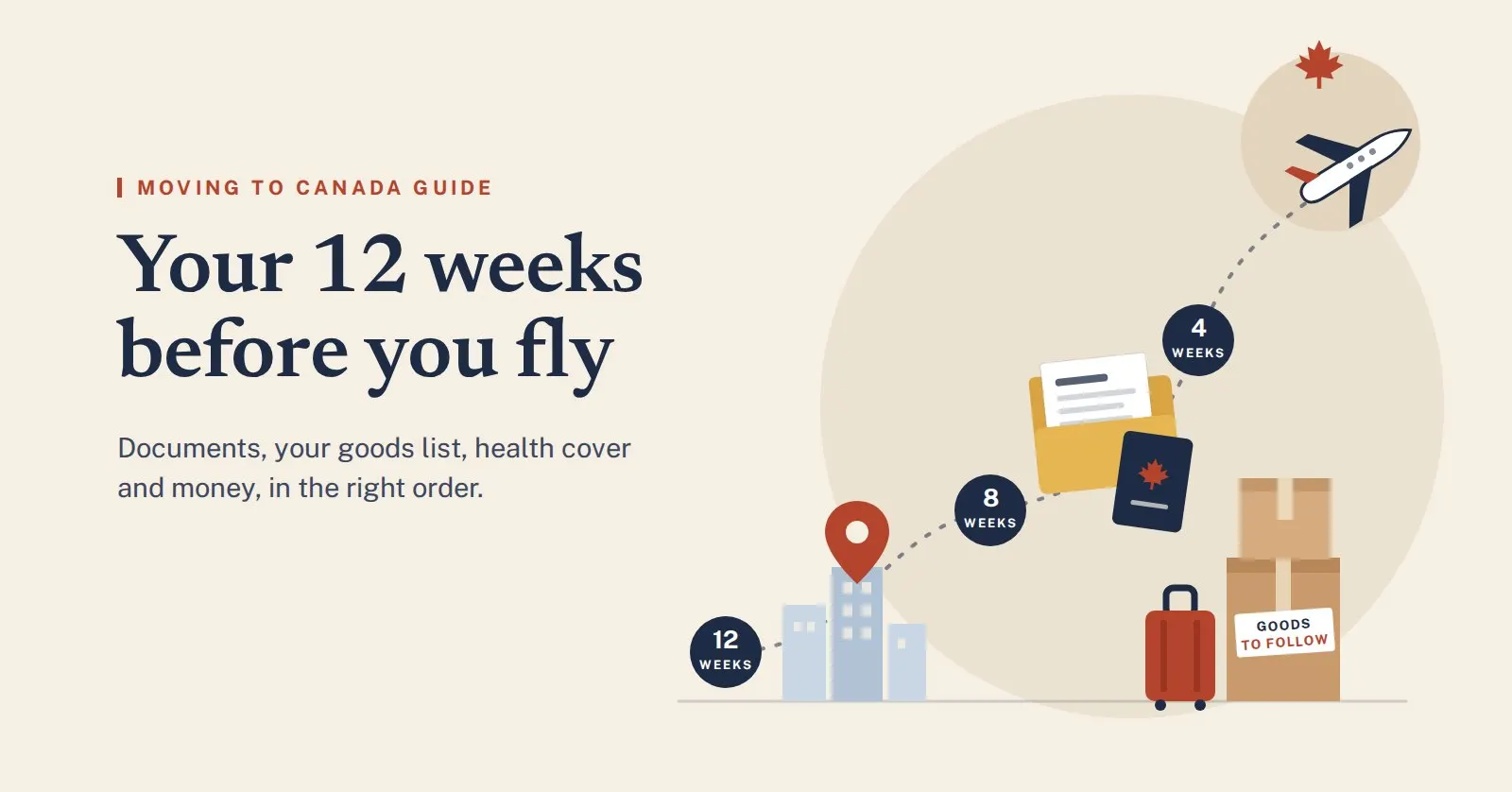
Table of Contents
- Moving to Canada: Quick Answer
- Who This Guide Is For
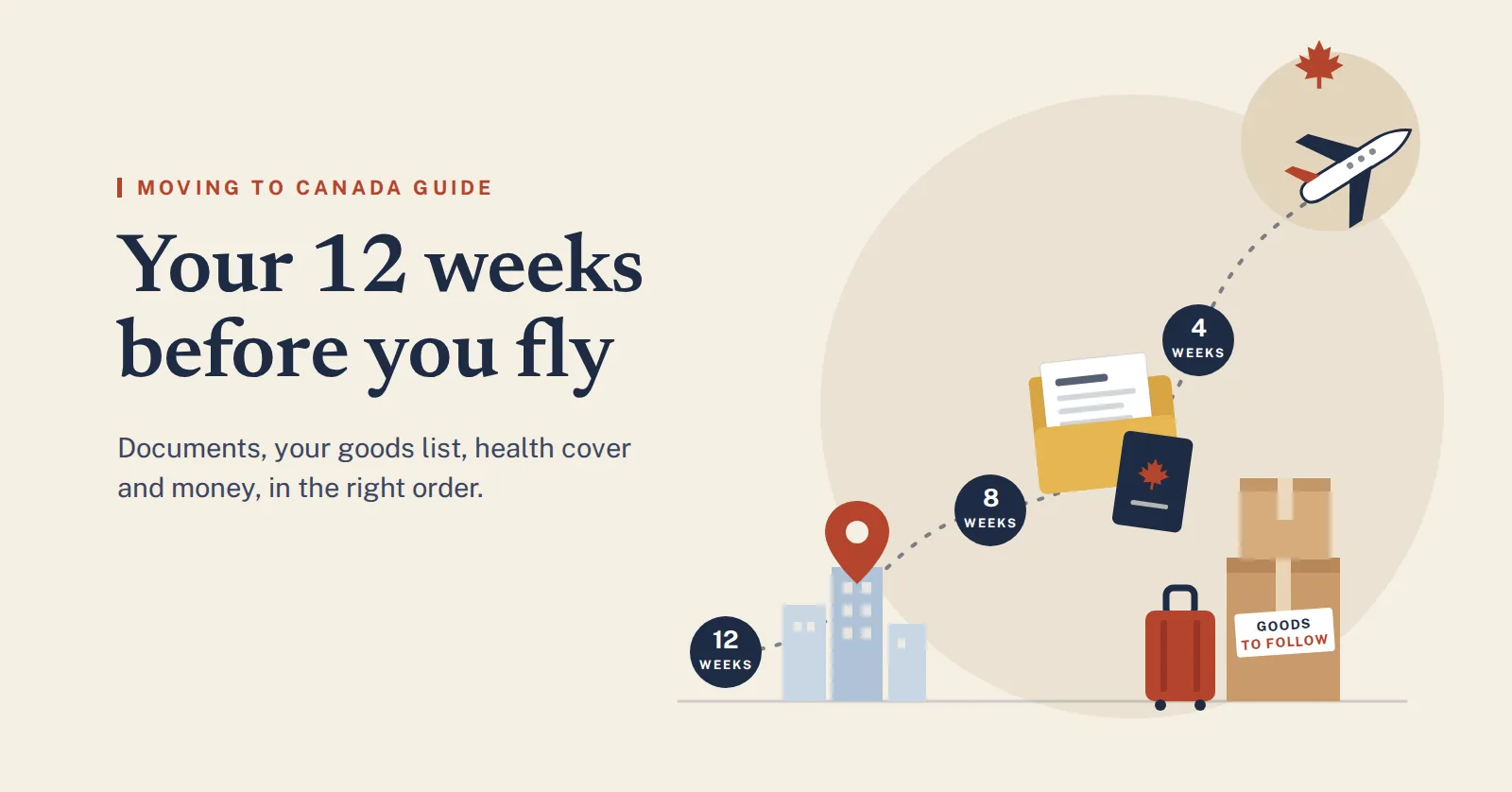
- Your 12-Week Timeline at a Glance
- 12 to 9 Weeks Before: Decide Where and When
- 8 to 5 Weeks Before: Documents, Driving, Work and Money
- 4 to 1 Weeks Before: Your Belongings, Pets and Health Coverage
- Landing Week and Your First Month
- If You Are Moving on a Work or Study Permit
- Five Mistakes That Cost New Arrivals the Most
- Plan Your Move With an RCIC
- Frequently Asked Questions
- Final Thoughts
Moving to Canada: Quick Answer
Once IRCC approves your permanent residence, the immigration part is mostly done. The move is not. The 12 weeks before you fly decide how smooth your first months will be, and most of the costly mistakes new permanent residents make happen here, not at the border.
In short: confirm your COPR expiry date and book your flight well inside it; choose your first city and arrange short-term housing; gather original documents for every family member; prepare two copies of a detailed list of everything you are bringing now and shipping later; arrange private health insurance in case your province has a waiting period; and plan how you will move your money. If you do those six things, landing day becomes a formality.
This guide covers the weeks before you fly. For the flight and the border itself, see Flying to Canada With COPR and Canada Landing Interview Questions. For what to do after you arrive, see First 30 Days in Canada.
Who This Guide Is For
This guide is written for people who have been approved for permanent residence and are preparing to land for the first time, whether through Express Entry, a Provincial Nominee Program, family sponsorship or another program.
If you are moving on a work permit or study permit, most of the planning below still applies, but several rules are different: customs treatment of your belongings, health insurance eligibility and access to free government-funded services. Those differences are collected in one section near the end, so you can check them before you rely on anything here.
Your 12-Week Timeline at a Glance
| When | Focus | Key tasks |
|---|---|---|
| 12 to 9 weeks before | Where and when | Check COPR expiry, choose your first city, plan short-term housing, book flights |
| 8 to 5 weeks before | Paperwork and money | Collect original documents, get a driving record letter, register for pre-arrival services, plan money transfers, get tax advice if you have significant assets |
| 4 to 1 weeks before | Belongings and coverage | Make your goods list, book shipping, prepare pets, buy private health insurance, pack your carry-on document folder |
| Landing week | The border | Present your COPR, declare goods and funds, confirm your mailing address |
| First month | Settling in | SIN, provincial health card, bank account, school registration |
If you have less than 12 weeks, keep the order and compress it. The order matters more than the exact timing.
12 to 9 Weeks Before: Decide Where and When
Check your COPR expiry date first
Your Confirmation of Permanent Residence (COPR) has a validity date, and you must enter Canada on or before it. That date is often tied to your immigration medical exam, so it can be earlier than you expect. Book your flight with a safety margin: flight changes, visa delays for a family member and last-minute illness all happen. Every accompanying family member needs their own COPR, and dependants cannot arrive in Canada before the principal applicant.
Choose your first city with three questions
Many people settle wherever their first job, family or community is. If you have a choice, ask three questions before you commit:
- Where is my work? Look at real job postings in your occupation, not general rankings. Job Bank shows postings and wage ranges by region.
- What will my first year cost? Rent is usually the largest cost and varies widely between and within provinces. Price actual listings in the neighbourhoods you are considering.
- Which province am I choosing? Health insurance, driver's licensing and some settlement programs are provincial. If you came through a Provincial Nominee Program, you are expected to live in the province that nominated you.
Plan short-term housing, not your forever home
Very few people sign a long lease well before they arrive. A common and sensible approach is to book two to four weeks of short-term accommodation, then look for a lease in person once you can view places and show Canadian references.
Two warnings. First, rental scams target newcomers: never send a deposit for a place you have not seen, in person or through a trusted contact. Second, the border officer will ask for a Canadian mailing address for your PR card. A friend's or relative's address works. If you give a temporary address and move within 180 days of arriving, you must update it with IRCC so your card does not go to the wrong place.
8 to 5 Weeks Before: Documents, Driving, Work and Money
Gather original documents for every family member
Documents are much easier to get while you are still in your home country. Collect originals, plus certified English or French translations where needed, for each person:
- Passports and COPRs
- Birth certificates, and marriage or divorce certificates
- Educational diplomas and transcripts
- Reference letters from employers
- Driver's licence and an official driving record letter (see below)
- Immunization records, especially for children, and a summary of any ongoing medical treatment and prescriptions
Keep all of these in a folder that stays in your carry-on. Do not pack originals in checked luggage or shipping boxes.
Driving: get your driving record before you leave
You can drive on your foreign licence for a limited time after you settle, then you must switch to a provincial licence. The period depends on the province: Ontario allows 60 days and British Columbia allows 90 days.
Whether you can simply exchange your licence depends on where it was issued. Each province has exchange agreements with a list of countries. If your country is not on your province's list, you will usually need to pass knowledge and road tests, and your previous driving experience may only count if you can prove it. Before you leave, ask your licensing authority for an official letter confirming your licence and how long you have held it, and get it translated if it is not in English or French. It is far harder to obtain from abroad.
Check the exact rules with your province: ICBC in British Columbia, ServiceOntario, or the licensing office in your province.
Work: register for free pre-arrival services
If IRCC has approved your permanent residence and you are still outside Canada, you can use IRCC's free pre-arrival services. They include settlement planning and job search support, including help with foreign credential recognition, and they connect you with local organizations once you arrive. You qualify with your COPR or another IRCC approval document.
If your occupation is regulated in Canada, such as nursing, engineering, teaching, accounting or the skilled trades, you will need a licence from the provincial regulator before you can work under that title. Start that process now. It often takes months, and some steps can be done from abroad. Your Educational Credential Assessment for immigration does not replace this licensing.
Money: budget, move and declare it correctly
Budget. If you immigrated under a program that required proof of funds, the amount you showed IRCC is a minimum, not a comfortable budget. Price your first three to six months: short-term housing, a rental deposit and first month's rent, furniture, winter clothing, transportation, phone and private health insurance, plus a cushion for the months before your first paycheque. Current proof of funds amounts are on IRCC's proof of funds page, and our proof of funds guide explains how they work.
Move. Most people move savings by bank transfer rather than carrying cash. Some Canadian banks let newcomers open an account before arrival, which gives you a destination for the transfer. Compare exchange rates and fees before you move a large sum.
Declare. If you carry CAN$10,000 or more in cash or monetary instruments, such as bank drafts, cheques or money orders, you must declare it to the Canada Border Services Agency (CBSA) when you arrive. It is a reporting rule, not a limit. See Declaring Money at a Canadian Airport.
Tax: know when you become a Canadian tax resident
According to the Canada Revenue Agency (CRA), you become a resident of Canada for income tax purposes when you have enough residential ties here, which for most newcomers starts on the first day you live in Canada. From then on, Canada generally taxes your income from all sources, including income earned abroad.
Two points to plan for before you move:
- Foreign property reporting. Canadian residents must file Form T1135 when the total cost of their foreign property is more than $100,000 at any time in the year. You do not have to file it for the year you first become a resident. For newcomers, the value of foreign property on the day you arrive becomes the starting point, so keep records of what your assets were worth on that date.
- File your first return even with little income. The CRA uses your tax return to calculate benefit and credit payments, including the Canada child benefit, even if you owe no tax.
If you own property, a business, investments or pensions abroad, speak to a cross-border tax professional before you land. Some planning is only possible before you become a resident.
4 to 1 Weeks Before: Your Belongings, Pets and Health Coverage
Make your goods list: two copies, before you leave
As a first-time settler, you can bring your personal and household goods into Canada free of duty and taxes, if you follow the CBSA's rules. The single most important step happens before you leave.
The CBSA asks you to prepare two copies of a list of all the goods you intend to bring, including the value, make, model and serial number where applicable. Split it into two parts:
- Goods accompanying you: what is in your suitcases.
- Goods to follow: everything arriving later by sea or air freight.
At the border, the officer uses your list to complete Form BSF186, the Personal Effects Accounting Document, and gives it a file number. Goods that arrive later only qualify for duty- and tax-free entry if they are on your original list. Anything you forget to list is treated as an ordinary import. This is why you should declare goods to follow at your first arrival, even if your shipment has not left yet.
The rules to know:
- Owned, possessed and used. Your goods must have been owned, possessed and used by you before you arrived. New items bought just before the move, still in their packaging, generally do not qualify.
- Keep them for a year. If you sell or give away goods within one year of importing them duty- and tax-free, you will have to pay the duty and taxes that were exempted.
- Wedding gifts. If you married within three months before arriving, or will marry within three months after, wedding gifts can qualify even if you have not used them.
- Vehicles. A vehicle made for a market other than the United States or Mexico generally cannot be permanently imported unless it is at least 15 years old or complies with Canadian safety standards. Check before you pay to ship a car.
- Declare restricted items. Food, plants, animals, firearms, cannabis and certain health products must be declared and may be refused. When in doubt, declare it.
Full details are on the CBSA's page on moving or returning to Canada.
Pets need their own paperwork
Bringing a dog or cat is possible, but requirements depend on the animal's species, age and the country it is coming from. Use the Canadian Food Inspection Agency's pet import guidance and check your airline's rules, which are often stricter. Dogs from countries at high risk for dog rabies face extra requirements, and since September 28, 2022, commercial dogs from those countries, including dogs intended to be given to another person or rehomed, have been prohibited. Your own pet travelling with you is treated differently, but check the requirements early: some vaccinations must be given weeks before travel.
Close the health insurance gap
Provincial health insurance is not automatic from the day you land, and in some provinces it does not start right away even after you apply. Ontario has no waiting period for eligible residents. In British Columbia, coverage begins after the rest of the month in which you become a resident plus two more months. Other provinces set their own rules.
Whatever your province, buy private health insurance that starts on your arrival date and runs until your provincial coverage begins. A single emergency room visit without coverage can cost more than the whole policy. Apply for your provincial health card as soon as you have an address; how to do it is covered in First 30 Days in Canada.
If you have children: school records and vaccination history
Public school registration is handled by local school boards. Bring birth certificates, recent report cards or transcripts and immunization records, translated if needed. Some boards also assess English or French language level on registration.
Pack a carry-on document folder
In the last week, put everything the border officer or your first appointments will need into one folder you keep with you: passports, COPRs, proof of funds if you need it, two copies of your goods list, your Canadian mailing address, and the originals listed above.
Landing Week and Your First Month
Landing itself is short if you have prepared. The officer confirms your COPR, asks a few questions about your family situation, admissibility, money and goods, and confirms your mailing address. We cover each step separately:
- Flying to Canada With COPR: what to carry and what happens at the port of entry
- Canada Landing Interview Questions: the questions officers ask and how to answer
- Declaring Money at a Canadian Airport: the CAN$10,000 reporting rule
- First 30 Days in Canada: SIN, provincial health card, bank account, PR card address and schools
- Landing in Canada Checklist: a printable five-stage checklist
If You Are Moving on a Work or Study Permit
Most of this guide applies to you as well, with four important differences:
- Customs. For customs purposes, a "settler" is someone coming to establish a residence for the first time for at least 12 months. People coming to study, or to work for 36 months or less, are not settlers, so the duty-free settlers' effects rules above do not apply in the same way. If you are coming to work for more than 36 months, you are treated as a settler. Ask the CBSA how your belongings will be treated before you ship anything valuable.
- Health insurance. Eligibility for provincial coverage depends on your permit and province. In Ontario, for example, work permit holders generally qualify only if they are working full time for an Ontario employer for at least six months. Many students are covered through their school's plan instead. Check before you arrive.
- Pre-arrival services. IRCC's free pre-arrival services are not available to temporary residents, including international students and temporary workers.
- Your COPR does not exist yet. Everything in this guide about landing as a permanent resident will apply to you later, when you become a permanent resident, whether from inside Canada or by landing at a port of entry.
Five Mistakes That Cost New Arrivals the Most
- Leaving goods off the original list. Anything arriving later that was not on the list you gave the officer at your first arrival can be charged duty and taxes.
- Booking flights too close to the COPR expiry date. A missed connection or a sick child can turn into an expired COPR.
- Arriving without private health insurance in a province with a waiting period.
- Leaving documents behind. Driving records, transcripts and reference letters are hard to get once you have left.
- Paying a rental deposit before seeing the place. Rental scams are aimed at people who are still abroad.
Plan Your Move With an RCIC
Most moves go smoothly with the preparation above. Some do not fit the standard pattern: a family member who will land later, a change in marital status, a PNP nomination for a province you are no longer sure about, or a work permit that is about to become permanent residence. Those are worth talking through before you book anything.
Planning your move to Canada? In a 30-minute strategy session (CA$90), Crystal Jing Chen, RCIC, reviews your timeline, your COPR and landing plan, and anything in your situation that has changed since your application, so you land prepared.
Frequently Asked Questions
How early should I start preparing to move to Canada?
Start as soon as your permanent residence is approved and you know your COPR expiry date. Around 12 weeks gives enough time to gather documents, arrange housing and ship your belongings without rushing. If you have less time, follow the same order and do the document and goods list steps first.
Can I ship my belongings after I arrive and still avoid duty?
Yes, if they are listed as goods to follow on the list you give the border officer at your first arrival. Goods that arrive later only qualify for duty- and tax-free entry if they are on your original list, so list everything before you leave, including items you have not shipped yet.
Do I need private health insurance when I move to Canada?
In many cases, yes. Some provinces, such as British Columbia, have a waiting period before provincial coverage starts, and even without a waiting period there is a gap between arrival and receiving your health card. Private insurance that starts on your arrival date covers that gap.
Can I drive in Canada with my foreign driver's licence?
For a limited time. Ontario allows 60 days and British Columbia allows 90 days before you must switch to a provincial licence. Whether you can exchange your licence directly or must take tests depends on your country and province, so bring an official driving record letter with you.
Do I pay Canadian tax on income from my home country?
Once you become a resident of Canada for tax purposes, which for most newcomers is the day you start living here, Canada generally taxes your income from all sources, including income earned abroad. If you have significant assets or income outside Canada, get professional tax advice before you move.
Can my family move to Canada after me?
Accompanying family members can land with you or after you, but not before you, and each needs their own valid COPR. If a family member will land later, make sure they arrive before their own COPR expires.
Final Thoughts
Moving to Canada is two projects at once: finishing your immigration and moving a household across the world. IRCC's approval completes the first. The second depends on what you do in the weeks before you fly, and most of it is simple once it is in the right order. Check your COPR, choose where you will start, gather your documents, list every item you own that is coming with you or after you, cover the health insurance gap and plan your money. Then landing day is just the first day of your new life in Canada.
This guide is general information, not legal or tax advice. Rules change; confirm current requirements with IRCC, the CBSA, the CRA and your provincial government before you act.