
Open Work Permit Canada: 5 Critical Eligibility Rules to Know
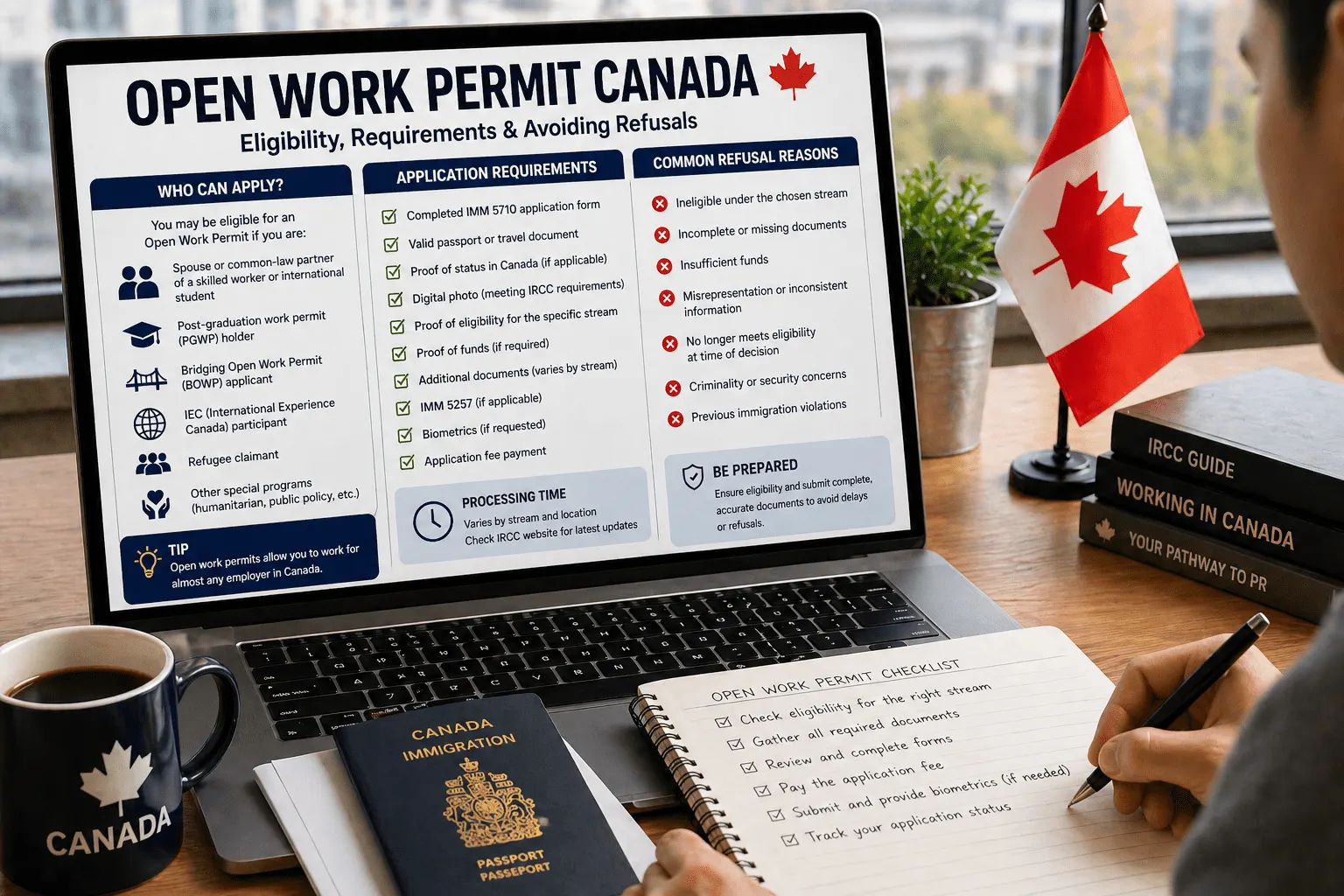
Table of Contents
- What an Open Work Permit Canada Authorization Actually Allows
- Rule 1 – Post-Graduation Work Permit Is the Most Common Open Work Permit Stream
- Rule 2 – Spousal Open Work Permits Depend on Your Partner’s Status
- Rule 3 – Bridging Open Work Permits Keep PR Applicants Working Legally
- Rule 4 – Refugee Claimants and Protected Persons Have Separate Open Work Permit Access
- Rule 5 – Destitute Students and Vulnerable Workers Have Emergency Access Streams
- FAQ
- Final Thoughts
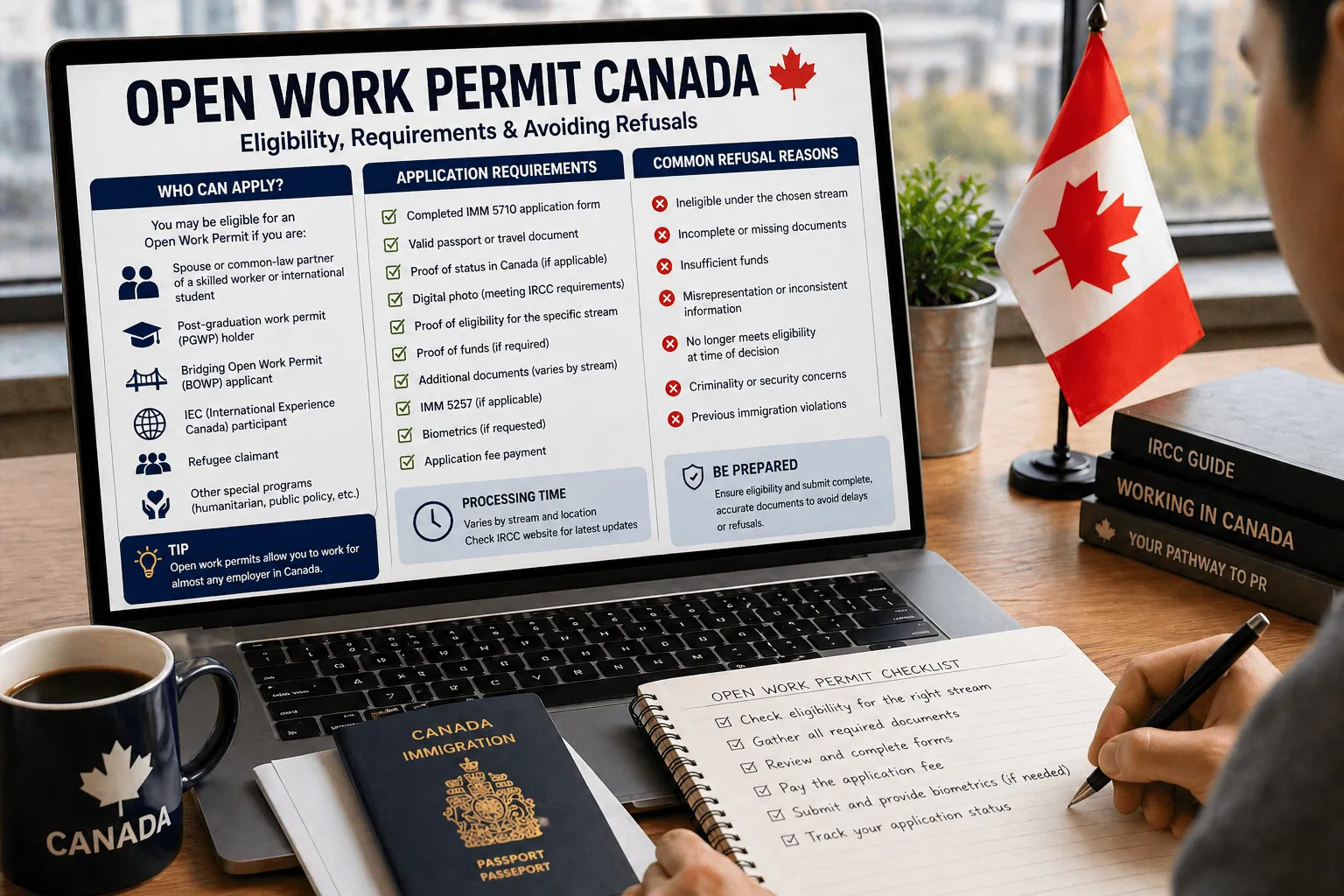
An open work permit Canada authorization gives you the freedom to work for any employer in Canada without being tied to a specific job offer or a specific employer. This flexibility makes open work permits among the most sought-after forms of Canadian work authorization – but they are also among the most misunderstood. Open work permits are not available on request. They are issued only to foreign nationals who qualify under specific eligibility streams, and each stream has its own requirements, application process, and validity conditions.
This article covers the five most critical eligibility rules that determine whether you qualify for an open work permit Canada authorization and which stream applies to your situation.
What an Open Work Permit Canada Authorization Actually Allows
Before covering eligibility, it is important to clarify what an open work permit Canada authorization does and does not permit. An open work permit allows you to work for any employer in Canada in any occupation, with two notable exceptions.
First, open work permits typically include a condition restricting work with employers who are ineligible to hire temporary foreign workers – specifically employers who have been found non-compliant with IRCC’s employer compliance framework. This restriction appears on your permit as a standard condition and does not affect legitimate employment.
Second, some open work permits are restricted to specific provinces or regions depending on the stream under which they were issued. Most open work permits have no geographic restriction, but verify the conditions on your specific permit before accepting employment in a different province than where you applied.
Within these conditions, an open work permit Canada authorization gives you genuine employment flexibility – you can change employers, change occupations, work part-time or full-time, and work in most sectors without obtaining a new work permit for each position change.
Rule 1 – Post-Graduation Work Permit Is the Most Common Open Work Permit Stream
The Post-Graduation Work Permit PGWP is the most widely issued open work permit Canada stream and the one most international students in Canada are planning toward. A PGWP allows eligible graduates of designated learning institutions DLI in Canada to work for any employer for a period linked to the length of their study program.
To qualify for a PGWP, you must have completed a full-time program of at least eight months at an eligible DLI, graduated successfully, and held a valid study permit for the duration of your studies. Your study program must have been at a public post-secondary institution or a private institution authorized to issue degrees. Short-term programs, language schools, and most private career colleges do not qualify.
PGWP duration is tied to program length. Programs of eight months to two years produce a PGWP of the same length as the program. Programs of two years or longer produce a PGWP of three years. A three-year PGWP is the maximum and provides significant time to accumulate Canadian work experience toward Canadian Experience Class CEC eligibility under Express Entry.
You must apply for your PGWP within 180 days of receiving written confirmation of graduation – your official transcript or completion letter. Missing this window means losing PGWP eligibility entirely, with no exceptions.
Rule 2 – Spousal Open Work Permits Depend on Your Partner’s Status
Spousal open work permits are issued to spouses and common-law partners of certain temporary residents in Canada. The eligibility of the spousal open work permit Canada application depends entirely on the status and NOC level of the principal permit holder – not on the spouse’s own qualifications or work history.
Spouses of international students enrolled in full-time programs at eligible DLIs qualify for an open work permit for the duration of the student’s study permit. This stream was expanded in recent years and now covers spouses of students at most post-secondary institutions.
Spouses of temporary foreign workers qualify for a spousal open work permit if the principal worker holds a valid work permit in a NOC TEER 0 or 1 occupation, or in specific NOC TEER 2 or 3 occupations that IRCC has designated as eligible. Spouses of workers in NOC TEER 4 or 5 occupations generally do not qualify for spousal open work permits.
Spousal open work permit applications must be submitted with documentation confirming the relationship – marriage certificate or evidence of common-law partnership for at least one year – and confirmation of the principal permit holder’s current status in Canada. Both permits should ideally be applied for simultaneously or the spousal application should reference the principal permit holder’s current permit details accurately.
Rule 3 – Bridging Open Work Permits Keep PR Applicants Working Legally
A Bridging Open Work Permit BOWP is an open work permit Canada stream specifically designed for permanent residence applicants whose current work permit is expiring before their PR application is decided. Without a BOWP, a worker whose work permit expires during PR processing would lose the ability to work legally in Canada.
To qualify for a BOWP, you must hold a valid work permit that is expiring, have submitted a complete permanent residence application that has been acknowledged by IRCC, and be applying under a permanent residence stream that leads to economic immigration – typically Express Entry or a Provincial Nominee Program.
The BOWP application can be submitted up to 180 days before your current work permit expires. Applying early is advisable because BOWP processing can take several weeks, and a gap between your work permit expiry and BOWP issuance creates a period where you cannot legally work.
A BOWP is typically issued until a decision is made on your permanent residence application. If your PR application is approved, your BOWP becomes irrelevant. If it is refused, your BOWP expires and you must leave Canada or obtain a new temporary status through another stream.
Rule 4 – Refugee Claimants and Protected Persons Have Separate Open Work Permit Access
Refugee claimants and protected persons in Canada have access to open work permit Canada authorization through a separate stream that operates independently of the economic immigration streams above.
Eligible refugee claimants – those who have had a refugee claim accepted for processing by the Immigration and Refugee Board – can apply for an open work permit while their claim is pending. The work permit allows them to support themselves during the claims process, which can take months to years.
Persons who have been recognized as protected persons by IRCC or the Immigration and Refugee Board are eligible for open work permits and may subsequently apply for permanent residence. The work permit issued to protected persons is typically valid for the same period as their protected person status.
This stream has its own documentation requirements and processing pathway that differs from economic immigration open work permit streams. If you are in this situation, the specific requirements are detailed in IRCC’s refugee and humanitarian protection guidelines.
Rule 5 – Destitute Students and Vulnerable Workers Have Emergency Access Streams
The final open work permit Canada eligibility category covers situations that fall outside the standard economic and family-based streams. Two important emergency access streams exist for specific vulnerable populations.
Destitute students – international students who are unable to continue their studies due to circumstances beyond their control, such as the unexpected closure of their institution or a significant financial hardship – may be eligible for an open work permit to support themselves while resolving their situation. Eligibility is assessed case by case and requires documentation of the circumstances that interrupted the studies.
Vulnerable workers – temporary foreign workers who are experiencing abuse or at risk of abuse from their employer – have access to an open work permit stream that allows them to leave their current employer and work for any other employer while their situation is addressed. IRCC processes these applications on a priority basis to protect workers from continued exploitation.
For workers planning to use an open work permit as a pathway to permanent residence through Express Entry, the express entry eligibility guide explains how Canadian work experience accumulated on an open work permit counts toward CEC and FSWP eligibility. For a complete overview of how open work permits fit within Canada’s broader work authorization framework, the work permit Canada requirements guide covers both open and employer-specific permit types in detail.
If you want a pre-submission review of your open work permit application documents before submitting to IRCC, the DIY Document Review service provides a structured assessment against IRCC’s actual review criteria.
FAQ
Who qualifies for an open work permit Canada authorization? Open work permit Canada eligibility is stream-specific. The main qualifying groups are: international graduates of eligible Canadian institutions through the PGWP stream, spouses of international students and certain temporary workers through the spousal stream, PR applicants with expiring work permits through the BOWP stream, and refugee claimants and protected persons through humanitarian streams.
How long is an open work permit Canada valid for? Open work permit Canada validity depends on the stream. PGWP duration matches program length up to a maximum of three years. Spousal open work permits are typically valid for the duration of the principal permit holder’s status. Bridging open work permits are valid until a decision on the permanent residence application. Check the specific validity conditions for your stream.
Can I apply for an open work permit Canada from outside Canada? Yes for some streams and no for others. PGWP applications must be submitted after graduation and can be submitted from inside or outside Canada within 180 days of receiving confirmation of graduation. Spousal open work permit applications can generally be submitted from outside Canada alongside the principal applicant’s permit application. BOWP applications must be submitted from inside Canada.
Does an open work permit Canada allow me to work in any province? Most open work permit Canada authorizations have no geographic restriction and allow work in any province or territory. Some stream-specific permits may include provincial conditions. Always check the specific conditions printed on your permit before accepting employment in a different province than where you applied.
Can I renew my open work permit Canada when it expires? Renewal eligibility depends on your stream. PGWP cannot be renewed – it is issued once per graduate. Spousal open work permits can be renewed as long as the principal permit holder maintains eligible status. BOWP continues until a PR decision and cannot be independently renewed. If your open work permit expires and you do not qualify for renewal, you must apply under a different stream or leave Canada.
Final Thoughts
An open work permit Canada authorization is one of the most valuable forms of Canadian work authorization available – but it is not available to everyone, and it is not available simply by applying. Each stream has specific eligibility criteria that must be met before an application can succeed.
The five eligibility rules in this article cover the streams that account for the vast majority of open work permit Canada applications. PGWP for graduates, spousal permits for partners of eligible temporary residents, and BOWP for PR applicants cover most economic immigration situations. Refugee and vulnerable worker streams cover the remaining humanitarian categories.
Know which stream applies to your situation before you apply. Confirm your eligibility against the specific stream criteria. Submit a complete application with documentation that supports every eligibility claim. An open work permit Canada authorization is a significant advantage in your Canadian immigration journey – prepare your application to match that standard.
This article is for educational purposes only and does not constitute legal or immigration advice. For guidance specific to your situation, consult a licensed RCIC or immigration lawyer.