
PNP Canada Requirements: 5 Critical Things You Must Qualify For
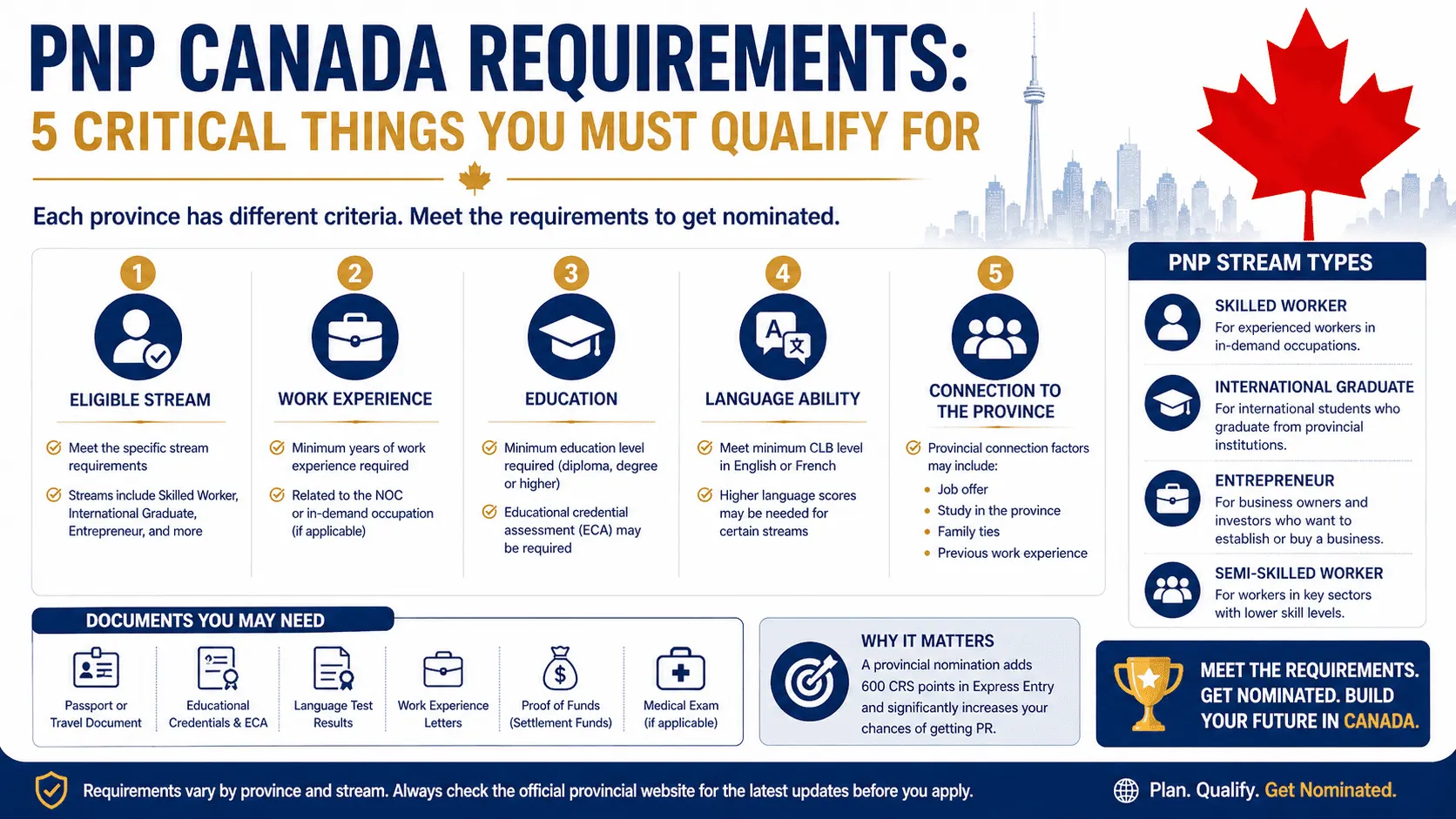
Table of Contents
- Why PNP Canada Requirements Vary So Much by Province
- Requirement 1 – Occupation Eligibility in the Province’s Priority List
- Requirement 2 – Valid Job Offer From a Provincial Employer
- Requirement 3 – Language Proficiency at Provincial Thresholds
- Requirement 4 – Genuine Connection or Intent to Settle in the Province
- Requirement 5 – Meeting Federal Admissibility Standards
- FAQ
- Final Thoughts
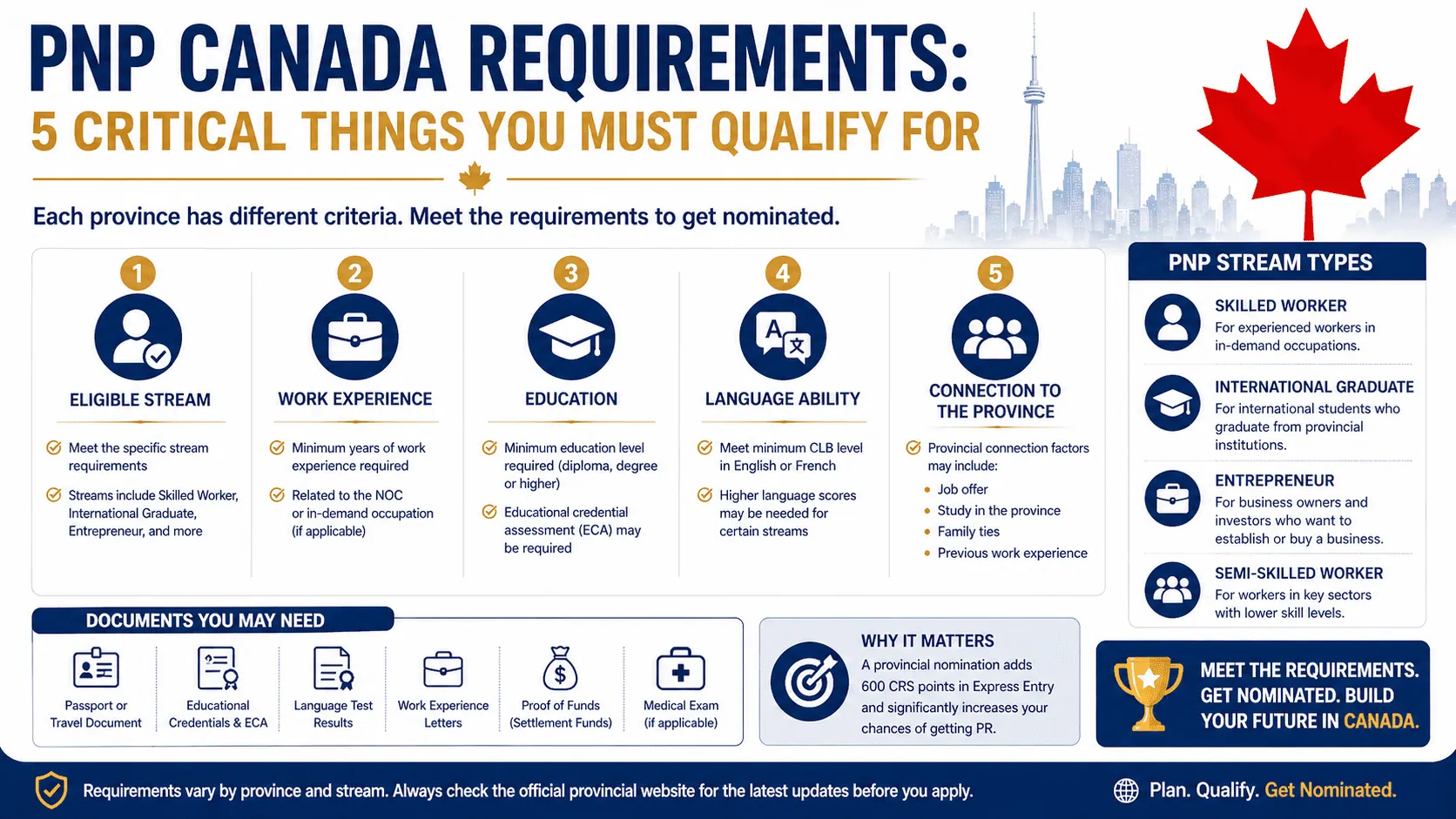
PNP Canada requirements are not uniform across the country. Each province sets its own eligibility criteria, and what qualifies you for a nomination in one province may disqualify you in another. This is the first and most important thing every DIY applicant must understand before investing time in a provincial application: there is no single set of PNP Canada requirements that applies everywhere. There are over 80 active provincial streams, each with its own rules.
This article identifies the five requirement categories that appear across virtually all PNP streams, explains how they vary by province and stream type, and clarifies what each one means for your application strategy.
Why PNP Canada Requirements Vary So Much by Province
Provincial Nominee Programs exist because Canada’s labor market needs differ dramatically by region. A province experiencing a shortage of healthcare workers will prioritize nurses and healthcare aides. A province with a growing technology sector will target software developers and engineers. A province with an aging population and low immigration rates will offer broader eligibility to attract any skilled workers willing to settle there.
This means PNP Canada requirements are deliberately designed to be different. They are not arbitrary – they reflect each province’s current economic priorities and demographic gaps. Applicants who understand this dynamic approach their provincial selection strategically: they identify which provinces have streams that match their occupation, education, and personal connections, not just which province is most popular.
For the broader context of how Canada PNP fits into the overall immigration system alongside Express Entry, the Canada PNP complete guide covers the structural differences between provincial and federal pathways in full detail.
Requirement 1 – Occupation Eligibility in the Province’s Priority List
Every PNP stream targets specific occupations or NOC TEER categories. The first PNP Canada requirement to verify for any stream you are considering is whether your occupation appears on that province’s eligible occupation list or falls within the TEER categories the stream covers.
Some streams are broad – accepting any skilled worker in NOC TEER 0, 1, 2, or 3 occupations. Others are highly specific – targeting nurses, truck drivers, cooks, or technology workers by exact NOC code. Some streams change their eligible occupation lists frequently based on current labor market data, adding and removing occupations as provincial needs shift.
Before starting any provincial application, download the current eligible occupation list for the specific stream you are targeting and verify your NOC code appears on it. Do not assume a stream you researched six months ago still has the same occupation list today. Provincial stream requirements change more frequently than federal requirements.
Requirement 2 – Valid Job Offer From a Provincial Employer
A valid job offer from an employer in the province is a PNP Canada requirement for many – though not all – provincial streams. For streams that require a job offer, the offer must meet specific standards that go beyond a simple employment letter.
The job offer must be full-time and permanent or of an indeterminate duration. It must be from an employer operating in the province who has conducted reasonable efforts to hire locally before offering the position to a foreign national. The wage offered must meet or exceed the provincial median wage for the occupation. And the employer must typically be in good standing with provincial employment standards authorities.
Some provinces require employers to submit their own documentation as part of the PNP application – confirming business registration, payroll records, and the legitimacy of the job offer. The strength and completeness of the employer documentation is a significant factor in provincial assessment of job offer-based applications.
For streams that do not require a job offer – including many Express Entry-linked streams and some international graduate streams – occupation eligibility, language scores, and connection to the province carry more weight in the selection process.
Requirement 3 – Language Proficiency at Provincial Thresholds
Language proficiency is a PNP Canada requirement across virtually all provincial streams, though minimum thresholds vary by stream and occupation type. Provincial language minimums are sometimes lower than federal Express Entry minimums, which is one reason PNP streams provide access for applicants who do not meet federal thresholds.
For most skilled worker streams, provinces require minimum Canadian Language Benchmark CLB 4 to CLB 7 depending on the occupation and stream. Healthcare and professional occupations typically require higher language thresholds. Semi-skilled and trade occupations sometimes accept CLB 4 or CLB 5.
Language scores must be from an IRCC-approved test – IELTS General Training or CELPIP General for English, TEF Canada or TCF Canada for French. Some provinces accept results from tests taken within the past three years rather than the standard two-year validity period for federal applications. Check the specific language result validity rules for the province you are targeting.
Higher language scores strengthen your application even when the minimum is met. In competitive streams where multiple candidates meet the minimum requirements, language scores are often a differentiating factor in selection.
Requirement 4 – Genuine Connection or Intent to Settle in the Province
Connection to the province is a PNP Canada requirement that is harder to quantify than language scores or occupation eligibility – but it is equally important in practice. Provinces select nominees they believe will settle and contribute to the local economy. Applications from candidates with no provincial connection and no documented intent to settle are viewed with skepticism at best and refused at worst.
Genuine connection factors that strengthen a provincial application include: previous work experience in the province, a Canadian degree or diploma from a provincial institution, a valid job offer from a provincial employer, family members currently living in the province, or a previous visit or period of residence in the province.
Documented intent to settle is expressed through a settlement plan submitted as part of many provincial applications. A settlement plan describes where you intend to live, how you will find work if you do not have a job offer, and what ties you have to the community. A vague or generic settlement plan is a common reason for provincial application refusal.
Do not apply to a province you have no intention of settling in. Provinces share information with IRCC, and a pattern of applicants using provincial nominations as stepping stones to preferred destinations creates scrutiny for the entire PNP stream.
Requirement 5 – Meeting Federal Admissibility Standards
The final PNP Canada requirement applies not at the provincial stage but at the federal stage – and it is non-negotiable. Every provincial nominee must meet federal admissibility standards before IRCC will issue permanent residence. A provincial nomination does not override federal inadmissibility.
Criminal inadmissibility, medical inadmissibility, misrepresentation in any previous immigration application, and outstanding removal orders can all result in federal refusal of a PNP application even after a valid provincial nomination has been issued. The province cannot override IRCC’s admissibility assessment.
Medical examinations through IRCC-designated panel physicians are mandatory for all PNP applicants at the federal stage. Police certificates from every country of residence for six months or more in the past ten years are required. These are the same federal requirements that apply to Express Entry applicants.
If any admissibility concern applies to your background, assess it carefully – ideally with guidance from a licensed RCIC or immigration lawyer – before investing in a provincial application that may succeed at the provincial stage and then be refused federally.
If you want a pre-submission review of your PNP document package before submitting to the province or to IRCC, the DIY Document Review service provides a structured assessment against both provincial and federal document standards.
FAQ
What are the basic PNP Canada requirements across most provinces? The core PNP Canada requirements across most provincial streams include: occupation eligibility in the province’s target NOC categories, language proficiency at the stream’s minimum CLB threshold, a valid job offer from a provincial employer in many streams, genuine connection or documented intent to settle in the province, and federal admissibility with no criminal or medical bars.
Can I apply for PNP Canada without a job offer? Yes. Many provincial streams do not require a job offer, including most Express Entry-linked streams and international graduate streams. However, having a valid job offer from a provincial employer significantly strengthens applications in streams where it is optional, and is a mandatory PNP Canada requirement in many of the most accessible streams.
Do PNP Canada requirements include a minimum CRS score? For base streams that operate outside Express Entry, there is no CRS score requirement – the provincial selection process is independent of your federal CRS score. For Express Entry-linked streams, provinces may set a minimum CRS score threshold for issuing Notifications of Interest, though these thresholds vary by province and stream.
How long are PNP Canada requirements in effect before they change? Provincial stream requirements – including eligible occupation lists, language thresholds, and job offer standards – can change at any time. Some provinces update their streams quarterly or in response to labor market changes. Always verify current requirements directly from the provincial immigration authority website before starting your application.
What happens if I meet PNP Canada requirements but my federal application is refused? If your federal application is refused after receiving a valid provincial nomination, the refusal is final for that application. You can appeal on procedural grounds or address the refusal reason and reapply, but the provincial nomination does not automatically carry over. Assess federal admissibility carefully before investing in the provincial application stage.
Final Thoughts
PNP Canada requirements are specific, variable, and provincial. Understanding the five requirement categories in this article gives you a framework for evaluating any provincial stream – but the details must always be verified against the current criteria for the specific stream you are targeting.
The most common mistake in PNP Canada applications is treating provincial requirements as a lower bar than federal requirements. They are not lower – they are different. A province may accept a lower language score than Express Entry while simultaneously requiring a stronger provincial connection than the federal system ever would.
Research your target province thoroughly. Verify your occupation eligibility, confirm your language scores meet the stream minimum, document your provincial connection genuinely, and assess your federal admissibility before you start. PNP Canada requirements are clear – the question is whether your preparation addresses all of them.
This article is for educational purposes only and does not constitute legal or immigration advice. For guidance specific to your situation, consult a licensed RCIC or immigration lawyer.