
Reapply After PR Refusal Canada: 5 Critical Steps to Succeed
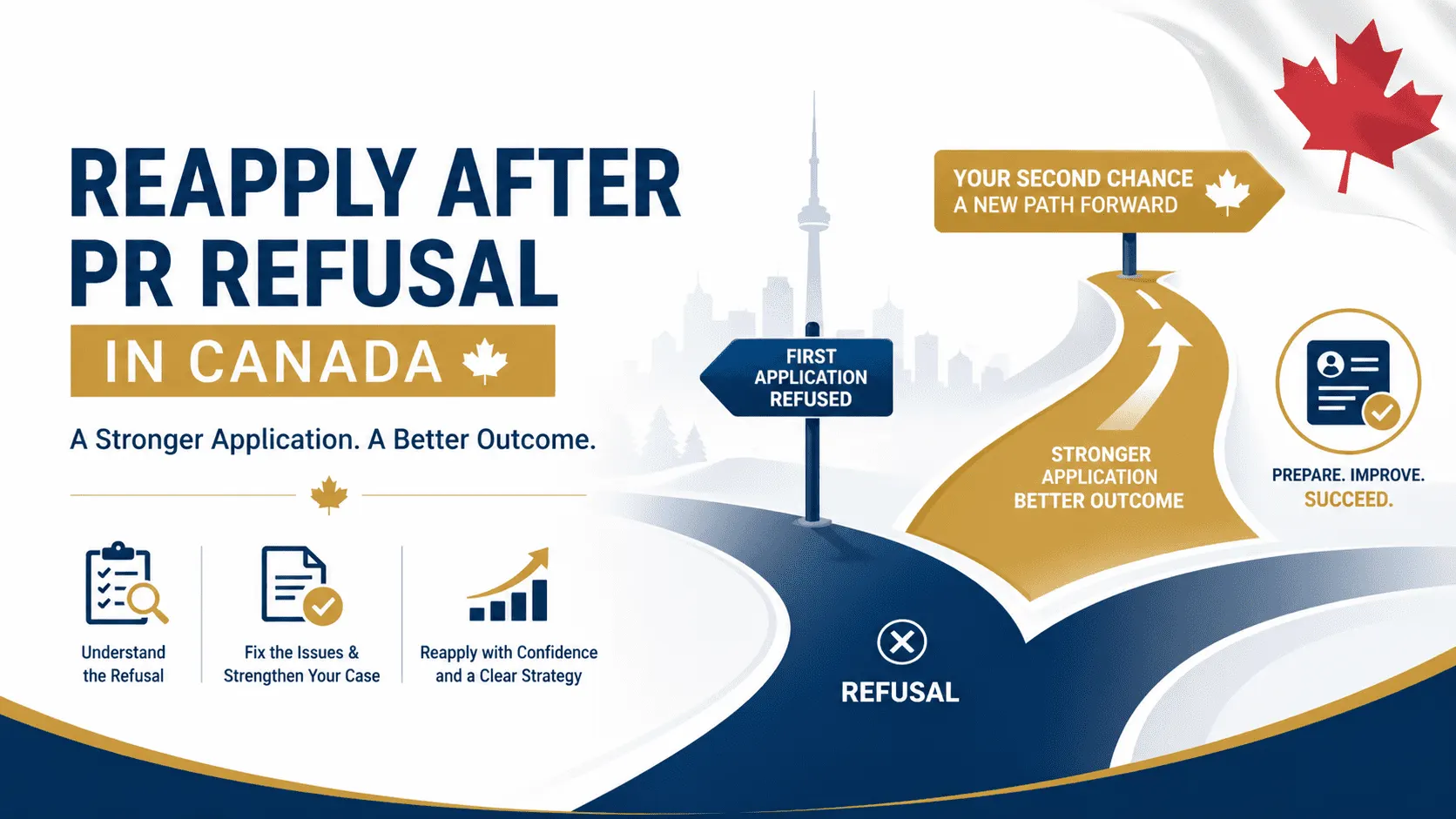
Table of Contents
- When Reapplication Is the Right Path Forward
- Step 1 – Obtain and Analyze Your GCMS Notes Before Reapplying
- Step 2 – Identify and Fix Every Document Weakness, Not Just the Refusal Reason
- Step 3 – Address the Previous Refusal Directly in Your New Application
- Step 4 – Consider Whether Your Program or Pathway Has Changed
- Step 5 – Have Your Complete Package Reviewed Before Submitting
- FAQ
- Final Thoughts
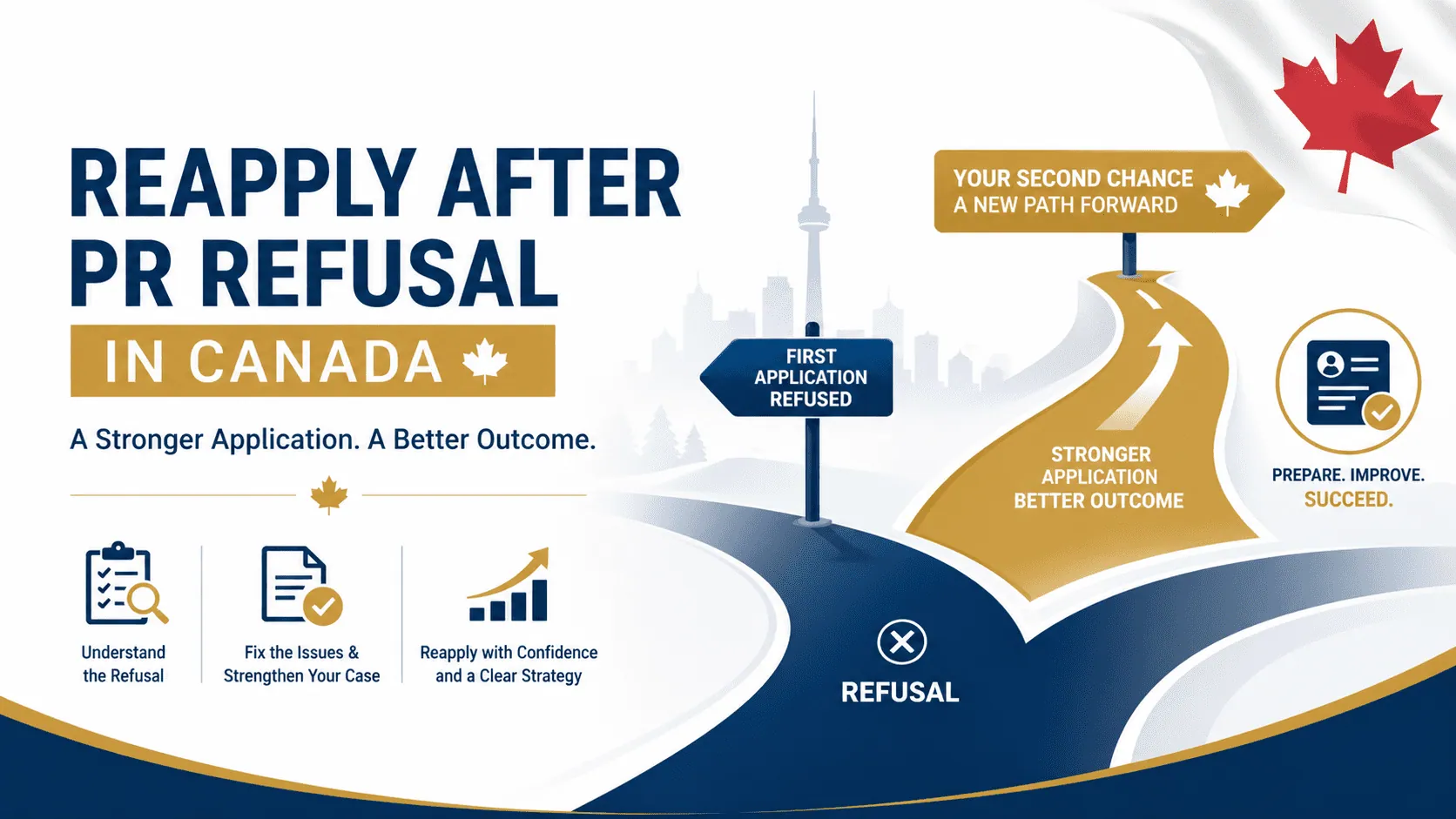
The decision to reapply after pr refusal canada is one that requires careful analysis before action. Reapplying too quickly without addressing the root cause of the refusal is the most common mistake applicants make after a negative decision – and it is the one most likely to produce a second refusal. IRCC officers reviewing a reapplication can see your application history. A file that shows multiple refusals for the same reason signals an applicant who does not understand why they were refused, not one who has fixed the problem.
This article covers the five critical steps for a successful reapplication after a Canadian permanent residence refusal.
When Reapplication Is the Right Path Forward
The decision to reapply after pr refusal canada versus pursuing an appeal or judicial review depends on the type of refusal you received. Reapplication is typically the right path when the refusal reason is a fixable deficiency – insufficient evidence, expired documents, or a documentation gap that can be addressed with stronger evidence in a new application.
Judicial review is more appropriate when the refusal appears to be based on a legal error, an unreasonable assessment of your documents, or a procedural failure by IRCC. The Federal Court will not substitute its opinion for the officer’s on factual matters, but it will correct decisions that are unreasonable or legally flawed.
For a complete overview of the options available after a refusal and how to assess which is right for your situation, the Canada PR refusal guide covers every pathway in detail. For understanding how to respond to an IRCC procedural fairness letter if one was issued before your refusal, the IRCC procedural fairness letter response guide covers the response process step by step.
Step 1 – Obtain and Analyze Your GCMS Notes Before Reapplying
Attempting to reapply after pr refusal canada without reading your GCMS notes is one of the most preventable mistakes in the reapplication process. The refusal letter gives you the formal reason. The GCMS notes give you the officer’s full reasoning – what they found, what they doubted, which documents they reviewed, and what concerns drove the decision.
Request your GCMS notes through an Access to Information and Privacy ATIP request to IRCC. The request is free and notes are typically provided within 30 to 60 days. Read them alongside your refusal letter and your original application documents to build a complete picture of what the officer saw and what they concluded.
The GCMS notes may reveal concerns beyond what was stated in the refusal letter – concerns that would affect your reapplication even though they were not the formal basis for the refusal. Addressing only the stated refusal reason while leaving other document weaknesses unaddressed is a common reason reapplications fail.
Timing matters while you wait. ATIP processing runs in parallel with the deadlines that govern your other options, and some of those deadlines are short. Before you commit to reapplying, review the timing mistakes that quietly remove options after a refusal.
Step 2 – Identify and Fix Every Document Weakness, Not Just the Refusal Reason
A reapplication after pr refusal canada is an opportunity to submit a comprehensively stronger application – not just to patch the specific hole identified in the refusal letter. IRCC officers reviewing reapplications have access to your application history and will be attuned to whether the second application genuinely addresses the identified weaknesses or simply repackages the same material with minor changes.
Work through every document category systematically. Employment reference letters should explicitly confirm your NOC main duties, hours, compensation, and the employer’s contact information. Language test results should be current – not expired – and as strong as possible for your target program. Proof of funds should show a complete six-month statement history with no unexplained large deposits and a current bank letter dated within six months of submission. Personal history documents should cover every period of your life without unexplained gaps.
The standard you are building toward is not the minimum required for eligibility. It is the standard that leaves no room for doubt in the officer’s assessment. A reapplication that meets the minimum is an invitation for the same scrutiny that produced the first refusal. A reapplication that exceeds the standard on every document gives the officer nothing to question.
Step 3 – Address the Previous Refusal Directly in Your New Application
When you reapply after pr refusal canada, IRCC’s system flags that a previous application was refused. The officer reviewing your new application will know about the refusal and will be looking for evidence that the situation has changed. Failing to acknowledge the previous refusal and explain what has changed is a transparency failure that raises questions about your credibility.
Include a cover letter with your reapplication that acknowledges the previous refusal, identifies the reason as you understand it, and explains specifically what you have done to address it. If the refusal was for insufficient proof of funds, your cover letter should explain that you now have six months of complete bank statements showing a stable balance, an updated bank letter, and documented source of funds for any large deposits. If the refusal was for work experience documentation, explain that you have obtained new reference letters that explicitly confirm your NOC main duties.
The cover letter is not an appeal of the previous decision. It is a factual explanation of what has changed. Keep it professional, specific, and evidence-referenced. Every claim in the cover letter should be supported by a document included in the application package.
Step 4 – Consider Whether Your Program or Pathway Has Changed
A reapplication after pr refusal canada is sometimes an opportunity to reconsider not just the quality of your documents but the program under which you are applying. If the refusal revealed that your qualifications do not clearly meet the requirements of your original program, a different program or pathway may be more appropriate for your actual profile.
For Express Entry applicants refused under FSWP for work experience reasons, CEC eligibility may be achievable after accumulating additional Canadian work experience. For applicants refused under a provincial nominee program for insufficient provincial connection, another province’s stream may be a better fit for your actual ties and qualifications.
Changing programs is not an admission of weakness. It is a recognition that immigration programs are designed for specific applicant profiles and that matching your profile to the right program is as important as document quality. A strong application under the right program is more likely to succeed than a strong application under a program that does not fit your profile.
Step 5 – Have Your Complete Package Reviewed Before Submitting
The single most effective action you can take before reapplying after pr refusal canada is having your complete document package reviewed by someone who understands IRCC’s assessment criteria – before you submit it. The cost of a pre-submission review is small relative to the government fees, professional fees, and time invested in a reapplication. The cost of a second refusal due to a document gap that a review would have caught is much larger.
A thorough pre-submission review checks every document in your package against the standard IRCC officers apply. It identifies inconsistencies between documents, catches missing required fields in letters and forms, flags documents that are approaching expiry, and verifies that your application tells a consistent story across every category.
The DIY Document Review service provides exactly this type of structured pre-submission assessment – a systematic check of your complete reapplication package against IRCC’s actual document standards before it reaches an officer’s desk.
FAQ
How long should I wait before I reapply after PR refusal Canada?
There is no mandatory waiting period before you reapply after pr refusal canada in most cases. However, reapplying before you have genuinely addressed the refusal reason is unlikely to succeed. Take whatever time is needed to obtain your GCMS notes, understand the root cause of the refusal, fix every document weakness, and build a comprehensively stronger application.
Will IRCC know about my previous refusal when I reapply?
Yes. IRCC’s system maintains a record of all previous applications including refusals. Officers reviewing your reapplication will be able to see that a previous application was refused. This is why acknowledging the previous refusal and explaining what has changed in a cover letter is important for your reapplication credibility.
Can I reapply under a different program after a PR refusal?
Yes. A refusal under one program does not bar you from applying under a different program if you meet that program’s eligibility requirements. If the refusal revealed that your profile is a better fit for a different program or pathway, changing programs for your reapplication is a legitimate and often effective strategy.
What documents should I update when I reapply after PR refusal Canada?
All time-sensitive documents should be updated for a reapplication. This includes bank statements covering the most recent six months, a current bank letter, any reference letters that are more than two years old, language test results if they are approaching expiry, and police certificates if they are approaching expiry. Do not reuse documents from your original application that may now be stale.
Is reapplying after PR refusal Canada the same as appealing the decision?
No. Reapplying is submitting a new application, which starts a fresh review process. Appealing – through judicial review at the Federal Court – is challenging the legal validity of the original refusal decision. Both options may be available after a refusal, but they follow different processes with different standards and timelines. Assess which is appropriate for your situation before deciding which path to pursue.
Final Thoughts
The path to reapply after pr refusal canada starts not with a new application form but with a complete understanding of why the first application failed. GCMS notes, a systematic document review, a cover letter that acknowledges the history, and a pre-submission check are the tools that turn a reapplication from a repeated gamble into a calculated second attempt.
The applicants who succeed when they reapply after pr refusal canada are not those who apply faster. They are those who apply smarter – with a complete understanding of what went wrong, a genuine fix for every identified weakness, and a document package that gives the reviewing officer no reason to repeat the previous decision.
A refusal is specific information about a specific problem. Use it to build a better application.
This article is for educational purposes only and does not constitute legal or immigration advice. For guidance specific to your situation, consult a licensed RCIC or immigration lawyer.