
How to Verify a Canadian Immigration Consultant: Check the CICC Public Register
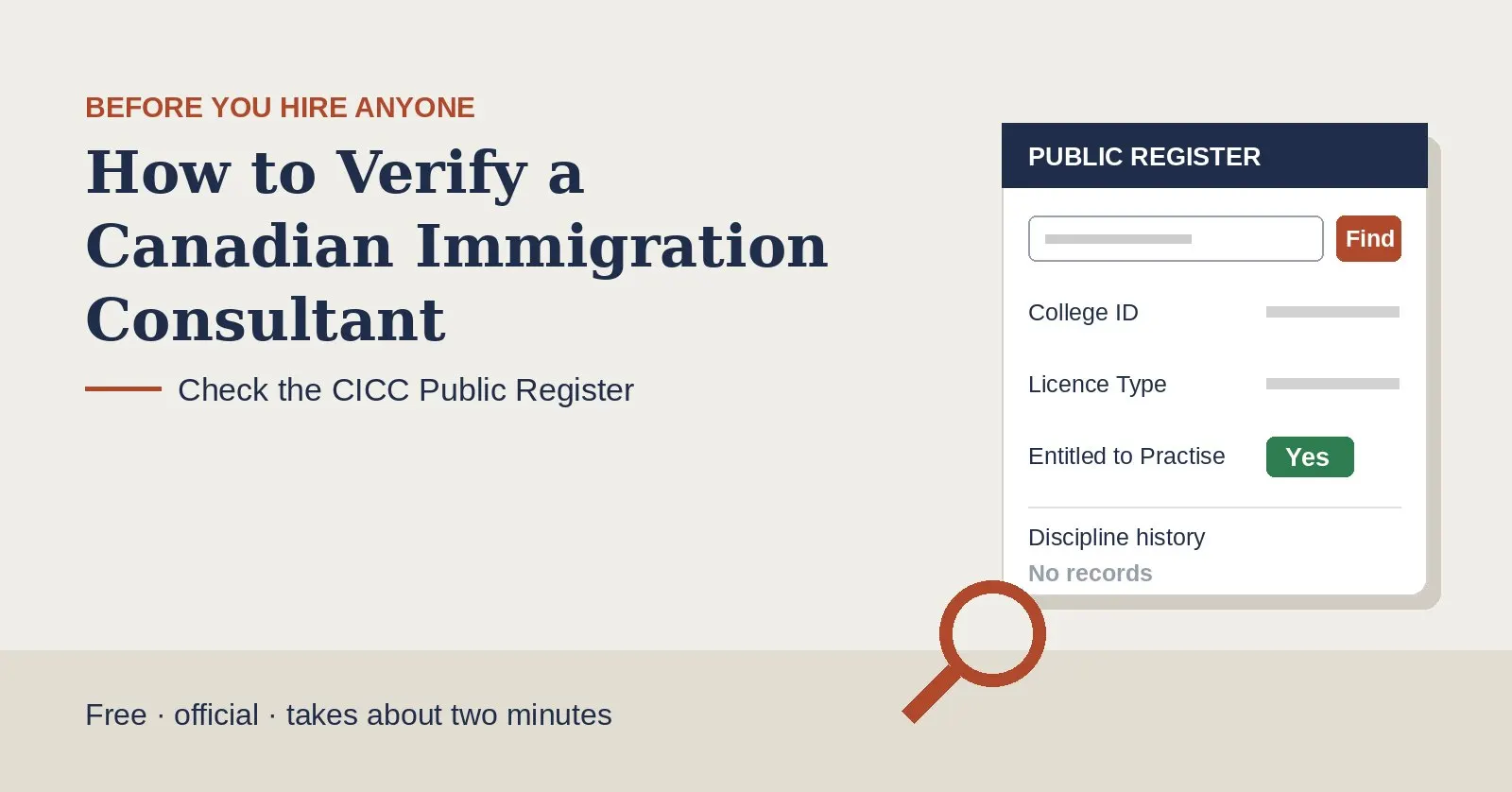
To verify a Canadian immigration consultant, go to the College of Immigration and Citizenship Consultants (CICC) Public Register at register.college-ic.ca, choose Search for an RCIC, and search by the consultant's name or College ID (their licence number, which starts with R). Two things matter: the Entitled to Practise column must say Yes, and their profile should show no suspension or revocation (if there is a practice restriction, read what it covers). It takes a minute or two. If the person is not on the register, they may be a lawyer or a Quebec notary, who are checked with their law society or the Chambre des notaires du Québec instead. If they are on none of those lists but want to be paid to help with your application, they are not authorized, and IRCC will not deal with them.
Do this before you pay, sign anything or hand over documents, and trust only what you see on the official register yourself, never a screenshot or certificate someone sends you.
Table of Contents
- Verify an Immigration Consultant: Quick Answer
- Who Can Legally Charge You for Immigration Help
- How to Search the CICC Public Register, Step by Step
- How to Read the Result: Licence Class and Status
- What If the Person Is Not on the Register?
- Six Checks Before You Sign
- Where to Complain or Report
- RCIC, RCIC-IRB or Lawyer: Who Can Do What
- Frequently Asked Questions
- Final Thoughts
Verify an Immigration Consultant: Quick Answer
| Question | Short answer |
|---|---|
| Where do I check? | The CICC Public Register, register.college-ic.ca. Free, no account needed |
| What can I search by? | First name, last name, College ID, company name, country, city |
| What do I look at? | Entitled to Practise: only "Yes" means they can practise. Then open the profile and read the discipline history |
| Not listed? | They may be a lawyer, Quebec notary or Ontario paralegal: check their regulator. Listed nowhere but charging a fee means unauthorized |
| What if I use an unauthorized representative? | IRCC says it won't deal with them and may return or refuse your application |
| Is a valid licence enough? | No. You still need a written agreement, signed receipts, your original documents back, and no blank forms signed |
| Who handles complaints? | CICC for licensed consultants; unauthorized representatives can be reported to CICC, IRCC, the CBSA and the Canadian Anti-Fraud Centre |
Who Can Legally Charge You for Immigration Help
Section 91 of the Immigration and Refugee Protection Act prohibits anyone from knowingly representing or advising a person for consideration in connection with an immigration application or proceeding, unless they belong to one of the groups the Act allows. IRCC calls these people authorized representatives:
| Authorized representative | Must be a member in good standing of |
|---|---|
| Immigration or citizenship consultant (RCIC) | College of Immigration and Citizenship Consultants (CICC) |
| Lawyer, or notary in Quebec | A Canadian provincial or territorial law society; the Chambre des notaires du Québec |
| Paralegal (Ontario only) | Law Society of Ontario |
Breaking section 91 is an offence. On conviction on indictment, the maximum is a fine of $200,000, two years in prison, or both. On summary conviction, the maximum is a fine of $40,000, six months in prison, or both.
The practical risk for you is on the IRCC side. IRCC states that it won't deal with representatives who charge a fee but are not authorized, and that if you use an unauthorized representative, in Canada or abroad, it may return your application or refuse it.
Two points people often get wrong:
- A friend or family member can help you for free. IRCC calls them unpaid representatives. The rule is about payment: as soon as someone receives a fee or any other form of payment, they must be an authorized representative.
- A representative does not make your application faster or more likely to be approved. In IRCC's words, using one will not draw special attention to your application and doesn't mean it will be approved. All forms and instructions are free on the IRCC website, and many people apply on their own.
How to Search the CICC Public Register, Step by Step
The CICC is the federal regulator for immigration consultants. It licenses them, sets the Code of Professional Conduct, handles complaints and imposes discipline. Its Public Register is the official record of who holds a licence. No third-party directory, screenshot or certificate replaces it.
- Open the register yourself. Type register.college-ic.ca into your browser, or go to college-ic.ca and find "Find an Immigration Consultant". Do not rely on a link someone sends you.
- Choose the list. RCICs and RISIAs (Regulated International Student Immigration Advisors) are listed separately. Most people need Search for an RCIC.
- Search. You can search by first name, last name, College ID, company name, country or city. The College ID is the most precise. For names, use the spelling on the person's licence, with first and last names in their own fields.
- Read the results list. Each result shows the College ID, name, company, licence type and entitlement to practise.
- Open the profile. The profile shows licence status, licence history, contact information and discipline history, including suspensions, revocations, restrictions, current proceedings and past decisions.
While you are there, confirm that the name matches the person you are dealing with, that the company matches the one on your agreement and receipts, and that the contact details line up.
How to Read the Result: Licence Class and Status
Licence class (the Type column):
| Class | What it means |
|---|---|
| L1: RCIC | New licensee in their first year, before completing the mentoring program |
| L2: RCIC | Full scope of practice; completed mentoring or licensed before July 2022 |
| L3: RCIC-IRB | Full scope, plus qualified to represent clients before the Immigration and Refugee Board |
| L4, L5: RISIA | International student immigration advisor: may advise international students and their dependants on study permits, temporary resident visas and related permits only; cannot represent you or complete immigration forms for you |
Status. The key column is Entitled to Practise: Yes or No. Behind it are two groups of statuses:
- Authorized to practise: Active (in good standing); Active - Practice Restricted (open the profile and read what the restriction is).
- Not authorized to practise: Leave of Absence; Resigned, Resigned - Called to the Bar, or Resigned - While Under Investigation; Administrative Suspension or Administrative Revocation; Disciplinary Suspension or Disciplinary Revocation; Deceased.
If the status is in the second group, do not hire them, whatever the explanation ("my renewal is in progress", "I work under my colleague's licence").
What If the Person Is Not on the Register?
Rule out three ordinary explanations first:
- They are a lawyer or notary. Lawyers are not on the CICC register. Check the law society of the province where they practise. Quebec notaries are listed by the Chambre des notaires du Québec, and Ontario paralegals by the Law Society of Ontario. The CICC register page also notes that immigration advice can be licensed by a Canadian law society or the Chambre des notaires du Québec, not only by CICC.
- The spelling is off. Search by College ID instead, or by last name only.
- You searched a company. Licences belong to individuals, not firms. Ask exactly who will handle your file and search for that person.
If none of these apply and the person still wants to be paid to prepare or submit your application, they are what CICC calls an unauthorized practitioner (UAP). CICC gives common examples: travel agents helping with visitor visas, labour recruiters putting together work permit applications, and student recruiters submitting study permit applications along with school applications. None of them are authorized to provide immigration services unless they are also a Canadian lawyer, a Quebec notary or a CICC licensee. A large social media following, a polished website or a "success rate" tells you nothing about authorization.
Six Checks Before You Sign
A valid licence means the person may practise. It does not guarantee good service. Combining IRCC's advice on choosing a representative with what the CICC Code requires, check these six things before you sign:
- Get a written agreement and read it first. Section 23 of the CICC Code of Professional Conduct requires a licensee to sign a written service agreement with you before providing services. It must include, among other things, the licensee's name and registration number, an itemized list of services, fee estimates and payment terms, how advance payments and refunds are handled, the licensee's confidentiality obligation and their own complaint procedure, and a description of CICC's role as regulator and its complaints process. If your agreement is missing these, ask why.
- Get a signed receipt for every payment, made out by the same person or firm named in the agreement.
- Do not leave original documents or photos with your representative.
- Never sign blank forms, and never sign anything you cannot read. Ask for an explanation of every form in a language you understand.
- Be wary of anything that sounds too good to be true. Guaranteed approval, "special attention" from IRCC, inside contacts, or advice to give false information are all red flags. The applicant carries the consequences of false information, which can include a misrepresentation finding and a five-year ban from Canada. Read why no one can guarantee approval.
- Ask for regular updates and copies of everything your representative prepares or submits for you.
When you appoint a paid representative, you both sign the Use of a Representative form (IMM 5476), which includes the representative's membership ID. Before you sign, check that the number matches what you found on the register.
Where to Complain or Report
If the person is a licensed consultant, complain to CICC. You file online through the complaints page on the CICC website (Protecting the Public, then Complaints Process, then Make a Complaint). If CICC closes your complaint without referring it for discipline and you disagree, you can ask the Independent Complaints Review Officer to review it by sending a Request for Review form to [email protected] within 30 days of the decision. Two more things to know:
- The complaints process looks at professional conduct, not fees. According to CICC, a complaint that only asks for a refund because an application was refused will be closed if the fees were reasonable and there is no evidence the licensee acted unprofessionally.
- CICC runs a Compensation Fund for theft, fraud and misappropriation of funds, and for misrepresentation or counselling misrepresentation, by licensees. According to CICC (page updated July 2026), the dishonest act must have happened on or after November 23, 2021, you must have filed a complaint with CICC, the final decision must be made on or after July 15, 2026, and you cannot have taken part in the dishonest act. The maximum payout is $7,000 per successful claim. It only protects clients of licensees. Losses caused by an unauthorized practitioner are outside it, which is one more reason to verify first.
If the person is a lawyer, notary or paralegal, complain to their law society or to the Chambre des notaires du Québec.
If the person is not authorized, you can:
- report the unauthorized practitioner to CICC through the CICC Portal (you need to create an account);
- report the representative to IRCC using its online form;
- call the Canada Border Services Agency Border Watch Line;
- report the scam to the Canadian Anti-Fraud Centre, and to your local police or the RCMP if money was taken.
IRCC says its goal is to find and stop the people committing fraud, not to punish the people who were misled. If you think you have been scammed, stop giving the person any documents or account access, sign in to your own IRCC account to see what was actually submitted, and keep every message, receipt and contract.
Reports do lead to results. In May 2024, the CBSA announced that a person running an unlicensed immigration consulting business in Edmonton, Alberta, who had charged clients, created fake job offers and forged documents, pleaded guilty under section 91 and received an 18-month conditional sentence, including six months of house arrest, plus an order to repay $148,000 to victims.
RCIC, RCIC-IRB or Lawyer: Who Can Do What
- RCIC (L1, L2): can act as your authorized representative with IRCC. Cannot represent you before the Immigration and Refugee Board (IRB) or in Federal Court. Regulated by CICC.
- RCIC-IRB (L3): everything an RCIC can do, plus representing you before the IRB, including the Immigration Appeal Division. Cannot represent you in Federal Court. Regulated by CICC.
- Immigration lawyer: all of the above, plus representing you in Federal Court, for example on judicial review. Regulated by a provincial or territorial law society.
For most routine applications (Express Entry, provincial nominee programs, work and study permits, family sponsorship), all three can legally represent you, and experience with your type of case matters more than the title. The class matters when you need an appeal or a court challenge. For costs, see how much Canadian immigration really costs.
Frequently Asked Questions
Can I trust a screenshot of a consultant's licence? No. Screenshots and certificates can be faked, and a certificate only shows that someone held a licence on some past date. The only reliable source is the live CICC Public Register, checked by you.
If the register says "Yes" today, is the consultant licensed for good? No. Status can change, for example after a leave of absence, a resignation or an administrative or disciplinary action. A search only reflects the day you run it. Check before you sign and again before important steps, such as submitting your application.
Is it illegal for a relative to help me fill in my forms? Not if they are not paid. IRCC allows family members and friends who charge nothing to act as unpaid representatives. Anyone who receives a fee, a gift or any other payment must be an authorized representative.
I already paid someone and just found out they are not licensed. What now? Act quickly. Stop sending documents or account details, sign in to your IRCC account to see what was submitted and with what information, save all records, and report the person to CICC, IRCC, the CBSA or the Canadian Anti-Fraud Centre. If your application contains errors or false information, get a licensed consultant or lawyer to assess how to correct it as soon as possible.
What is the difference between an RCIC and a RISIA? A RISIA is a Regulated International Student Immigration Advisor. RISIAs may only advise international students and their dependants on study permits, temporary resident visas and related permits. They cannot represent you in any immigration or citizenship case or complete immigration forms for you. The register lists RCICs and RISIAs separately.
How can I verify Crystal Jing Chen, RCIC? On the CICC Public Register, choose Search for an RCIC and enter College ID R515424, or the name Jing Chen. As of September 30, 2026, the register lists her as an RCIC eligible to provide services, with no suspensions, revocations, restrictions or proceedings on record. Please rely on your own search on the day you check.
Final Thoughts
Verifying a consultant comes down to three habits: check the official register yourself (or the law society for a lawyer) instead of trusting a screenshot; make sure Entitled to Practise says Yes and read the discipline history; and even after that, insist on a written agreement, signed receipts, your originals back and no blank forms. Someone who charges you without being authorized is not just a risk to your money. IRCC will not deal with them, and your application can be returned or refused because of them.
If you are deciding whether you can handle your application yourself, request a free written assessment from a licensed RCIC, or book a 30-minute strategy session (CA$90) to talk through your options.
This article is for educational purposes only and does not constitute legal or immigration advice. Regulatory rules and processes change. Check IRCC and CICC for current information, and for guidance specific to your situation, consult a licensed RCIC or immigration lawyer. Sources checked September 30, 2026: IRCC pages on representatives, CICC Public Register, Unauthorized Practice, Complaints and Compensation Fund pages, IRPA section 91, and the CICC Code of Professional Conduct, section 23.