
Table of Contents
Canada immigration cost is one of the most underestimated aspects of the entire application process. Most DIY applicants budget for the IRCC government fees and stop there. The actual canada immigration cost is two to three times higher when you account for the preparation expenses that come before the application and the settlement expenses that follow. Underestimating your total budget creates financial pressure at exactly the wrong moments in the process.
This article breaks down the five cost categories every applicant must account for, with specific figures where available and ranges where costs vary by situation.
Why Canada Immigration Cost Goes Far Beyond IRCC Fees
The IRCC fee schedule is public and fixed. For an Express Entry principal applicant, the government processing fee is $850 CAD. For a spouse or partner, it is $850 CAD. For a dependent child, it is $230 CAD. The right of permanent residence fee RPRF is an additional $515 CAD per adult.
These figures are accurate. They are also only one component of your total canada immigration cost. The preparation costs that precede your application – language testing, credential assessment, document preparation – often exceed the government fees themselves. The settlement costs that follow your landing add another layer that most applicants do not budget for until they arrive.
Understanding the full cost picture before you start protects you from running short of funds at a critical stage.
Cost Category 1 – Government Processing Fees
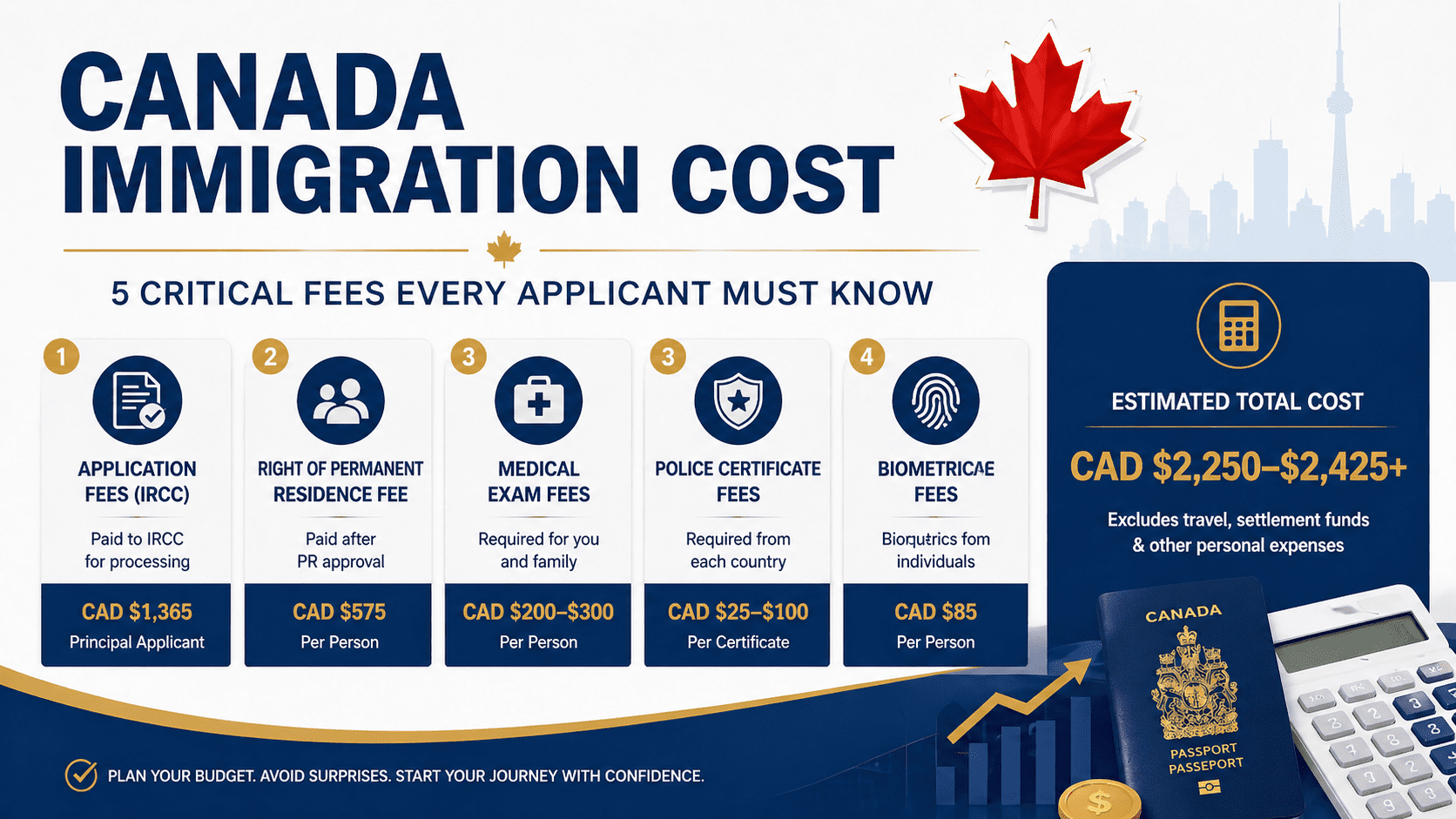
The core canada immigration cost at the government level covers your application processing and the right of permanent residence. For a single Express Entry applicant, the total government fee is $1,365 CAD – the $850 processing fee plus the $515 RPRF.
For a family of four with two adults and two dependent children, the total government fees are $2,190 CAD – two processing fees at $850 each, two RPRFs at $515 each, and two dependent child fees at $230 each.
Biometrics add $85 CAD per person or $170 CAD for a family applying together, if biometrics have not been provided to IRCC within the past ten years.
These fees are paid at different stages. The processing fee is paid when you submit your application after receiving your ITA. The RPRF can be paid upfront or deferred until your application is approved, depending on your preference. Pay it upfront to avoid a potential delay at the approval stage.
For Provincial Nominee Program PNP applicants, provincial fees apply in addition to federal fees. Provincial nomination fees vary by province and stream, ranging from zero in some provinces to several hundred dollars in others. Check your specific province’s fee schedule before budgeting.
Cost Category 2 – Language Testing Fees
Language testing is a mandatory canada immigration cost that most applicants pay at least once and many pay twice. IELTS General Training costs approximately $310 to $350 CAD depending on your test location. CELPIP General costs approximately $280 to $320 CAD.
If your first attempt does not produce scores high enough for your target program or CRS score, you will retest. Many applicants test two or three times before achieving their target scores. Budget for at least two attempts – approximately $600 to $700 CAD total – as a realistic baseline.
French language tests TEF Canada and TCF Canada have similar fee structures for applicants pursuing French-language Express Entry draws or French-language PNP streams.
Language test results are valid for two years. If your results expire before you submit your application – which can happen if you spend a long time in the Express Entry pool – you must retest, incurring the cost again.
Cost Category 3 – Educational Credential Assessment Fees
An Educational Credential Assessment ECA is required for all foreign-educated applicants under the Federal Skilled Worker Program FSWP. This is a fixed canada immigration cost that varies by assessment organization and credential type.
WES World Education Services is the most commonly used ECA provider. A standard WES evaluation costs approximately $235 USD plus a courier fee for sending original documents, typically $50 to $100 CAD depending on your country. Total WES cost for most applicants runs $300 to $400 CAD equivalent.
Other designated ECA organizations – IQAS, ICES, PEBC, and others – have similar fee structures and are required for specific professional credentials. Engineers, pharmacists, and other regulated professionals may need both a general ECA and a professional credential assessment, adding to the total cost.
If you hold multiple foreign degrees, each may require a separate assessment. Budget accordingly if your education spans more than one institution or country.
Cost Category 4 – Document Preparation and Supporting Costs
This is the canada immigration cost category that catches most DIY applicants off guard because it is not a single fee – it is a collection of smaller costs that add up significantly.
Police certificates are required from every country where you have lived for six months or more in the past ten years. Fees vary by country – Canadian police certificates cost $25 CAD, while certificates from other countries range from free to several hundred dollars. For applicants with residence history in multiple countries, this cost adds up quickly.
Medical examinations through IRCC-designated panel physicians are mandatory. Costs vary by location but typically range from $200 to $400 CAD per adult, and $100 to $200 CAD per child. For a family of four, budget $600 to $1,200 CAD for medical examinations.
Document translation by a certified translator is required for any document not in English or French. Translation costs vary by language pair and document complexity, but budget $50 to $150 CAD per document as a baseline.
Notarization and document certification fees vary by country and document type. Factor in $200 to $500 CAD for document preparation costs as a conservative estimate.
If you choose to have your documents reviewed before submission, the DIY Document Review service provides a structured pre-submission assessment at a fraction of the cost of a full immigration consultant engagement.
Cost Category 5 – Settlement Funds and Landing Costs
The final canada immigration cost category is the one with the highest dollar value: the settlement funds you must demonstrate to IRCC and actually have available upon landing in Canada.
For a single applicant, IRCC requires a minimum of $14,690 CAD in liquid settlement funds. For a family of four, the minimum is $27,297 CAD. These are not fees paid to IRCC – they are funds you must have available for your own use after landing. But they are a real financial requirement that affects your overall budget planning.
Beyond the settlement fund minimum, your actual landing costs include first and last month’s rent in your new city, transportation from the airport, initial household setup expenses, and living costs during the period before your first Canadian paycheck. For most newcomers, practical landing costs run $3,000 to $8,000 CAD above the settlement fund minimum in the first 30 days.
For a complete breakdown of what the settlement fund requirement covers and which accounts qualify, the proof of funds Canada guide covers the financial evidence standard in detail. For what to expect financially in your first weeks after landing, the first 30 days in Canada guide covers the practical setup costs new permanent residents face.
FAQ
What is the total canada immigration cost for a single Express Entry applicant? For a single applicant, the total canada immigration cost typically ranges from $4,000 to $7,000 CAD when you include government fees of $1,365 CAD, language testing at $300 to $700 CAD, an ECA at $300 to $400 CAD, medical examination at $200 to $400 CAD, police certificates, and document preparation costs. This excludes settlement funds, which are a separate requirement.
Are canada immigration costs refundable if my application is refused? IRCC processing fees are generally non-refundable once your application has been submitted and accepted for processing. The right of permanent residence fee RPRF is refundable if your application is refused. Language testing and ECA fees are paid to third-party organizations and are non-refundable regardless of your application outcome.
Does canada immigration cost differ for PNP applicants? Yes. PNP applicants pay both provincial nomination fees and federal processing fees. Provincial fees vary by province and stream. Some provinces charge no nomination fee, while others charge several hundred dollars. Federal processing fees for PNP applicants are the same as Express Entry applicants once the federal stage begins.
Can canada immigration cost be paid in installments? Government fees must be paid in full at the time of application submission. There are no installment options for IRCC fees. The right of permanent residence fee can be deferred to the approval stage if preferred, but must be paid in full before your COPR is issued.
What is the biggest hidden canada immigration cost most applicants miss? The most commonly underestimated canada immigration cost is the combination of police certificates from multiple countries, medical examinations for a family, and document translation costs. Applicants with residence history in three or more countries and families of four or more often find this category adds $2,000 to $3,000 CAD to their total budget.
Final Thoughts
Canada immigration cost is manageable when you plan for all five categories before you start, not just the government fees that appear on the IRCC website. The total investment for a single Express Entry applicant runs $4,000 to $7,000 CAD in preparation and application costs, plus settlement funds on top of that.
The applicants who run into financial difficulty during the process are almost never those who could not afford it – they are those who budgeted only for the visible fees and were caught off guard by the preparation costs that come before the application and the landing costs that follow approval.
Build your canada immigration cost budget across all five categories before you begin. Account for retesting, multiple police certificates, family medical examinations, and a landing buffer above the settlement fund minimum. A complete budget is one of the most practical preparations you can make before starting your application.
This article is for educational purposes only and does not constitute legal or immigration advice. For guidance specific to your situation, consult a licensed RCIC or immigration lawyer.
