
Study Permit Requirements Canada: Documents & Process (2026)
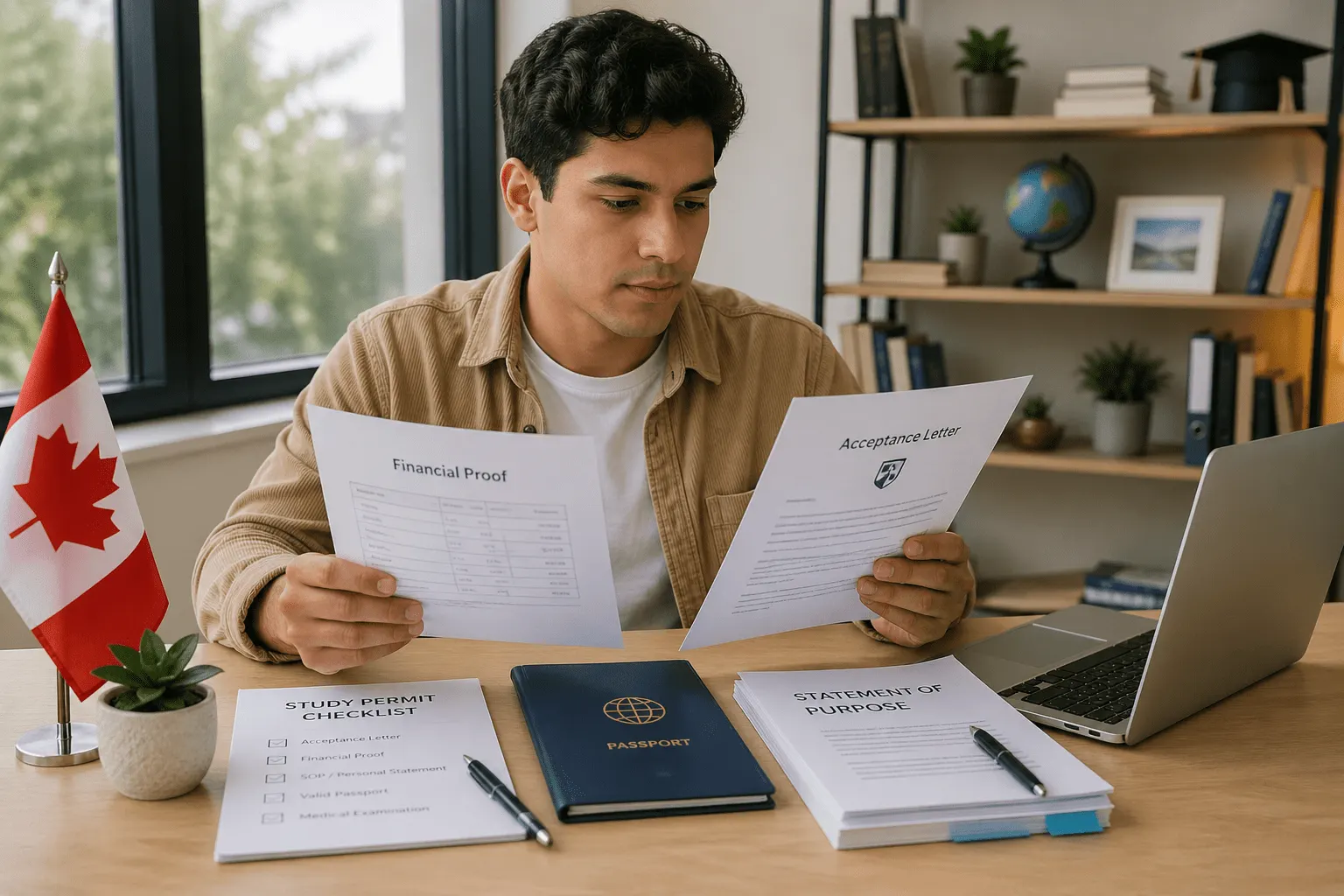
Table of Contents
- Why Study Permit Requirements Canada Go Beyond Basic Enrollment Proof
- What a Study Permit Authorizes and What It Does Not
- Document 1 – Acceptance Letter From a Designated Learning Institution
- Document 2 – Financial Proof Covering Tuition and Living Expenses
- Document 3 – A Detailed and Credible Study Plan
- Document 4 – Evidence of Ties to Your Home Country
- Document 5 – Biometrics and Supporting Identity Documents
- Admissibility – No Criminal or Medical Bars
- How to Apply for a Study Permit: Step by Step
- FAQ
- Final Thoughts
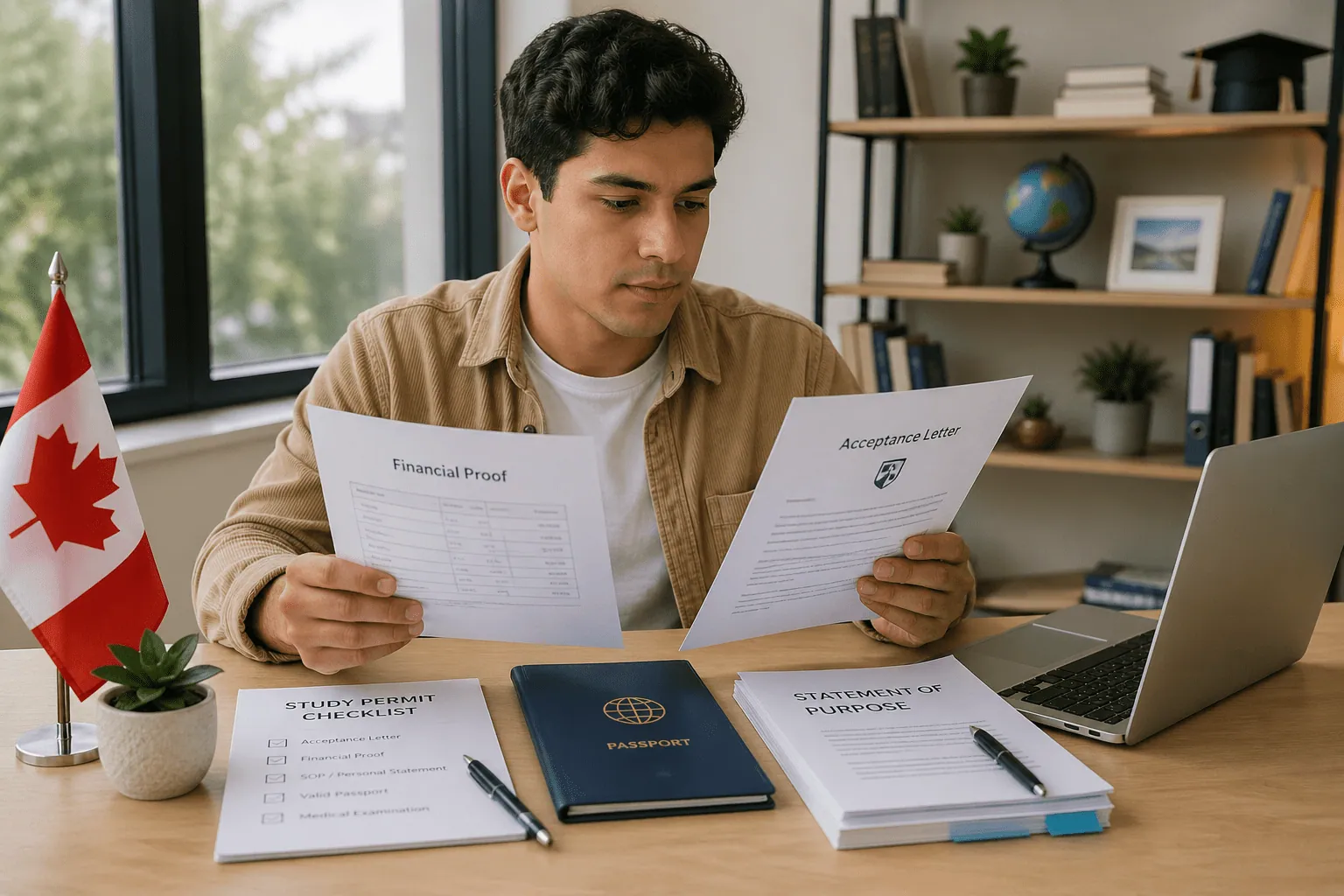
Study permit requirements canada are document-specific and format-specific in ways that many international students do not anticipate when they begin preparing their application. IRCC does not simply want evidence that you are enrolled and have money in the bank – it wants evidence in specific formats, covering specific periods, from specific sources, that together build a coherent picture of a genuine, financially supported student with a credible reason to study in Canada and genuine ties to their home country. Missing any element of this picture does not just weaken your application. It can result in refusal of an otherwise strong candidate.
This article covers the five most critical document categories in a study permit requirements canada application and what each one must contain.
Why Study Permit Requirements Canada Go Beyond Basic Enrollment Proof
Many international students assume that receiving an acceptance letter from a Canadian institution and having a bank account balance above a minimum threshold is sufficient for a study permit. These are necessary conditions – but they are not sufficient ones. IRCC officers assess the full application package to answer three questions: Is this person genuinely coming to study? Do they have the financial capacity to complete their program without becoming a public burden? Will they leave when their authorized stay ends?
Study permit requirements canada are designed to give officers enough evidence to answer all three questions affirmatively. An application that answers only the first question leaves the others unanswered – and unanswered questions become refusal reasons. For the broader context of what a study permit authorizes and the pathway it enables, the study permit Canada guide covers the full requirement framework.
What a Study Permit Authorizes and What It Does Not
A study permit authorizes you to study at a specific designated learning institution (DLI) for a defined period. It does not authorize you to work without a separate work authorization. However, most full-time international students at eligible DLIs are authorized to work up to 24 hours per week off-campus during academic sessions as a condition of their study permit – you do not need a separate work permit for this, but the work authorization is tied to your enrollment status.
A study permit does not authorize your spouse to work in Canada automatically, though spousal open work permits are available for spouses of international students at eligible institutions. It does not authorize you to study at a different institution than the one specified on your permit without first updating your permit. And it does not extend your authorization to remain in Canada beyond the permit’s expiry date – if your studies are longer than your permit’s validity, you must renew before expiry.
Document 1 – Acceptance Letter From a Designated Learning Institution
The acceptance letter is the foundational study permit requirements canada document. It must come from a Designated Learning Institution DLI, must confirm your enrollment in a specific program with a specific start date, and must be current – not expired and not provisional pending additional conditions you have not yet met.
The acceptance letter must include: the institution’s name and DLI number, your full name exactly as it appears on your passport, the program name and level, the program start date and expected end date, and the total tuition cost. If your acceptance is conditional on meeting additional academic or language requirements, wait until all conditions are cleared and you have an unconditional acceptance before submitting your study permit application.
A provisional or conditional acceptance letter submitted with a study permit requirements canada application may result in refusal or an additional request for documentation once the conditions are cleared. Submit when your enrollment is confirmed and unconditional.
Document 2 – Financial Proof Covering Tuition and Living Expenses
Financial proof is the most scrutinized component of study permit requirements canada, because it directly addresses the public burden concern. IRCC requires proof that you can pay your first year of tuition and cover your living costs and return transportation. For programs longer than one year, officers also look for a credible plan for how the remaining years will be paid.
Bank statements must cover the past 6 months, including the month you apply or the month before, and show the balance consistently – not a recent large deposit that inflated a previously low balance. A sudden large deposit without explanation raises the same questions in a study permit application that it does in a proof of funds assessment for permanent residence: is this money genuinely available to this applicant, or was it temporarily placed in the account for the purpose of the application?
The bank letter confirming your balance must be official – issued by the bank on letterhead, signed or stamped, and dated recently. A printed online statement or a screenshot of your banking app is not an acceptable substitute for an official bank document in study permit requirements canada.
If your financial support comes from a sponsor – a parent or other family member paying your tuition – include the sponsor’s bank statements and bank letter, plus a letter from the sponsor confirming their commitment to support your studies and their relationship to you. The sponsor’s financial documents must meet the same standard as documents showing your own funds.
Document 3 – A Detailed and Credible Study Plan
The study plan is the document that most directly addresses whether your study intent is genuine. Study permit requirements canada include a personal statement or study plan that explains why you are applying to study in Canada, why you chose this specific program and institution, how the program connects to your educational background, and what your plans are after graduation.
A strong study plan is specific – it references the specific program content, the institution’s reputation in the relevant field, and concrete career goals that the program supports. A weak study plan is generic – it could describe any student applying to any program in any country and contains no specific reasons why Canada or this institution was chosen.
The study plan should also address your plan after graduation if your home country ties are not immediately obvious from your other documents. A study plan that acknowledges your post-graduation intentions – whether that is returning to your home country to apply the qualification, pursuing further study, or exploring authorized pathways to work in Canada – demonstrates transparency about your goals and addresses the temporary intent question proactively.
For a section by section breakdown of what a credible study plan contains, and the reasoning an officer is looking for in each part, see the guide to writing a Canada study plan that answers officer concerns.
Document 4 – Evidence of Ties to Your Home Country
Home country ties documentation is one of the study permit requirements canada that is most frequently underprepared. IRCC officers must be satisfied that you have sufficient reasons to return to your home country after completing your studies. For applicants from countries with high study permit refusal rates, this documentation carries particular weight.
Tie documents that support a study permit canada application include: evidence of family members remaining in your home country such as a marriage certificate or birth certificates of children, property ownership documents, employment letters from your current employer indicating a leave of absence and expectation of return, or business registration documents if you own a business in your home country.
The strength of ties required is proportional to the risk profile of the application. A student from a country with a high historical overstay rate, applying for a four-year program, needs stronger tie evidence than a student from a country with a low overstay rate applying for a one-year program. Assess your specific situation honestly and provide the strongest tie evidence available.
Ties are weighed as a whole rather than scored item by item, and the same documents can read differently depending on the rest of the file. For the factors an officer may consider when assessing ties and temporary intent together, see ties to home country and applicant intent.
Document 5 – Biometrics and Supporting Identity Documents
Biometric information – fingerprints and a photograph – is a mandatory study permit requirements canada element for most applicants between 14 and 79 years of age. Biometrics must be provided within 30 days of the date on the biometric instruction letter IRCC sends after you apply. If you have provided biometrics to IRCC in the past ten years, they may still be valid and do not need to be repeated.
Supporting identity documents include your valid passport – valid for the duration of your program plus additional time – and any prior Canadian immigration documents such as previous study permits, work permits, or visitor visas that show your Canadian immigration history. Applicants with previous Canadian immigration status that was maintained in good standing benefit from presenting this history as evidence of their respect for Canadian immigration conditions.
Your passport must be valid for the entire duration of your intended study program. A passport expiring before your program ends will result in a study permit valid only until your passport expiry – which may require an early study permit renewal and a passport renewal before your program concludes.
If you want a pre-submission review of your complete study permit requirements canada application before submitting, the DIY Document Review service provides a structured check against IRCC’s assessment criteria. For workers planning to transition from study to work authorization after graduation, the work permit Canada requirements guide covers the full work authorization framework.
Admissibility – No Criminal or Medical Bars
International students must meet federal admissibility requirements as part of their study permit application. Criminal inadmissibility and medical inadmissibility can result in study permit refusal regardless of how otherwise qualified the applicant is.
Medical examinations are required for study permit applicants who plan to study for six months or longer and who come from certain countries designated by IRCC, or who plan to study in healthcare programs that involve patient contact. The examination must be completed by an IRCC-designated panel physician.
Criminal inadmissibility is assessed the same way for study permits as for work permits and permanent residence applications. A criminal conviction – even a minor one – can affect study permit eligibility if it corresponds to a Canadian criminal law offense.
How to Apply for a Study Permit: Step by Step
- Get your acceptance letter. Apply to a designated learning institution (DLI) and receive a letter of acceptance for your program.
- Get a provincial or territorial attestation letter (PAL/TAL), unless you are exempt. Most applicants need one, and it comes through your school. Exemptions include preschool, primary and secondary school students and, for applications from January 1, 2026, students in degree-granting master's or doctoral programs at a public DLI. Students going to Quebec also need a Quebec Acceptance Certificate (CAQ).
- Prepare the documents above and apply online through your IRCC account.
- Give your biometrics within 30 days of the date on the biometric instruction letter.
- Complete a medical exam if your situation requires one (see Admissibility above).
- Wait for a decision. If you apply from outside Canada and are approved, you receive a port of entry letter of introduction; the study permit itself is issued by a border services officer when you arrive.
FAQ
What are the minimum study permit requirements Canada for financial proof?
Study permit requirements canada for financial proof include evidence of funds sufficient to cover first year tuition plus living expenses of at least CAD 23,448 for a single applicant outside Quebec (applications on or after September 1, 2026; CAD 22,895 before that), plus return transportation. Quebec sets its own amount. The figure rises with each accompanying family member. Evidence must be in official bank documents covering the past 6 months, including the month you apply or the month before, not screenshots or informal printouts.
Do I need a language test for study permit requirements Canada?
A language test is not a universal study permit requirements canada document – it is a requirement of the institution’s admission process, not IRCC’s study permit process directly. Your acceptance letter from the institution confirms that you have met their language requirements. IRCC does not separately assess language ability as part of the study permit application.
How recent must financial documents be for study permit requirements Canada?
Bank statements for study permit requirements canada should cover the past 6 months, including the month you apply or the month before. The bank letter confirming your balance should be dated as recently as possible – ideally within the past 30 days of your application submission. Older financial documents raise questions about whether the balance is still current.
Can I submit study permit requirements Canada documents in a language other than English or French?
Documents in languages other than English or French must be accompanied by a certified translation by a qualified translator. Both the original document and the certified translation must be included in your study permit requirements canada application package. Machine-translated documents or informal translations are not acceptable.
What happens if my study permit requirements Canada application is incomplete?
An incomplete study permit requirements canada application may be returned by IRCC without processing, or may result in a request for additional documentation that delays your application. In some cases, an incomplete application is refused on the basis of insufficient evidence. Submit a complete package on first submission to avoid delays.
Can I work in Canada on a study permit?
Most full-time international students at eligible DLIs are authorized to work up to 24 hours per week off-campus during academic sessions as a condition of their study permit. This work authorization does not require a separate work permit. During scheduled academic breaks, eligible students may work full-time. Verify the specific work conditions on your permit.
How long does study permit processing take?
Study permit processing times vary by country of application and current IRCC volumes. Online applications generally process faster than paper applications. Check IRCC’s current processing time tool for the most accurate estimate for your specific country and application date. Apply well in advance of your program start date to account for processing time.
Does a study permit lead to permanent residence?
A study permit itself does not lead directly to permanent residence, but it enables the educational credential and Canadian work experience that support permanent residence applications. Graduates from eligible programs can apply for a Post-Graduation Work Permit, use that period to accumulate Canadian work experience, and then apply for permanent residence through Express Entry under the Canadian Experience Class.
Final Thoughts
Study permit requirements canada are a document checklist with a coherent purpose: to give IRCC officers sufficient evidence that you are a genuine student with financial support and real ties to your home country. Every document in the five categories covered in this article serves one of those three purposes.
Prepare your study permit requirements canada application as a complete package – not as individual documents assembled at the last minute. Read every document before you submit it. Verify that your acceptance letter confirms unconditional enrollment. Verify that your financial documents show a stable balance over a full statement period. Write a study plan that is specific to your situation, not generic. Provide the strongest home country tie evidence available. And ensure your passport is valid for your full program duration.This article is for educational purposes only and does not constitute legal or immigration advice. For guidance specific to your situation, consult a licensed RCIC or immigration lawyer.