
Table of Contents
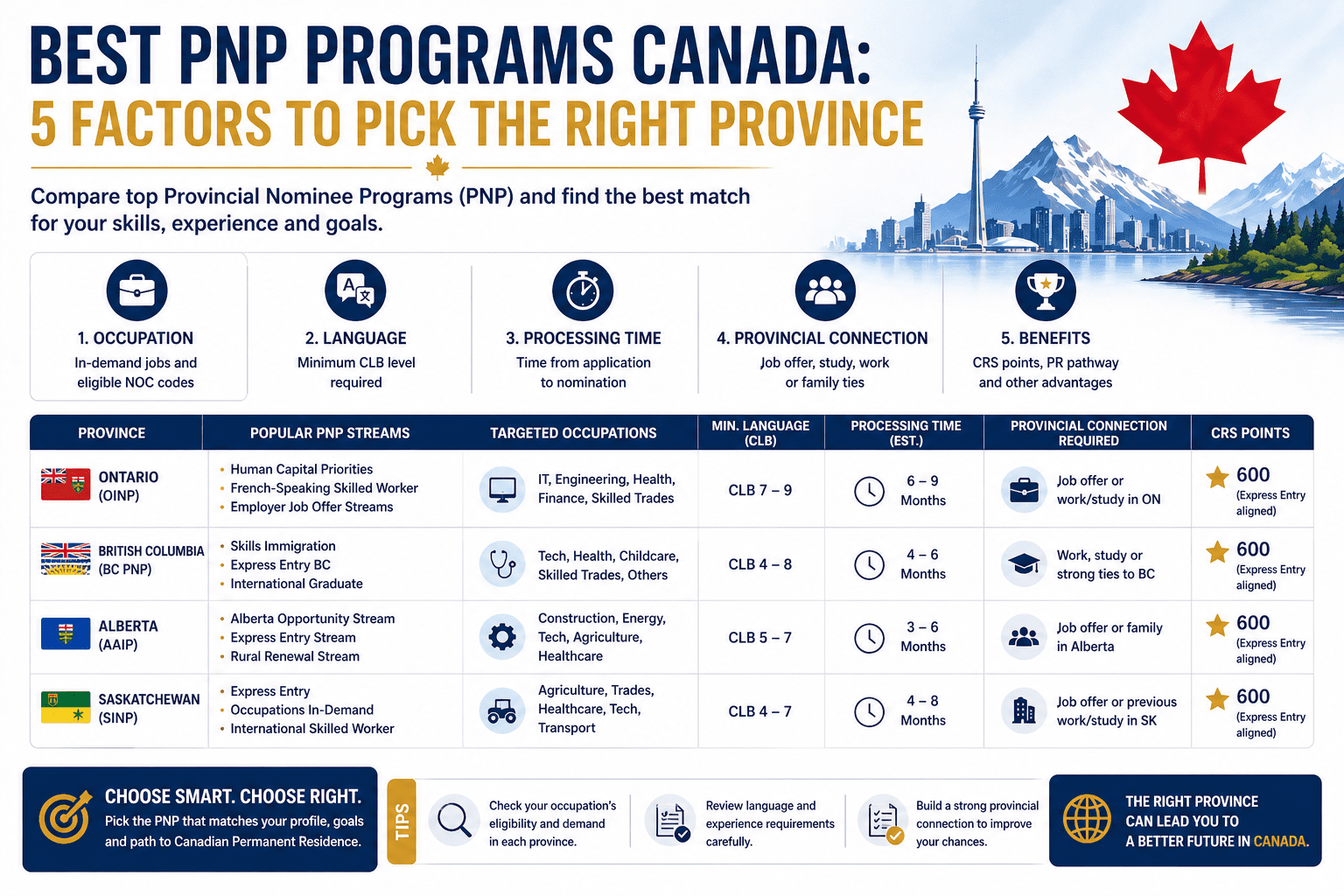
Choosing the best PNP programs Canada has to offer is not a question with a single correct answer. The right provincial stream depends entirely on your occupation, your language scores, your work history, your personal connections to specific provinces, and your timeline. An applicant who is a strong candidate for British Columbia’s tech-focused streams may have no pathway through Ontario. A healthcare worker may find Saskatchewan or Manitoba far more accessible than any of the larger provinces.
This article identifies the five factors that determine which provincial stream is genuinely the best match for your specific profile – and how to evaluate any province against those factors.
Why There Is No Single Best PNP Program for Every Applicant
The best PNP programs Canada offers are best defined relative to an individual profile, not in absolute terms. Province rankings that circulate online – “Ontario is the best PNP” or “BC is the fastest” – are generalizations that ignore the fact that eligibility and selection vary dramatically by applicant type.
A province with a high nomination volume is not automatically the best option if your occupation is not on their priority list. A province with fast processing is not helpful if you do not meet their language threshold. A province with flexible eligibility criteria may still deprioritize your application if you have no connection to the region.
The framework below applies to any provincial stream. Use it to evaluate your specific options rather than relying on general reputation or nomination volume alone.
For the foundational understanding of how PNP streams work and what types exist, the Canada PNP complete guide covers the structural differences between Express Entry-linked and base streams in detail. For the specific eligibility requirements that apply across most provincial streams, the PNP Canada requirements guide covers the five core criteria you must meet.
Factor 1 – Your Occupation Matches the Province’s Current Priority List
Occupation alignment is the first and most decisive factor in identifying the best PNP programs Canada has available for your profile. Every provincial stream targets specific NOC codes or TEER categories, and streams change their occupation lists regularly based on current labor market data.
Ontario PNP streams regularly issue Notifications of Interest to Express Entry candidates in specific in-demand occupations – technology, healthcare, and skilled trades appear frequently. BC PNP Skills Immigration streams prioritize applicants with job offers in eligible occupations, with a points-based registration system that scores heavily on occupation demand. Saskatchewan targets healthcare workers, agricultural workers, and skilled tradespeople through dedicated streams. Manitoba has historically maintained broad occupation eligibility with lower CRS score requirements than larger provinces.
The practical step: identify your NOC code, then systematically check the current eligible occupation list for each province’s streams. Provinces that include your NOC code are your candidate list. Provinces that do not are eliminated regardless of their general reputation.
Factor 2 – Your Language Scores Meet the Stream Threshold
Language threshold is the second filter for identifying the best PNP programs Canada offers your profile. Different streams have different minimum CLB requirements, and streams targeting different occupation types vary significantly.
If your English or French scores are strong – CLB 9 or higher across all four abilities – language is rarely a limiting factor and most streams are open to you. If your scores are lower – CLB 5 or CLB 6 – your eligible stream list narrows considerably, and the best PNP programs Canada has for your profile shift toward provinces and streams with lower language minimums.
Some semi-skilled and trade occupation streams accept CLB 4 in some abilities. Healthcare and professional streams typically require CLB 7 or higher. Express Entry-linked streams generally follow federal minimums of CLB 7 for most occupations.
Knowing your exact CLB scores – not just your raw test scores – before evaluating provincial options allows you to quickly filter which streams you are eligible for and which require improvement before you can apply.
Factor 3 – Processing Time Matches Your Timeline
Processing time is the third factor in identifying the best PNP programs Canada has for your situation. Provincial processing times vary from a few weeks for some Express Entry-linked streams to over 12 months for some base streams. Federal processing after provincial nomination adds another six months for Express Entry-linked nominees or 18 to 24 months for base stream nominees.
If your timeline is urgent – a work permit expiring, a family situation requiring permanent status soon – the best PNP programs Canada has for your situation are those with the fastest combined provincial and federal processing. Express Entry-linked streams at provinces like Ontario, BC, and Alberta typically move faster than base streams, though competitiveness varies.
If your timeline is flexible, slower processing at a province with higher acceptance rates for your profile may produce better results than a faster but more competitive stream where your application is unlikely to be selected.
Always check current processing times directly on the provincial immigration authority website. Published timelines are updated periodically and can shift significantly based on application volume.
Factor 4 – Your Connection to the Province Is Genuine
Provincial connection is the factor that most applicants underweight when evaluating the best PNP programs Canada has to offer. Provinces are not neutral selection systems – they prioritize applicants who are likely to settle and contribute to the local economy and community.
Genuine connection factors that strengthen any provincial application include: current or previous work experience in the province, a Canadian degree or diploma from a provincial post-secondary institution, a valid job offer from a provincial employer, immediate family members living in the province, or previous residence in the province.
Provinces that you have a genuine connection to are better options than provinces where your only connection is that their stream seems easier. A strong application to a province you are connected to will consistently outperform a weak application to a province you have no ties to, even if the second province has higher nomination volumes or faster processing.
Factor 5 – Your CRS Score Aligns With the Stream’s Selection History
For Express Entry-linked streams, your CRS score relative to the province’s historical Notification of Interest cutoffs is the final factor in identifying whether a stream is realistically accessible for your profile. Each province maintains records of what CRS scores triggered Notifications of Interest in recent draws.
If your CRS score is 420 and a province’s Express Entry-linked stream has historically only issued Notifications of Interest to candidates with scores above 450, that stream is not currently the best PNP programs Canada has available for you – regardless of how well your occupation and language scores match.
Check provincial draw history for any Express Entry-linked stream before investing application time. Provinces publish this data on their immigration authority websites. If your score falls consistently below recent cutoffs, either focus on score improvement or shift to base streams where CRS score is not a selection factor.
If you want a pre-submission review of your provincial or federal application documents before submitting, the DIY Document Review service provides a structured check against the standards both the province and IRCC apply during assessment.
FAQ
What are the best PNP programs Canada has for skilled workers? The best PNP programs Canada has for skilled workers depend on your occupation and provincial connection. Ontario PNP, BC PNP, and Alberta PNP are the largest by nomination volume. Saskatchewan and Manitoba offer broader occupation eligibility with lower CRS score requirements. The best match for your profile is determined by occupation list alignment, language thresholds, and genuine provincial connection.
Which province has the fastest PNP processing in Canada? Processing times vary by stream and change frequently. Express Entry-linked streams at Ontario, BC, and Alberta generally process provincial nominations faster than base streams. Federal processing after nomination runs approximately six months for Express Entry-linked nominees. Always verify current processing times directly on the provincial immigration authority website.
Can I apply to multiple provinces at the same time for PNP? Yes. You can apply to multiple provincial streams simultaneously, as long as you meet each stream’s eligibility criteria and can genuinely represent your intent to settle in each province. If you receive multiple nominations, you must choose one to proceed with for your federal application.
Do the best PNP programs Canada offers require a job offer? It depends on the stream. Many of the most accessible PNP streams require a valid job offer from a provincial employer. Others – including most Express Entry-linked streams and international graduate streams – do not require a job offer. Having a job offer generally strengthens any provincial application where it is not mandatory.
How do I know if my CRS score is competitive for the best PNP programs Canada has? Check the draw history for any Express Entry-linked provincial stream you are targeting. Provinces publish records of recent Notifications of Interest including the CRS score ranges selected. If your score falls consistently below recent cutoffs, focus on score improvement or target base streams where CRS score is not a selection factor.
Final Thoughts
The best PNP programs Canada has to offer are the ones that match your occupation, your language scores, your timeline, your provincial connections, and your CRS score – in that order. No single province is universally best, and no stream is accessible to every applicant.
Use the five factors in this article as a systematic filter. Start with occupation eligibility. Apply the language threshold. Check processing time against your timeline. Assess your genuine provincial connection. Verify your CRS score against draw history for Express Entry-linked streams.
The best PNP programs Canada has for your profile will emerge from that analysis – not from general reputation or nomination volume rankings. Provincial immigration is a matching exercise. Match your profile to the stream, not the other way around.
This article is for educational purposes only and does not constitute legal or immigration advice. For guidance specific to your situation, consult a licensed RCIC or immigration lawyer.
