
Table of Contents
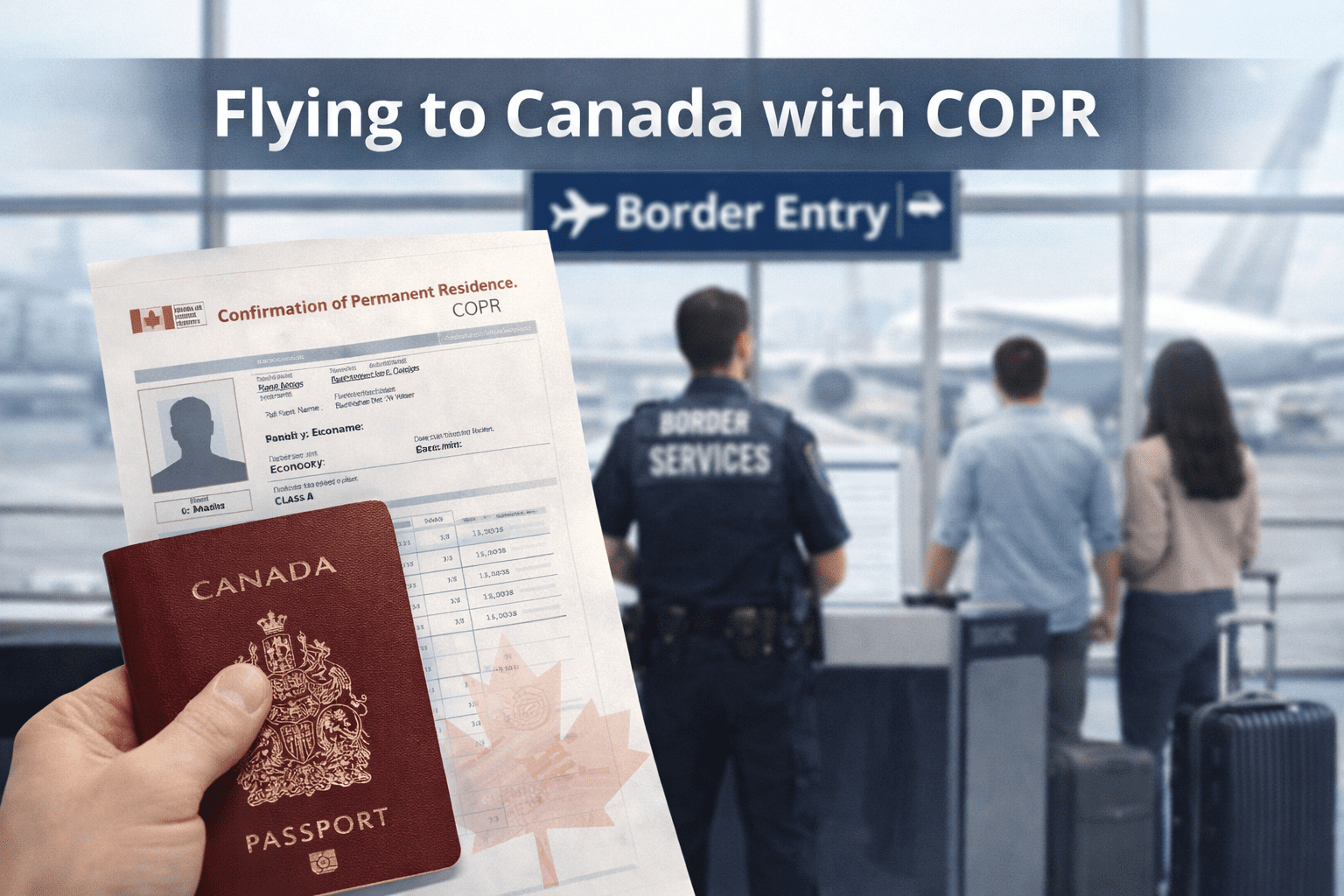
Flying to Canada with COPR is one of the most significant moments in your immigration journey – and one of the most mishandled. A Confirmation of Permanent Residence is not a boarding pass. It is a conditional document that only becomes effective the moment a border services officer validates it at a Canadian port of entry. Getting the steps wrong, arriving with incomplete documents, or misunderstanding what happens at the border can delay or complicate your landing in ways that are entirely avoidable.
This article walks through the five steps every applicant must complete before and during their first entry to Canada as a permanent resident.
What Your COPR Actually Is and What It Is Not
Before covering what flying to canada with copr involves practically, it is important to understand what the document itself represents. A COPR is issued by IRCC after your application is approved. It confirms that you have been approved for permanent residence – but it does not make you a permanent resident automatically.
Permanent resident status is only granted at the port of entry, when a Canada Border Services Agency (CBSA) officer reviews your COPR, verifies your identity, confirms you still meet the conditions of your approval, and stamps or validates the document. Until that moment, you are an approved applicant, not a permanent resident.
Your COPR has an expiry date printed on it. This date is typically tied to your passport expiry or your medical exam expiry, whichever comes first. Flying to canada with copr after the expiry date on the document means your landing will be refused – IRCC will not honor an expired COPR regardless of your application approval status.
Step 1 – Verify Your COPR Expiry Date Before Booking Your Flight
The single most avoidable landing failure is arriving at the border with an expired COPR. Before you book any flight, check the expiry date on your COPR document and confirm that your intended arrival date falls before that date – not on the date itself, and with enough margin to account for flight delays or itinerary changes.
If your COPR is close to expiring, contact IRCC immediately to request an extension. Extensions are possible but not guaranteed, and processing takes time. Do not assume you can request an extension at the port of entry – CBSA officers cannot extend a COPR expiry. That decision rests entirely with IRCC.
If your medical exam results are approaching their expiry – typically 12 months from the exam date – this may also limit your COPR validity. If you are in this situation, contact IRCC or consult an RCIC before booking travel.
Step 2 – Carry Your Complete Document Package on the Flight
Flying to canada with copr means carrying a specific set of documents in your carry-on luggage – not checked baggage, not a digital copy on your phone. Border officers require original physical documents. If your bag is delayed or lost, you need everything accessible.
Your document package must include: your original COPR document, your valid passport (the same passport linked to your COPR), your PR visa if one was issued alongside your COPR (some applicants receive both), proof of funds showing you meet the settlement fund requirement at the time of landing, and two passport-sized photos if requested.
Additional documents that are strongly recommended but not always mandatory: your employment offer letter if applicable, your marriage certificate if your spouse is accompanying you and listed on the application, and birth certificates for any dependent children traveling with you.
Your Express Entry documents checklist covers the full document set for your application stage. For the landing specifically, the COPR package above is what matters most.
Do not laminate your COPR. Do not fold it excessively. Present it in its original condition. A damaged or altered COPR can raise questions at the border that delay your processing.
Step 3 – Understand What Happens at the Port of Entry
When flying to canada with copr, your first stop after landing is the primary inspection line at CBSA. This is a routine process, but understanding what it involves removes unnecessary anxiety and helps you respond clearly and confidently.
The CBSA officer will ask to see your passport and COPR. They will verify your identity against the information on file, confirm your COPR has not expired, and ask a series of standard questions. Common questions include: where you plan to live in Canada, whether you are bringing goods or funds that need to be declared, and whether anyone listed on your COPR is not traveling with you today.
If your spouse or dependents are not traveling with you on the first landing, you must declare this. Family members listed on a COPR must land before the expiry date on their own COPR documents. Missing this detail does not automatically cancel their permanent residence, but it requires careful follow-up with IRCC.
After primary inspection, the officer may direct you to secondary processing. This is normal and does not indicate a problem with your application. Secondary processing simply means additional document verification, which is routine for first-time permanent resident landings.
Step 4 – Declare Everything You Are Bringing Into Canada
Flying to canada with copr as a new permanent resident comes with specific customs declaration obligations that differ from those of a visitor or tourist.
You are permitted to bring your personal and household goods into Canada duty-free as a settler. However, to claim this exemption, you must declare all goods you are bringing with you – and all goods that are following you later, such as furniture or boxes being shipped from your home country.
At the border, you will complete a BSF186 form (Settler’s Effects form) listing items you have with you and items arriving later. Goods that arrive later but were not declared on your initial settler’s effects form may be subject to duty and taxes. This is a common and expensive mistake that is entirely avoidable by declaring everything upfront, even if the items have not yet shipped.
If you are bringing more than CAD $10,000 in cash or monetary instruments into Canada, you must declare this to CBSA. Failure to declare is a serious offense with significant financial penalties. This applies to any combination of cash, bank drafts, traveler’s cheques, or money orders. Read our “Declaring money Canada airport guide” for more information.
If you want to ensure your full landing document package is complete and consistent before you fly, the DIY Document Review service provides a structured pre-submission check against IRCC and CBSA standards.
Step 5 – Know What to Do Immediately After Landing
The moment your COPR is stamped and validated, your permanent residence begins. Flying to canada with copr successfully means you now have a specific set of administrative tasks to complete in the days and weeks that follow.
IRCC will mail your PR card to the Canadian address you declared at the port of entry. This card is your proof of permanent residence for future travel outside Canada. Make sure the address you provide at the border is accurate and that someone can receive mail there. Your PR card typically takes several weeks to arrive.
If you are landing without a permanent address yet – staying in a hotel or with family temporarily – you can use that address initially but must update your address with IRCC as soon as you have a permanent one. Failing to receive your PR card because of an outdated address creates complications that are slow to resolve.
For a full breakdown of what to do in your first weeks as a new permanent resident, the next article in this series covers the complete first 30 days settlement checklist.
FAQ
What documents do I need when flying to Canada with COPR? When flying to Canada with COPR, you need your original COPR document, your valid passport linked to the COPR, your PR visa if issued, proof of settlement funds, and passport photos. Carry all documents in your carry-on luggage as originals – not photocopies or digital versions.
Can I fly to Canada with COPR if my passport is expiring soon? Your COPR expiry is tied to your passport expiry. If your passport expires before your COPR, your COPR expiry date will match your passport expiry. Renewing your passport after your COPR is issued does not automatically extend your COPR. Contact IRCC if your passport is expiring before your planned landing date.
What happens if I miss my COPR expiry date? If you attempt flying to Canada with COPR after the document’s expiry date, CBSA officers will refuse your landing as a permanent resident. You would need to contact IRCC to determine whether a new COPR can be issued, which is not guaranteed and requires a new processing cycle.
Do I need to declare money when flying to Canada with COPR as a new permanent resident? Yes. Any amount exceeding CAD $10,000 in cash or monetary instruments must be declared to CBSA when flying to Canada with COPR. This is a legal requirement regardless of your immigration status, and failure to declare carries significant penalties.
Can my family members land separately when flying to Canada with COPR? Yes, family members listed on the application can land separately, but each person must land before the expiry date on their individual COPR document. Declare any family members not traveling with you to the CBSA officer at your own landing.
Final Thoughts
Flying to Canada with COPR is the culmination of months or years of preparation. The border crossing itself is typically straightforward – but only for applicants who arrive with the right documents, understand the process, and have completed their pre-landing checklist.
The mistakes that complicate flying to Canada with COPR are almost always administrative: an expired document, a missing bank letter, undeclared goods, or an address error that delays the PR card. None of these are difficult problems to prevent. They are all the result of treating the landing as an afterthought rather than a step that requires the same attention as the application itself.
Check your COPR expiry date today. Prepare your document package before you book your flight. Declare everything at the border. Your permanent residence begins the moment that document is stamped – make sure nothing stands in the way of that moment.
This article is for educational purposes only and does not constitute legal or immigration advice. For guidance specific to your situation, consult a licensed RCIC or immigration lawyer.
